For the most heartbreaking of reasons, they became an impromptu community of faith – about 95 of those most intensely impacted by the shooting on June 17, 2015 at Emanuel African Methodist Episcopal Church in downtown Charleston, South Carolina; the survivors and victims who were present during the shooting, and family members of the nine people killed.
When Dylann Roof went on trial in late 2016 in U.S. District Court in Charleston, facing 33 federal charges and the death penalty, that community gathered day by day to observe the trial and sometimes to testify – a vigil that proved draining, intense, and emotional.
At the request of the U.S. attorney’s office, Presbyterian pastor J. Eric Skidmore and United Methodist minister Steve Shugart – both with the South Carolina Law Enforcement Assistance Program – coordinated what became this community of 95’s spiritual support team.
They set up shop in a large room on the third floor of the courthouse, one floor down from the courtroom. They created an altar and gathered each morning for prayer and Scripture reading, often from the Psalms, the assembly including the husbands and wives, the children and the grandchildren of those killed at Mother Emanuel. Most days, someone from the Emanuel group would break into song, so if someone got off the elevator and walked down the hall, “you’d hear 80 people in the back room singing hymns,” Skidmore said.
The space in the courthouse “became our home in the midst of this tragedy,” Shugart said. “When we talk about the care of these families, it’s the common stuff that you would do for anybody in a tragedy” – food and drink; someplace to sit and rest; someone to walk and talk with the family, or sit in silence; flowers in the room; prayer shawls to wear in the courtroom to provide warmth and solace in the long, long days.
Also important: a video link so families could watch the proceedings remotely if they chose, “without having to be present,” Shugart said. “That’s pretty important, because some of it was so graphic so terrible. And we didn’t want to have to re-traumatize people more than we already were.”
This team emerged in part from the structure for chaplaincy support that exists in the statewide South Carolina law structure; in part by drawing on the resources of Charleston faith communities; and in large part from the determination of Clarissa Walker Whaley, who is the lead victim’s advocate for the U.S. attorney’s office in Charleston and a Presbyterian Church (U.S.A.) ruling elder from St. James Presbyterian Church and one of the winners of the 2016 Women of Faith Awards.
In constructing the team, Whaley and Beth Drake, the U.S. Attorney for the District of South Carolina, drew on the experiences and the advice gleaned from victims advocates who had worked in other mass traumas which led to trials, including that of Dzhokhar Tsarnaev for the Boston Marathon attack in 2013 and the Timothy McVeigh trial following the bombing of the Alfred P. Murrah Federal Building in Oklahoma City in 1995. Skidmore and Shugate drew on what they learned following the shootings on the campus of Virginia Tech in 2007, and training provided by the response teams from school shootings in Newtown, Connecticut and at Columbine High School in Colorado.
The spiritual support team was piece one of what Skidmore – who works in state chaplaincy full-time and serves as a parish associate at Forest Lake Presbyterian in Columbia, South Carolina – calls the “three-legged stool” of care provided during the trial, which stretched from a competency hearing in October 2016 to the imposition of the death penalty on Roof in January 2017.
The other two legs of the stool: mental health services and victim advocacy.
The spiritual support team included 15 pastors – Skidmore and Shugate, plus a rotating, ecumenical group of 13 more. Skidmore, who’s program manager for the South Carolina Law Enforcement Assistance Program (a hybrid organization which was formed in 1997; serves five state agencies and provides critical incident stress management and chaplaincy services to law enforcement across the state), and Schugart, who’s a clinical chaplain for SCLEAP and a former Army chaplain, coordinated the effort.
On the ground, some of the work the support team did was to provide a ministry of presence, with practical and financial help from a lot of others – what Shugart described as “extraordinary support.”

For example, the group of 95 typically rode secure buses to the courthouse each day, but Judge Richard M. Gergel typically broke for only about an hour each day for lunch – not enough time for the buses to drive them to a restaurant. So each day the group would walk about a block away to St. Michael’s Church, an Anglican congregation, where box lunches were provided – and, placed inside each one each day, was a prayer card written by a local pastor. “The hospitality of Charleston was amazing,” Skidmore said, including the nearby First (Scots) Church Presbyterian and Second Presbyterian.
To support the work, financial contributions came to a nonprofit group created years ago to support the work of SCLEAP – including $9,000 from Presbyterian Disaster Assistance and $30,000 from the South Carolina United Methodist Conference.
Funds also came from the federal Office for Victims of Crime. The idea of formally including spiritual support as part of assistance to victims is relatively new, Skidmore said – and was done in part because the Emanuel group of 95 requested a spiritual support team. “Now they are looking at that in other places” – as a possible template for providing care after a community trauma, Shugart said.
Both Shugart and Skidmore spoke of their time spent with the Emanuel group as a privilege, an honor. With some of the families, their conversations went deep.
Among the questions: “How do these terrible things happen, in light of our belief in a good and forgiving God,” Shugart said. “The tough questions of ‘what’s next for me in my life, and where would God use me?’ We watched people make these incredible decisions and stands of faith, (including) what to say to Dylann at the end – oh, my goodness. … Those are some pretty powerful questions.”
Also, “people reframe what they believe after a critical incident, which is so common, particularly in Scripture. We mostly listen….Just to be present as they were able to give voice to some of those groanings, as the Scripture would say. And then we had them too” – those questions and groanings – “in a small way.”
Spending weeks in Charleston, Shugart began attending a Bible study at Mother Emanuel, held in the very room where pastor Clementa Pinckney and eight others were killed, graphic photographs of which were shown at the trial. “I’m an outsider” – a white man from out of town – and to be welcomed, “to be included in that space was really powerful,” Shugart said. “To hear God’s word called in that space, that still touches me.”

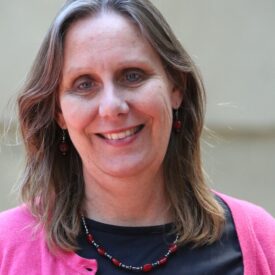
Those participating included (left to right) J. Eric Skidmore, a Presbyterian pastor who works as program manager for the South Carolina Law Enforcement Assistance Program; Clarissa Whaley, a Presbyterian ruling elder and lead victim’s advocate for the U.S. attorney’s office in Charleston; George “Spike” Coleman, pastor of St. Andrew’s Presbyterian in Charleston; and Steve Shugart, a United Methodist minister and chaplain for the South Carolina Law Enforcement Assistance Program.
At the end of the proceedings, after a federal jury imposed the death penalty on Roof on Jan. 10, the Emanuel community of 95 and their spiritual support team gathered for a closing worship service at St. Michael’s church. They set up an altar, with large candles representing hope, the survivors and healing. Smaller candles ringed those, each bearing the name of a victim whose life had been cut short.
People gathered to light the candle and to pray, “as a moment of healing and a moment of promise for the future,” Shugart said. They said of the victims: “They live on in our hearts through the grace of God.”
Former President Barack Obama said this at Pinckney’s funeral: “As a nation, out of this terrible tragedy, God has visited grace upon us for he has allowed us to see where we’ve been blind. He’s given us the chance, where we’ve been lost, to find our best selves.”
Shugart said of what he experienced working with the families: “It was more than a trial. It was a chance to see God and God’s goodness,” to hope and pray to be part of something better.
The work isn’t done yet. A community worship service is planned, Skidmore said
And the ramifications of what Roof – a self-avowed white supremacist – did that day in Charleston, and the faith and grace with which the Emanuel community has responded, echo on and on.