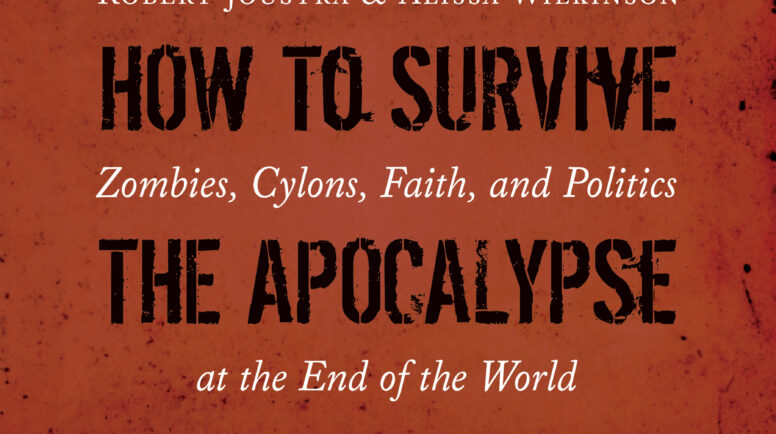
 Robert Joustra and Alissa Wilkinson
Eerdmans, Grand Rapids, Mich. 208 pages
You know the feeling. It’s too late at night to send another work email, and your brain is fried. You reach for the remote, turning to a soothingly predictable show: peaceful setting, major disruption, heroic solution and, finally, resolution. Your anxiety is eased; all is well with the world.
This is how TV watching used to work. Until the apocalypse.
Increasingly, a typical episode looks more like this: The peaceful setting is replaced with worlds already devoured by zombies. We used to watch the disruption of Eden, now it’s more like watching corrupt Washington get inundated with more corruption. The new heroes are Don Draper, Katness Everdeen, and a Captain Kirk who has a newfound tact for existential crises. And resolution? Please.
How did it come to this? Are we voyeuristic animals doomed to watch the narrative equivalent of car crashes with no happy endings? Or do these shows say something more important about what’s going on in our culture writ large?
According to Robert Joustra (Redeemer University College, Toronto) and Alissa Wilkinson (The King’s College, New York), these stories are indeed signs of the times, but ones that can be well explained by the writings of Charles Taylor. Writing in the vein of James K.A. Smith’s popular book “Who’s Afraid of Postmodernism? Taking Derrida, Lyotard, and Foucault to Church,” Joustra and Wilkinson seek to make Taylor’s 896-page magna carta, “A Secular Age,” more digestible through the lenses of “Mad Men,” “Game of Thrones,” “Breaking Bad” and many more examples of modern entertainment that start with the end of the world as a backdrop and leave us with a sense of “ugh.”
The weaving of cultural critique with the teaching of Taylor’s text makes the book read like a well-written sermon, albeit with far fewer mentions of the Savior. Our understanding of God, however, is one of the chief items of discussion. The authors carefully describe the apocalypse at hand, beginning with a shift in self-identity that changes from the pre-modern age (where our identities were porous, defined by the gods that controlled our world) to the secular age (where our identities became buffered against the forces of deities and elemental nature by a self-sufficient humanism). Convinced we are our own curators, we come to believe that the chief aim of man is to seek our own individual flourishing. This drive for personal authenticity and achievement is the idol of our age, shown by hyperbole in “House of Cards” or more realistically through Spike Jonze’s “Her” – whatever the cost, we must find out “who am I?”
And yet, like a great sermon, the exegesis of the law bears forth the hope of the gospel. At the end of “Her,” Joaquin Phoenix makes clear for us that a sense of purpose cannot be found by contemplating one’s identity in isolation; the quest is unachievable without the help of others. The antidote to the secular age’s apocalyptic anti-narrative is to stand up for a helpful narrative.
So before you turn on Netflix tonight and go to bed with a feeling of despair, try reading about “How to Survive the Apocalypse.” It’s the perfect medicine for societal-wide manifestations of anxiety that keep creeping into our imaginations… and our nightmares.
 Eric Peltz is associate pastor of Chevy Chase Presbyterian Church in Washington, D.C.