
SAN JUAN, Puerto Rico (Outlook) – Some members of the Presbyterian Mission Agency Board voiced discomfort March 23 with pieces of a proposal to potentially reduce the size of the board, change its committee structure and alter how the board relates to a variety of committees and organizations across the Presbyterian Church (U.S.A.).
 The board voted by a close margin – 18 to 16 – to approve a recommendation (H.001 Governance Task For Recommendation) that the board stop from now until September making any new appointments for board representatives to serve as liaisons to more than 20 committees and entities around the denomination. The board’s Governance Task Force, which is making the recommendations for change, has argued that such “deployments” of board members would prove especially burdensome if the board’s size (currently 40 voting members and 17 non-voting members) were cut by more than half (to 16 voting members and 8 non-voting members).
The proposal the board is considering “is a first draft,” board chair Ken Godshall said. At the center of the proposal is a sense that the Presbyterian Mission Agency “would be better served by a smaller board” and by sending fewer liaisons to a variety of Presbyterian groups, he said.

The board did not vote directly on the overall proposal from the Governance Task Force – which was outlined in a white paper released in January. The task force had hoped to have small group discussions to get a sense of how board members are reacting to the proposal – but enough questions were raised about the deployment matter, which was up for a vote, that the task force ran out of time.
Under the surface of the technicalities, what’s at stake in the discussion are questions like these:
- Who has a seat at the table as the board makes decisions affecting the PC(USA)? Who gets to decide who has a seat at the table?
- Will the proposed changes diminish the access to power of the denomination’s advocacy and advisory committees – which the General Assembly created to raise up to the broader church social justice matters and issues affecting women and people of color?
- If deployments are scaled back, how would that affect the relationships between the board and a broad range of groups across the church?
The assembly requires the board to send a representative to certain groups (for example, the Board of Pensions, the Presbyterian Foundation and the Committee on the Office of the General Assembly). But there’s more leeway with other groups, ranging from the Committee on Theological Education to Presbyterians Caring for Chaplains and Military Personnel.
The measure the board approved March 23 authorizes the Governance Task Force to “explore and propose revisions” to the Manual of Operations “that would decrease the number of Presbyterian Mission Agency Board members serving on other committees.” That proposed change would be presented at the board’s September meeting in Louisville.
The Governance Task Force’s proposal states that finding nominees to serve on all these committees has been difficult – that those serving on the board don’t have enough time to give. One idea mentioned in the discussion was the possibility of allowing former board members to serve.
The board does not have the authority to reduce its size on its own – it would need approval from the General Assembly or the Way Forward Commission to do that. But it could reconfigure its committee structure – and the white paper proposal calls for assigning representatives from the denomination’s advocacy and advisory committees to a new liaison committee, and eliminating their non-voting seats on the board.
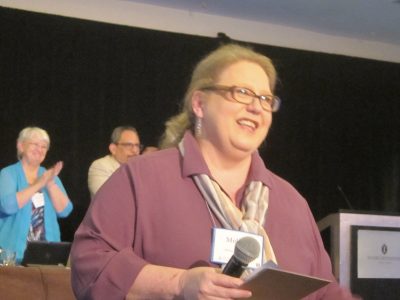
Melinda Sanders, chair of the Governance Task Force and a ruling elder from Nashville, said task force members have been consulting with those committees and the task force has “a strong desire to increase communication, but just do it in a different way. We don’t think the communication model we have now is very effective.”
But the discussion also hinted at deeper tensions regarding the Governance Task Force’s white paper proposal. A headline saying that the board is suspending nominations to send representatives to Presbyterian groups “could be damaging to those relationships,” as some groups use those relationships “to have a voice at the table,” said Jason Chavez, a board member from Virginia.
Sanders said the board of the Montreat Conference Center in North Carolina has already communicated that it is willing to give up having a representative from the Presbyterian Mission Agency Board. Heath Rada, moderator of the 2014 General Assembly, said the Montreat board is trying to be cooperative – but said, “Montreat has absolutely no desire to minimize its relationship with our denomination.”
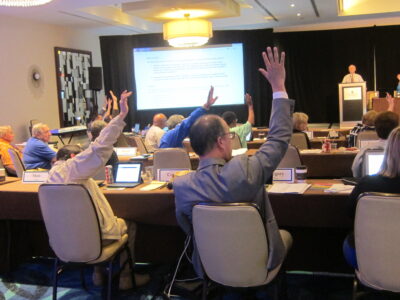 “I don’t think we’re ready to make a decision,” said Marci Glass, a pastor from Idaho. Some groups already have lost access to the board through previous changes in the board’s committee structure, “and now are losing access to our board members.”
Chad Herring, a board member and pastor from Kansas City, said the debate about deployments “is perhaps becoming a proxy conversation about this larger thing.”