 Kevin M. Kruse
Basic Books, New York. 384 pages
Over the past several decades Americans have debated whether the nation was founded on Christian principles. As Princeton historian Kevin M. Kruse observes, this debate usually centers on the religiosity of the founding fathers. The consensus among historians has long been that America’s founders were generally deists or nominal Christians and that Christianity had little or no direct impact on the republic’s founding principles. Hence the question arises: Where did Americans get this idea? After all, we have heard it from presidents as diverse as Dwight Eisenhower and Barack Obama, and it continues to be asserted as axiomatic by the Christian right. Kruse offers an intriguing hypothesis. The idea, he explains, emerged in the 1930s and 1940s among conservative Christians and those in business as a response to the statism of Franklin Roosevelt’s New Deal. They saw the New Deal as “creeping socialism” and an overconcentration of power in the executive branch that would lead to dictatorship. Hence, they opposed the New Deal’s regulation of the economy, minimum wages, price controls, Social Security, unemployment insurance and the taxes that supported these programs.
As a counternarrative, they argued that America was founded on Christian principles contained in the Declaration of Independence. This document, meant to oppose coercive government, asserted God-given human rights. While Roosevelt had famously offered the Four Freedoms (freedom of speech, freedom of religion, freedom from want and freedom from fear), conservatives wondered what happened to the freedoms for property, for enterprise and from intrusive government. Consequently, corporate leaders supported Christian organizations such as Spiritual Mobilization that, in the 1940s and 1950s, trumpeted free enterprise and Christianity.
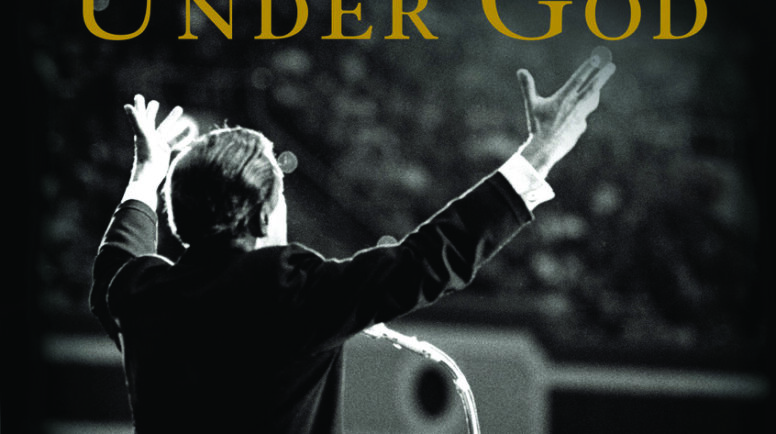
All of this made perfect sense to Dwight Eisenhower. President-elect Eisenhower confided to Billy Graham, “I think one of the reasons I was elected was to help lead this country spiritually.” Following the oath of office, he led the nation in prayer and, in his inaugural address, asserted that the founding fathers had an “abiding creed” in the “deathless dignity of man, governed by eternal moral and natural laws.” He became the first president to begin cabinet meetings with prayer. He supported the newly established National Prayer Breakfast. And under his leadership, Congress added “under God” to the Pledge of Allegiance and “In God We Trust” to the national currency.
In tracing subsequent events, Kruse notes at least three rich ironies. First, while conservatives had joined Christianity and business to rehabilitate capitalism in the midst of the Great Depression and to roll back New Deal programs, Eisenhower recognized that abolishing treasured programs like Social Security would wreck the Republican Party. Therefore, he quietly ensured that the New Deal would continue and even expanded it in significant ways. Second, while “Christian libertarians” saw government and religion as opposed, Eisenhower happily united the two in a “government under God.” And, finally, while Eisenhower used religion to unite Americans, politicians in subsequent decades would use it to create wedge issues to divide us.
Kruse fills an important lacuna in the historical record and tellingly alters the debate about America’s Christian origins.
Michael Parker is Presbyterian World Mission’s interim coordinator for Europe and the Middle East. He lives in Louisville, Kentucky.