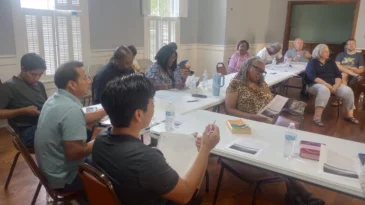
ST. PAUL (Outlook) The high-level conversations about the future of the Presbyterian Church (U.S.A.) continue – this time, in St. Paul, Minnesota, at the July retreat of the Presbyterian Mission Agency Board’s executive committee, where both Mark Hostetter, moderator of the Way Forward Commission, and Deborah Block, moderator of the All Agency Review Committee, presented updates July 17 on the work their groups are doing.

There were no blockbuster revelations – but a continuing unspooling of the thinking that undergirds these efforts and will shape the recommendations those groups will make to the 2018 General Assembly.
Block, for example, said the All Agency Review Committee is trying to write an ethos statement for the PC(USA), a draft of which may be ready by the committee’s meeting in Louisville August 21-22. Block described that ethos statement as an “articulation of identity” and of Presbyterian belief – something that “defines and guides” how Presbyterians live together in congregations and governing councils.
“We’re not looking at the blank canvas, but kind of the tangle of yarn or the mix of colors, whatever you want to call it, to evoke and identify and name” what it means to be Presbyterian. “It’s more than a slogan,” Block said. “This is not bumper sticker stuff. It is also not Karl Barth volumes. It’s the air we breathe.”
And Hostetter said the Way Forward Commission – as it works to craft specific policy recommendations to present to the 2018 General Assembly – identified two core, overarching themes in its mid-term report, involving a focus on congregations and the importance of making mission a priority.
In a changing environment, congregations are “crying out” for support for the work they’re doing in local ministry – at the same time that mid councils and the national PC(USA) offices have fewer financial resources to offer, Hostetter said. “How can we best partner with congregations and worshipping communities in order for them to fully live into their misssional lives?” he asked.
There is “anecdotal evidence,” Hostetter said, that many congregations see the national church as essentially irrelevant to the work those congregations do in their own communities.
The second big theme is that “at the core of who we are is mission, is service to Jesus Christ,” Hostetter said. But he raised the possibility that this focus sometimes comes into conflict with a regulatory, institutional way of thinking that inhibits people “from really thinking creatively and innovatively and nimbly” about how to keep mission at the center.
He said of the Presbyterian Mission Agency that often, “much of your time is spent, because of the way things are structured and done, not because of any fault” not on mission discernment, but discussing budgets, accounting, legal matters and more.
While those are critical matters, “that gets in the way of innovative thinking,” Hostetter said. “We can let mission fly … and soar in a way that makes our church more relevant and appealing to more people.”
There was some pushback to that way of thinking.
When the Presbyterian Mission Agency takes seriously its corporate and administrative responsibilities – such as conducting an annual audit and releasing its financial reports – that’s a way of exercising accountability, said Tony De La Rosa, interim executive director of the Presbyterian Mission Agency.
“It’s very easy to be innovative and let things fly if there isn’t a counterweight of responsibility,” De La Rosa said.

“If we don’t pay enough attention to this stuff,” the PC(USA) could run into problems with risk management, said Molly Baskin, an executive committee member from Chicago. “I want to make sure that in the dreaming, there is accountability. We have donors that expect us to treat their money as we would treat our own. That we spend it appropriately.”
Hostetter he agreed – and the idea is not that “we want to get rid of the corporate structure or the accountability,” but “the question is how these parts fit together in a way that allows us to fly and to thrive.”
Those involved continue to struggle with the distinctions in the responsibilities of three groups that are considering the future of the PC(USA), all of which will report to the 2018 Assembly – the Way Forward Commission, the All Agency Review Committee, and the 2020 Vision Team.
The three groups are communicating with each other, and “do not want there to be competing recommendations that are coming from such different angles that the General Assembly is just thrown into” – Hostetter paused.
“Chaos,” Block jumped in.
“Chaos and confusion,” Hostetter said.
Block spoke of finding “the fun in ambiguity” and ways “to not compete with each other.”
Hostetter said “there may be differences of opinion” and different recommendations from the three groups, but the hope is that will be minimized unless they come from real differences in discernment. “We’re trying as much as we can to coordinate the work.”
He also said that in the next few weeks, the commission plans to put out a list of initiatives on which the six PC(USA) agencies are collaborating, so Presbyterians can see the cooperative work already underway.
Another of the Way Forward’s seven themes identified in their mid-term report has to do with diversity and leadership – the hope of the PC(USA) becoming more diverse, and of claiming that commitment to diversity as part of the denominational identity. There’s also a question of diversity of leadership, Hostetter said – and a recognition that the traditional model of congregations having a full-time, seminary-educated pastor may not be the norm for many churches in the future.

With new models of leadership including tent-making, yoked congregations, congregational leadership from elders and more, “we have to be sure we can provide support, training and encouragement” for those new forms of leadership, Hostetter said.
“We have been talking about diversity for a long time,” said José Luis Casal, the PC(USA)’s director of world mission. But “we have not been intentional enough about doing it. I believe we have to create a path of intentionality if we really do want to have a more diverse leadership.”
The executive committee’s meeting continues through July 19. Also on the agenda: a report from its Governance Task Force, which is working to revise its recommendations, and discussion of the Presbyterian Mission Agency work plan.