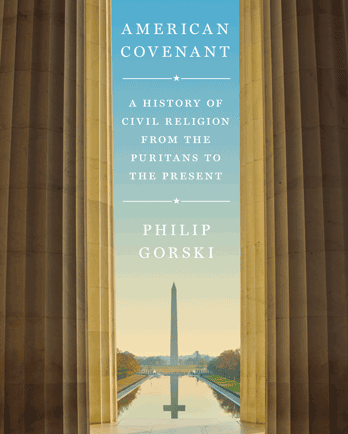
 Philip Gorski
Princeton University Press, 325 pages
Contemplating the references to God made by John F. Kennedy in his inaugural address, sociologist Robert Bellah wrote a famous essay, “Civil Religion in America,” in which he argued that America’s civil religion is based on the nation’s founding myth and is a blend of motifs from “civic republicanism” and “covenantal religion.” It is a theme that began with the Puritans and was further shaped by the Revolution and Civil War. Listening to Barack Obama respond to criticism over his relationship with the Reverend Jeremiah Wright in 2008, Philip Gorski heard some familiar strands of the “American Civil Religion” – mention of founding covenants, the original sin of slavery, an ever-elusive Promised Land – and decided to revisit and update the subject.
While Bellah used civil religion as a jeremiad on national decline, Gorski sees it as a living tradition and plausible via media between two toxic extremes currently poisoning the body politic. The first is the view of “radical secular liberals” who believe that America was founded entirely on Enlightenment principles and want to exclude religion from the public square. The second is the view of “religious nationalists” that America was founded as a Christian nation and has a divine mandate to extinguish evil in the world through its righteous might.
The first being illiberal and the second idolatrous, Gorski wants to reclaim what Arthur Schlesinger Jr. called the “vital center.” In Gorski’s updating of this idea, he seeks to reassert the “prophetic republican tradition” at the heart of the “American project.” This middle way avoids the illiberalism of the left by recovering the spiritual and moral aspects of American political thought, and it eschews the idolatry of religious nationalism by embracing the principle of the separation of church and state and by not envisioning civil religion as a replacement for the church. Hence America is neither a Christian nation nor a secular democracy, but a “prophetic republic.”
Gorski is careful to define his terms, distinguishing between Lockean liberalism and classical republicanism – and among Christian nationalism, radical secularism and civil religion. This is important because such terms are often used so loosely and inaccurately today that their real meanings have become obscured. Also, some of the key ideas in our political tradition (such as virtue in republicanism, which was crucial to the Founders’ thought and commonplace in writers as diverse as Aristotle, Machiavelli and Milton) have now largely disappeared from public discourse. Finally, Gorski is fair-minded in that he gives due credit to both Western political philosophy and the Judeo-Christian tradition for launching and nurturing the American creed.
Though Gorski is a Yale University sociologist-cum-political-philosopher, his book is essentially the history of one strand of the American political tradition. As such, it is often a delightful romp through American history that highlights such key contributors as John Winthrop, Frederick Douglass, Abraham Lincoln, H.L. Mencken, Reinhold Niebuhr, Hannah Arendt and Martin Luther King Jr. And he is unsparing in his critique of the intellectual gaucheries of such recent leaders as Jerry Falwell, Ronald Reagan, Pat Robertson and George W. Bush. This book may not put American politics back on track, but it will help readers to think more clearly about the deeper purposes of the nation.
 Michael Parker is Presbyterian World Mission’s interim coordinator for Europe and the Middle East. He lives in Louisville, Kentucky.