
“DDT – Diagnosis determines the treatment.” – Joseph Barndt, Crossroads Ministry
As a senior in seminary, I was required to write a narrative for my personal information form (PIF), an account of an experience or event that captured my sense of call and signaled my passion for ministry to churches seeking pastors. As I pondered this project in the office of Johnson C. Smith Theological Seminary, seminary dean James Hutton Costen intervened and blessed me with a story that illuminated the problem with attaining racial equality, a story that launched me into ministry.
During Costen’s youth in Omaha, Nebraska, his mother worked at a packing plant. To provide for her family, she worked long, hard hours. One day she cut her hand. Without worker’s insurance and with no leave policy in effect, she did what many resorted to in that kind of system: She wrapped her hand and continued working. Over time, her hand began to ache to the point that she had no choice but to see a doctor. After examining her swollen hand, the doctor told her the wound, albeit closed, had to be lanced, the bad blood cleaned from the infected area and then her hand needed to be dressed properly for true healing to take place. Without intervention, the hand could be lost.
This story was gifted to me in 1982, nearly 20 years after the American church and society took flight on the wings of Martin Luther King Jr.’s dream of building the beloved community – and just a year from the reunion of the Presbyterian Church. The hope was that with a little hard work and God’s grace, citizens of all stripes could journey together and take up residence in a reformed church and society where the barriers of racial discrimination and inequity would give way to an open social order governed by mutuality, reciprocity, justice and equality.
 Toward this end, Glenn Harris, president of Race Forward and the publisher of the news site Colorlines says: “Racial equity is about applying justice and a little bit of common sense to a system that’s been out of balance. When a system is out of balance, people of color feel the impacts most acutely, but, to be clear, an imbalanced system makes all of us pay.”
The resurging clamor and unrest we are witnessing in our communities and institutional lives (such as the protest at Standing Rock, Black Lives Matter, Make America Great Again and pro- and anti-immigrant movements) and the distressed voices of those experiencing pain at diverse intersections of oppression are indicative of the fact that the long journey toward racial equity in America has left many of the hopeful feeling disillusioned and disappointed. The Band-Aid approach to healing the disease of racism over the years is reflected in an old proverb: “For the want of a nail the shoe was lost. For the want of a shoe the horse was lost. For the want of a horse the battle was lost. For the failure of battle the kingdom was lost. And all for the want of a horseshoe nail.”
Three score and two years since Brown v. the Board of Education christened the voyage of court-ordered social transformation in 1954, and despite our best intentions to live into the hope of a healthy America, the superficially healed body of diversity began feeling severe discomfort in the late 20th century.
Affirmative action, executive orders by Presidents Kennedy (1961) and Johnson (1965) were met with the pain of reversed discrimination (Regents of University of California v. Bakke, 1978). State and local governments’ consistent challenge to the racial gerrymandering prohibitions in the Voting Rights Act of 1965 – and in the most recent election cycles – has caused vulnerability in the body politic of racial ethnic and immigrant communities, undermining the power of their voice and vote.
White flight into racially specific suburbs and the supporting mechanisms of redlining, housing discrimination and restrictive covenants have contributed to the abject poverty and the economically barren communities where so-called racial ethnic people, particularly African-Americans, chose or were forced to live. Complaints about unfair policies and actions are met with charges of “playing the race card,” or being called anti-American. Critical discussions about the problems of white privilege and supremacy are often muted in political correctness, undermining sincere attempts to get to the heart of the matter. Blacks, other people of color and whites have drawn proverbial “lives matter” lines in the sand with neither side showing signs of retreat. Such saber-rattling across racial lines has done much to deepen division and heighten the tension between the races.
We have learned, from the era of the civil rights movement until now, that racial relationships forced by shame, court mandates and executive orders have caused suppressed racial feelings to fester. The founders of this great republic had the opportunity to address the festering wound of race in 1787. They struggled to no avail. Nineteenth century American writer John Jay Chapman wrote: “There was never any moment in our history when slavery was not a sleeping serpent. It lay coiled up under the table during the deliberations of the Constitutional Convention.” Since then, every time the wind of social change blows hard on the inclining trajectory of America’s diversity, racism raises its ugly head to strike.
“One’s got to change the system,or one changes nothing.”– George Orwell, in “Keep the Aspidistra Flying”
The well-documented struggles of the last 10 years are indicative of the fact that all is not well with race relations in America. This includes the election of Barak Obama and the reaction to his presidency; the escalating conflict between law enforcement and people of color, including an inordinate amount of deaths and mass incarceration in corporate sponsored prisons; the proliferation of hate groups and speech; policies of forced removal of young people deemed illegal aliens; and the proposed building of barriers of exclusion in institutional American life and at its borders.
Back in the 1960s, I used to hear the deacons in my grandmother’s Baptist church sing an old spiritual, one that to my knowledge has never been recorded or published, with words that make greater sense to me today:
Time, time, time is winding up!
‘Struction’s in the land.
God’s gonna move his hand.
Time is winding up.
They saw racism as a spiritual illness, a destructive condition that needed immediate attention. The prophet Jeremiah said it another way to the leaders of his day: “They dressed the wound of my people as though it were not serious. ‘Peace, peace’, they say, when there is no peace” (Jeremiah 8:11).
In the saga of racial relations in America we have known periods of relief – seasons of détente, but not peace.
Charlottesville eruption. Evidence of the lack of peace was on global display during the so-called nationalist rally in Charlottesville, Virginia, the weekend of August 11-12, 2017. Though the city-mandated removal of the Robert E. Lee statue and renaming the site Emancipation Park was the galvanizing issue that brought many protestors and counter-protestors into confrontation, these actions served merely as kindling thrown on the already smoldering embers of historical racial hatred, oppression and displacement. The constant fanning from zealous reporting by the members of the national press, social media pundits, grassroots activists, religious leaders, elected officials and even the president of the United States have stoked the raging flames of fear and anxiety that are scorching the socio-political landscape. And everyone is feeling the burn.
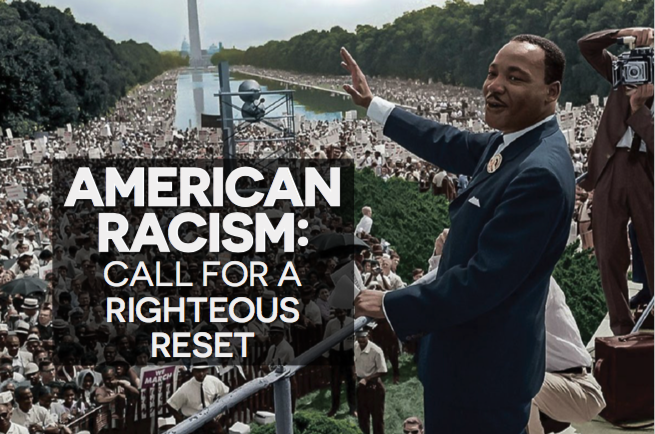
Call for a righteous reset. The racial wounds in American society are organic injuries in need of critical attention. Racial feelings and discomfort will continue to fester for generations to come, causing interpersonal and communal distress and destruction until we are willing to lance these old wounds and intentionally address the infected framework. The first step toward racial healing is confessing the work we have done to the present has fallen short of God’s glory. It requires re-opening the historical wounds, however painstaking that may be, addressing them with the scalpel of justice and carefully nursing them to an antiracist reality.
The Presbyterian Church (U.S.A.) has taken significant steps to raise awareness of racism in the church and beyond. The 222nd General Assembly in 2016 approved recommendations encouraging the Presbyterian Mission Agency, mid councils and congregations to specifically address the worsening plight of the African-American male and called the church to confess its role and repudiate the Doctrine of Discovery, a 16th century church-based policy that promoted the dehumanization of people who were not white Christians. Its systemic affects continue to be a thorn in the flesh in present efforts toward racial equity.
Belhar Confession. The PC(USA) approved the Belhar Confession to be added to the Constitution in the Book of Confessions at the 222nd GA. A theological response to apartheid by the Dutch Reformed Mission Church (now the Uniting Reformed Church of Southern Africa), Belhar concludes that racism is a structural sin. Racism is an offense in the body of church and society.
Belhar’s focus on unity, reconciliation and justice offers a platform for Presbyterian leaders and congregations to become purpose-driven co-participants in the fight to eradicate racism.
“Facing Racism.” The 222nd GA approved “Facing Racism: A Vision of the Intercultural Community Churchwide Antiracism Policy.” The policy is accompanied by six study guides that congregations and groups can use for anti-racism training. The churchwide policy has issued a sevenfold challenge to the General Assembly, synods, presbyteries, congregations, educational institutions, related agencies and ecumenical partners to engage in anti-racism training, develop courses and resources and recruit and empower leaders who will carry the work of antiracism into the present context and into the future.
Undoing Racism. An example of righteous resetting in race relations is the Undoing Racism project in the Synod of the Northeast between Rendall Memorial Presbyterian Church, an African-American congregation in New York City Presbytery, and the Presbyterian Church of Morristown, a Euro-American congregation in Newton Presbytery, pastored by Flora Wilson Bridges and Dave Smazik respectively.
Twelve members from each congregation have collaborated for a year starting August of 2016, focused on community building and education on Undoing Racism. Resources they studied included “The Cross and the Lynching Tree” by James Cone, and the films “I Am Not Your Negro” inspired by the writings of James Baldwin, and “13th,” a documentary that sheds light on mass incarceration of black and brown people in the United States.
An essential part of the experience was a civil rights tour of the South that included not only historic sites, but also conversations with Presbyterian pastors in white and black churches and other key leaders in the movement. Sidney Lent, a participant on the tour confessed: “I am changed. I see now more clearly than ever, the dots across the timeline of history that led to our current situation of racism and the effect it has across an entire community and nation.”
Bridges states, “The ultimate purpose or goal is for our learnings on Undoing Racism to culminate in creating a sustainable mission project together in the Harlem community.”
This kind of intense exploration past the surface racial and cultural relationships provides the springboard to a level of empathy needed to overcome the psychic wounding of American racism, and reset racial relations on righteous path toward healing and purpose.
 Sterling Morse is coordinator for African-American Intercultural Congregational Support in Racial Ethnic & Women’s Ministries for the PC(USA) in Louisville.