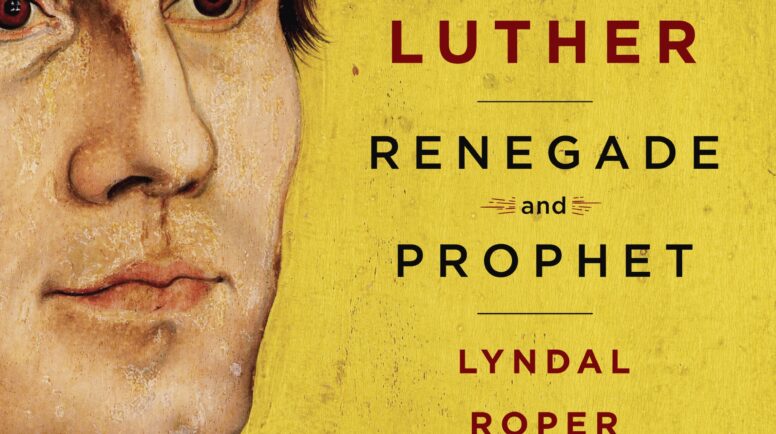
 Lyndal Roper
Random House, 576 pages
Lyndal Roper, holder of the Regius Chair at Oxford University, is a scholar of early modern history whose previous books have largely been about witchcraft. For the past 10 years she has been researching and writing the life of Martin Luther. There is no lack of good Luther biographies now available, from Roland Bainton’s and Heiko A. Oberman’s classic works to Eric Metaxas’ “Martin Luther: The Man Who Rediscovered God and Changed the World.” How is the canny reader to choose among such treasures?
For those interested in a straightforward, lucid account of Luther’s life, Roper’s biography may be the best choice. For the most part, she keeps the focus tightly on Luther himself, only pulling back and panning to take in the larger scene when it is necessary to provide context – as, for example, with the Peasants’ War. She does not indulge in sweeping historical narratives to explain the social, political and intellectual antecedents of the Reformation, nor does she give a detailed account of the theology of the period.
Roper is careful to debunk common misconceptions such as the importance of the Ninety-five Theses for launching the Reformation and the chronology of the developments in Luther’s thought that led to his key theological insights. She is masterful in providing succinct explanations of such things as indulgences, the importance of the Diet of Worms and the controversy between Luther and the “sacramentarians” over the Eucharist.
She was especially good in explaining Andreas Karlstadt’s role in the Reformation. Historians usually present Karstadt as an overzealous and misguided leader of the Reformation in Wittenberg during Luther’s yearlong absence following the Diet of Worms. Luther, in this view, is seen as the hero who returned to Wittenberg in time to salvage the Reformation by reversing many of Karstadt’s reforms. Yet, as Roper points out, Luther actually agreed with Karstadt’s reforms at the time, but was politically astute – and cold-hearted – enough to side with the powers that be and sacrifice his friend and colleague.
Roper believes that postwar Luther scholarship was skewed toward the southern cities of Germany because the Cold War made it difficult for historians to examine archives in the East. She attempts to correct this deficiency by emphasizing the social and cultural context that shaped Luther’s life and outlook. Readers will no doubt be delighted with her exploration of Luther’s childhood in the mining town of Mansfeld and her portrayal of the Luder family. On the other hand, her account of the often violent and scatological language that Luther marshaled against his enemies – Catholics, Jews, Anabaptists, and others – will be disturbing. She admits that “Luther was a grand hater” and does not attempt to explain away his vitriol by arguing that he was a product of his time or that his more unsavory remarks were the result of age and illness. This is a reliable biography that breaks new ground and should be well received by scholars and non-specialists alike.
 Michael Parker is Presbyterian World Mission’s interim coordinator for Europe and the Middle East. He lives in Louisville, Kentucky.