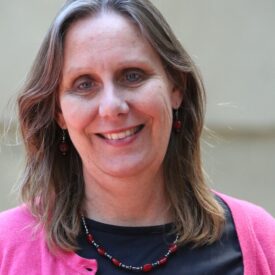
LOUISVILLE – J. Herbert Nelson, stated clerk of the Presbyterian Church (U.S.A.), presented a General Assembly per capita budget that he said is needed to “do what the Lord requires” – and which would be funded by a sizeable increase in the General Assembly per capita apportionment.
The vote on that proposed General Assembly per capita increase – from an apportionment of $7.73 per member in 2018 to $10.71 in 2019 and $11.45 in 2020 – is expected to come Feb. 8, with the Committee on the Office of the General Assembly (COGA) and the executive committee of the Presbyterian Mission Agency Boardmeeting jointly.
 If approved, that would amount to a 39 percent increase from 2018 to 2019 and a 7 percent increase from 2019 to 2020.
The proposed increase would lift the General Assembly per capita budget from $11.5 million in 2018 to $15.5 million in 2019 and $15.8 million in 2020. That would also give a “break even” funding level – adding more than $66,000 to per capita reserves in 2020, compared to this year, when more than $2.6 million is being withdrawn from reserves to cover costs.
For the details of that proposal, see this Outlook story.
During a discussion of the proposal Feb. 7, Nelson said the budget is based on “what we are required and called to do,” but acknowledged that “we may not get all that we are asking for. That’s not my hope, but it is a reality.”
Nelson also said, “I’ve always believed, even as a local pastor, that you ask for what you need” and that “we serve a Lord of abundance. … Whatever we receive will come from the Lord.”
Nelson said he hopes and prays the denomination will support the request. As he sees it, “It’s a faith issue. It’s not a budget issue.”
In presenting the proposal during a video conference call session Feb. 7 of COGA (meeting in St. Louis) and the executive committee (meeting in Louisville), Nelson and Kerry Rice, deputy stated clerk of the Office of the General Assembly (OGA), spoke of the work that OGA is trying to do on behalf of the church – all of which requires resources.
Issues of justice “are re-emerging in ways that are not seen as a burden to the denomination but are becoming a blessing” and a chance for renewal, Nelson said.
 Nelson spoke of the responsibility OGA has to model ministry – “what it means in this age to go through transformation.” He spoke of the importance of leader training and education – including support for small congregations that may not be able to afford full-time pastors, and explanation of the communal nature of property ownership in the PC(USA) system. “I am convinced that our work is no longer in the office,” but in connecting with mid councils and congregations, Nelson said.
And he spoke of the need to support contextual ministry.
More and more, refugees and immigrants who are Presbyterian come to PC(USA) churches, Nelson said. That means more resources need to be translated into languages other than English.
And for a local pastor, that might mean “spending hours at the jail when someone is in ICE lockup” – so in that context “pastoral care is not in the hospital,” but trying to seek the release of undocumented immigrants who have been detained and may be deported.
OGA leaders also spoke of the work that per capita supports – from the expenses of holding the biennial General Assembly to ecumenical relations and much, much more – and the realities of increasing costs for travel, meeting planning, salaries and other work.
As the proposal was made public, questions are beginning to surface of the potential impact of a per capita increase on congregations and presbyteries.
 In 2016, about half of the uncollected per capita came from 9 presbyteries, and another 44 presbyteries accounted for the other half, Rice said. Nelson spoke of the connectional nature of the PC(USA), asking whether mid councils with larger congregations and more resources might need to help those with fewer resources.
After the video call ended, Melinda Sanders, a Presbyterian Mission Agency Board member from Tennessee, asked what research has been done to find “what this type of increase will do to the presbyteries.” Rice had said that some presbyteries only pay what they receive from congregations; some pay all of the apportionment; some land in between.
“I know that my own presbytery pays for its churches that don’t pay, and this will become a significant item in our budget,” Sanders said.
Joseph Morrow, a board member from Chicago, asked if research has been done on why some presbyteries don’t pay more – and what’s needed to close the gap.
Molly Baskin, a board member from Chicago, raised the question of whether the level of uncollectible per capita might go up if the per capita rate rises. Baskin said she suspects “the revenue number may go up, but the write-off number is going to get much bigger.”