 Churches like our own are “challenged more strongly by the sacraments than by anything else,” according to J.J. von Allmen, a Swiss Reformed theologian. Why? One reason is that since the Reformation we have been frozen in a posture of resistance to the superstition so evident in the medieval church. That resistance pressed us to insist that true Christianity has to do with spiritual things, not idolized objects. Our Reformers fought superstition with a cascade of words: translations of the Bible, preaching, lectures, catechisms and volumes that could be mass-produced on Gutenberg’s new printing press. Words, it seems, are spiritual. Water, bread and wine not evidently so.
Fast forward. We have sermons every Sunday. We celebrate sacraments now and then, or quarterly, maybe the first Sunday of the month. Ritual, involving material things, makes us nervous. Although in “Institutes of the Christian Religion,” John Calvin himself observed: “For if we were incorporeal … [God] would give us these very things naked and incorporeal. Now, because we have souls engrafted in bodies, [God] imparts spiritual things under visible ones.”
Calvin is right, of course. God created us from dust, and declared the creation good. Spirit is not incompatible with material things, including the human body, rivers of water, bread baked or grapes pressed into wine. When Scripture warns against “the flesh,” it is not denigrating the physical as such, but warning against a shortsighted focus on bright, shiny things that misdirect our longings and affections.
Do you remember the Gospel story about Jesus handing out users’ manuals to the disciples with instructions about when, where, how and whom to baptize? With an appendix that explained in detail what it means? Oops! No, guess that didn’t happen! Neither sacrament was simply dropped directly from heaven to the church, all finished and whole. Both Baptism and the Lord’s Supper grew into what they are — gradually, organically, over time, working from materials at hand.
John the Baptist was the first to baptize, including baptizing Jesus at the beginning of Jesus’ public ministry. The word “Trinity” is not mentioned, but the stories speak of the descent of the Spirit and a voice from heaven, “You are my Son, the Beloved … ” (Mark 1:11). It is intentional that we baptize in the name of the Father, the Son and the Holy Spirit (see W-3.0402).
Fleming Rutledge has described the Old Testament as the “operating system” for the New Testament. The Old Testament doesn’t mention baptism, but tells stories that seem, in retrospect, to have helped to shape it. For example, it did not escape people in the times of Old Testament that water was both essential to life and, in large enough quantities, dangerous. In the story of Noah, the waters of the flood are meant to cleanse the earth of wickedness, but the ark carries to safety those who will make a new beginning (Genesis 6-9). God provides our sacramental ark.
Crossing to safety — the waters of the Red Sea open to provide Israel a way out of bondage (Exodus 14:21-23), and they cross the Jordan to enter the Promised Land — a new beginning (Joshua 3:14-16).
 Jesus’ sermon in Nazareth outraged his hometown folks with the story of Naaman, commander of the Syrian army. Jesus pointed out that, although there were many Hebrew lepers in the time of the prophet Elisha, this Gentile was the only one healed (Luke 4:27-28). Reluctant but desperate, Naaman had followed Elisha’s curious order to bathe seven times in the Jordan River. To his own astonishment, the gentile stranger was healed, and broke out in praise of Israel’s God (2 Kings 5:15). It’s about healing, making new.
Images of the “river of the water of life” appear several times in the Bible. The river flows from Eden (Genesis 2), but in a second account it flows from God’s temple in Jerusalem (Ezekiel 47:1), nurturing trees whose leaves would heal the wounds of the captives returned from Babylon; and finally the healing stream flows directly from the throne of God and the Lamb (Revelation 22:1). The fruit of the trees by the river will serve the healing of the nations — everybody. Shall we gather by the river?
In the New Testament, one of the earliest ways to understand baptism was as a representation of new birth. In utero, we were formed in a bath of amniotic fluid. The baptismal font represents the sacramental womb. There, new lives in Christ begin to take shape (1 Peter 1:3).
The apostle Paul characterizes baptism as dying and rising with Christ, “so that we too might walk in newness of life” (Romans 6:4). The “meaning” of the sacrament is multilayered: It is a prayer to God to drown that part of us that leads to swollen self-interest and shutting out the other — a sacramental healing. It’s a death that promises resurrection in Christ.
Who should be baptized? All churches agree that baptism unites first-generation converts with Christ and his church, but the New Testament says nothing about the second generation of any age. Jewish children were initiated into the covenanted community soon after birth. In the case of adult converts to Judaism, their children were washed in the convert’s ritual bath, with the understanding that the children were free to leave the covenanted community later should they choose. In other words, they were included unless and until they chose to be out. Presbyterians do not baptize children indiscriminately, but only children of the covenant, those who have at least one parent who professes the faith and is on the active roll of a congregation (W-3.0403).
An analogy may be the process of becoming a naturalized citizen. German or Chinese parents who choose to become American are accompanied by their children — as the Hebrews’ children accompanied parents through the divided Red Sea waters. Children typically embrace the inherited identity derived from naturalized parents’ decisions, although not bound by them. At maturity, they get to choose.
At whatever age, baptism incorporates the baptized into the body of Christ, the church. They become baptized members, to be added to the active roll when confirmed (G-1.0401). We reaffirm our baptism in the holy meal.
During his last meal with the disciples, Jesus took bread and said, “Explain this, in remembrance of me.” Oh, wait! Not “explain,” but “do this.” We have that old hang-up from our quarrel with the medieval church — a suspicion of ritual. Explaining ritual makes us a little less anxious about it. It also establishes a respectable distance, leaving us checking off the boxes that tell us what we should be thinking about as we break the bread and share the cup. Explanations are good — in other settings. Explanations during the rite kill it. The “remembering” — the meaning — is in the doing, not the explaining.
It has been a problem for us that in English, “Lord’s” and “Last” are both short words that begin with the letter “L.” It has led us to presume that the Lord’s Supper is a replay of the Last Supper. Therefore, it must be solemn and melancholy, as appropriate for any last meal, particularly on the eve of a betrayal and execution. But, as important as the “last” meal is, the sacrament is not meant to be a replay.
In fact, the first “Lord’s” Supper occurred on the evening of the first Easter. The risen Lord, unrecognized, had spent the afternoon on the road with two distraught disciples. They had been struggling with the horror of the cross and rumors of resurrection. The apparent “stranger” led them in Bible study until they reached their destination. They invited him for dinner and, “when he was at the table with them, he took bread, blessed and broke it, and gave it to them. Then their eyes were opened, and they recognized him” (Luke 24:29,30).
Note here the use of a sequence of four verbs: took, blessed, broke, gave. The same sequence is used in the accounts of the Last Meal. The words are familiar because they occur in the words of institution used at table in Communion services. The same four verbs are used in Gospel accounts of the feedings of the 5,000 and the 4,000. John used the words “took” and “gave” from that sequence in the story of the post-resurrection feeding by the sea (John 20:13). Whenever we encounter these verbs, we are dealing with a text that has to do with the Lord’s Supper (thanksgiving meal/Holy Communion).
As in the case of baptism, the several ways of understanding the Lord’s Supper are laid each on top of the others, based on a variety of meal experiences in both testaments. Jethro, celebrating Israel’s delivery from the Egyptians, hosted a meal: “And Aaron came with all the elders of Israel to eat bread with Moses’ father-in-law in the presence of God” (Exodus 18:12). In a commandment, God gives instructions to the people to go to a certain place, “And you shall eat there in the presence of the Lord your God … rejoicing” (Deuteronomy 12:7). The similarities in these Old Testament meals are that they are eaten in God’s presence, rejoicing. Our Lord’s Supper has, from the beginning, accented the same themes: the Lord’s presence and rejoicing. Not a downcast, sorry meal, but a “Eucharist” — thanksgiving. Eyes are opened. In the sacrament, what God gives us is Christ.
The Gospels record accounts of Jesus eating meals with “sinners” and tax collectors, reaching across forbidden boundaries: reconciliation. The community that Jesus gathered around him was a meal-keeping community. The meals continued after his death and resurrection as disciples assembled on the first day of the week. “They devoted themselves to the apostles’ teaching and fellowship, to the breaking of bread and the prayers” (Acts 2:42). John Calvin insisted that a weekly celebration of the meal alongside the preached Word was the norm, describing the absence of the meal as a “defect.”
The host of the meal is the risen Lord, who remains always also the crucified Lord, bearing the wounds of the cross (John 20:27). The meal looks to past events, especially those in which Jesus was central; to the present: Jesus with us now; and, easily overlooked, to the future. The Supper anticipates a great wedding banquet, a feast of thanksgiving in the kingdom of God: “Then people will come from east and west, from north and south, and will eat in the kingdom of God” (Luke 13:29). Set side by side in the meal is a realistic acknowledgment that our world is filled with cross-shaped places, on the one hand, and that the resurrection is God’s promise of a transformed, healed creation of which Jesus’ healing and reconciling ministry is a foretaste. We are called to remember forward as well as backward — rejoicing, even in a troubled world.
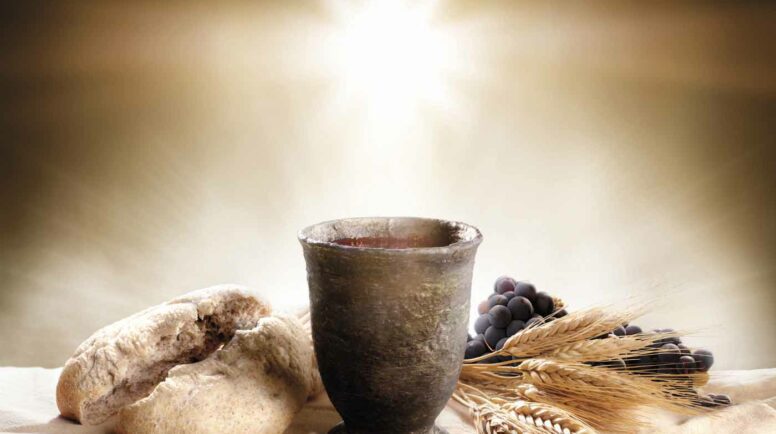
Jesus is bread “to strengthen the human heart,” and he is “wine to gladden the human heart” (Psalm 104:15). Bread, baked from wheat gathered from many fields, ground into flour. Wine, making hearts glad, a symbol of the kingdom. Prophets promise, “In that day the mountains shall drip sweet wine” (Joel 3:18, John 2:1-11).
When the apostle Paul warns that “all who eat and drink without discerning the body, eat and drink judgment against themselves,” he is exhorting us to recognize that those invited to his table may be a curious assortment of people, nevertheless it is Jesus who has called us to be his body. He said to his disciples, “You did not choose me but I chose you” (John 15:16).
The Reformed tradition is not alone in testifying that God is at work in and through the sacramental action by the power of the Holy Spirit. It is by the Spirit that Jesus becomes present to us and for us in thanking, eating and drinking; and by the Spirit that eyes are opened and we recognize him. The Spirit speaks, calling to us, “Lift up your hearts,” and the same Spirit enables us to “lift them to the Lord.”
 RONALD P. BYARS is professor emeritus of preaching and worship at Union Presbyterian Seminary in Richmond, Virginia.
Further reading by Ron Byars in the “Being Reformed” series from Congregational Ministries Publishing:
“Baptism — Workbook: Coming to the Font” (2016)
“The Lord’s Supper — Workbook: Coming to the Table” (2017)