 Leslie Williams
Eerdmans, 208 pages
In the summer of 1529, theology professor Thomas Cranmer decided to escape the plague and passed through Cambridge to stay at the home of the Cressy family in Waltham Abbey in Essex. In August, two of King Henry VIII’s advisors, Stephen Gardiner and Edward Foxe, happened to join him there for dinner. The three former university colleagues naturally fell into discussion about the recent trial in the Great Hall of the Blackfriars that was to decide the king’s “great matter” — the annulling of his marriage to Catherine of Aragon. When the papal legate, Lorenzo Campeggio, postponed the proceedings to October, the king knew that he was unlikely ever to receive the decision he wanted from Pope Clement VII.
Over dinner, Cranmer suggested to his friends that Henry change tactics. Rather than decide the case on the basis of canon law in an ecclesiastical court, the king should seek out scholarly divines to determine the issue on the basis of Scripture. When Henry was told the suggestion, he remarked, “That man has the sow by the right ear.” Henry then ordered Cranmer to carry out the plan. The obscure Cambridge fellow was suddenly a key player in the trial of the century. Theologians from Europe’s most prestigious universities soon decided in the king’s favor, beginning a process that resulted in the creation of a new, independent Church of England.
In 1532 Henry appointed Cranmer archbishop of Canterbury, and the new primate judged the annulment issue in the king’s favor and presided over his marriage to Anne Boleyn. Cranmer then helped to lead the reformation in England under a mercurial and often murderous sovereign. Cranmer somehow survived while others, such as Thomas More, Thomas Cromwell and four of the king’s six wives, did not. Under Henry’s son, Edward VI, Cranmer’s slowly evolving Protestant convictions came to full bloom as he produced the “Book of Common Prayer” and the “Forty-Two Articles,” the church’s confessional statement. But when Edward died after only five years on the throne and was replaced by his Catholic half-sister Mary, Cranmer’s days were numbered. After being forced to sign six recantations, Cranmer summoned the courage to die heroically and unforgettably, his story immortalized in “Foxe’s Book of Martyrs.”
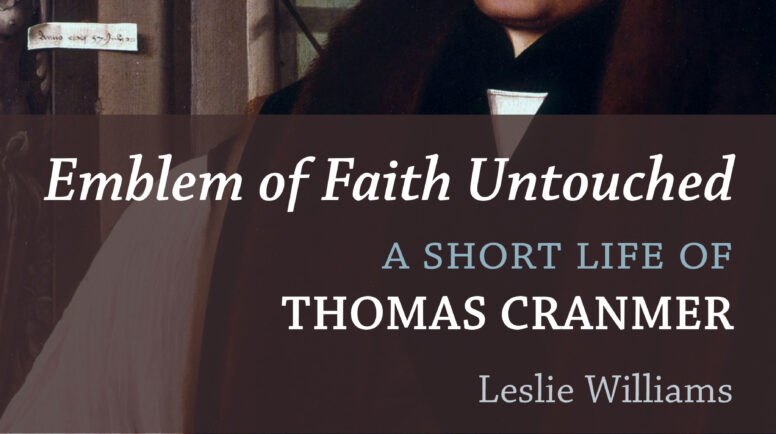
Leslie Williams’ biography of Cranmer, the latest in Eerdman’s “Library of Religious Biography” series, is a brief narrative of one of the towering but often overlooked figures of the Reformation. Williams is not a scholar of the Reformation, English history or theology. Rather, she is an English teacher with a master’s degree in sacred theology and a doctorate in English and American literature. Her usual genre is the novel, which shows in her briskly paced and lively retelling of Cranmer’s life.
Williams’ work will not replace Diarmaid MacCulloch’s “Thomas Cranmer,” the masterful, richly detailed and definitive biography of Cranmer for our time; however, MacCulloch’s densely packed oeuvre is probably too daunting for all but the most avid scholars of the English Reformation. Williams’ modest effort, in contrast, does not linger over the complexities of Cranmer’s life or the subtleties of his intellectual contribution, yet will serve admirably as a concise, reliable introduction.
 Michael Parker is Presbyterian World Mission’s interim coordinator for Europe and the Middle East. He lives in Louisville, Kentucky.