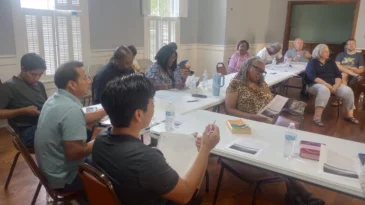
LOUISVILLE – With two significantly different proposals involving the Presbyterian Church (U.S.A.), A Corporation heading towards the 2018 General Assembly, a group of Presbyterian leaders are meeting in Louisville April 8-9 to see if they can find common ground.
The first day of conversation did not bring any breakthroughs – but did help to illuminate some of the differing views and potentially some of what’s at stake.
At the table at this gathering – which was convened by the Governance Task Force of the Presbyterian Mission Agency Board – are representatives of the board, and also of the Way Forward Commission, the All Agency Review Committee, the denomination’s advocacy and advisory groups, the Committee on the Office of the General Assembly and Presbyterian Women.
Heath Rada, moderator of the 2014 General Assembly, is moderating the conversation – a last-minute addition (he was invited to do so just two days before), and a significant one, in that his leadership set a tone of civility and mutual respect.
“I do not bring a bias into this meeting,” Rada said at the beginning.

“I do believe firmly that the church membership has said over and over recently that we are at a time when change not only is needed, but is essential.”
The conflicting proposals the assembly will consider involve structural change for the denomination – specifically regarding the PC(USA), A Corporation, which is the corporate identity serving the Presbyterian Mission Agency and the Office of the General Assembly.
The Way Forward Commission and All Agency Review are making a joint recommendation to the General Assembly, which includes altering the structure of the A Corporation board to provide representation for all six PC(USA) agencies, plus the Advocacy Committee for Women’s Concerns and the Advocacy Committee for Racial Ethnic Concerns.
The Presbyterian Mission Agency Board voted Feb. 28 to send its own proposal to the assembly – asking the assembly to divide the A Corporation and create an independent General Assembly Mission Corporation, plus a separate corporation for the Office of the General Assembly. Currently, the A Corporation board members are those who serve as voting members of the Presbyterian Mission Agency Board.
Rada stressed that those involved, despite their disagreements, are trying to do what they consider best for the PC(USA). “Let’s acknowledge that everyone’s motives are well-intentioned,” and their motivation is “they love this church,” he said.
Rada also pointed out some other realities.
The Way Forward Commission was created “to offer a new direction immediately,” he said. The commission and the All Agency Review Committee were “given the responsibility of making the primary recommendation,” and will have time during a plenary session June 17 to address the assembly commissioners. “It isn’t a level playing field,” he said, and the Presbyterian Mission Agency Board does not “have the same authority,” although both recommendations will go for consideration to the assembly’s The Way Forward committee.
Cynthia Jarvis, a pastor from Philadelphia who will serve as moderator of that committee, and Veronica Goines, a minister from California who’ll be the committee’s vice-moderator, also are at this meeting, as observers. J. Herbert Nelson, the PC(USA)’s stated clerk, sat listening as well.
As the meeting began April 8, representatives of the board and of the Way Forward Commission and All Agency Review were given opportunities to present some of the thinking behind their proposals. Then representatives from each of the other groups were given a chance to outline their thoughts about the recommendations.
There was discussion too about the deadlines and about whether the proposals submitted are set in stone, or whether more revisions are possible. The recommendations already submitted are the ones the assembly will consider – it’s too late to change them, said Tom Hay, director of assembly operations.
“But that doesn’t negate the ability to go to the committee and say we’ve reached a different conclusion,” said Conrad Rocha, co-chair of the board’s Governance Task Force.
Presbyterian Mission Agency Board
Rocha outlined changes the board has made in its own composition and structure since it created the Governance Task Force in early 2016, following a review of the Presbyterian Mission Agency that he acknowledged left the board “visibly shaken.”
That review led the Governance Task Force to take a deep look at what was working and what was not, Rocha said, and to focus on “responsible change.” As a result, the board voted last September to reduce its size and reconfigure its structure.
Board member Chad Herring, a minister from Kansas City, said “we at the Presbyterian Mission Agency are not trying to offer a proposal because we are trying to be contradictory,” but because the board has concerns about the recommendations from Way Forward and All Agency Review.

“Can the removal of corporate powers and responsibilities free the PMA for robust mission, which is what I think the intended goal is … or will it create havoc and inefficiencies, and thus diminish mission?” Herring asked.
Herring said PMA does not want sole control of the A Corporation or of shared services (such as information technology or legal services). But he said PMA needs to have some responsibility for corporate governance in order to do mission for the PC(USA) – for example, to be able to effectively do international mission work.
He also raised concerns about giving all six PC(USA) agencies a seat on the A Corporation board, citing possible fiduciary conflicts.
All Agency and Way Forward
Jim Wilson, a lawyer from Ohio, said the A Corporation proposal is just part of a broader set of recommendations that the two groups have made – with All Agency encouraging the denomination to live into a new openness. All Agency hopes to create accountability across the church, he said, and an environment in which those called to work for the denomination are “feeling joy in their work.”
All Agency had concerns that corporate issues “really were dominating the agenda” at PMA – and has a desire “to free PMA to do mission,” Wilson said.

He went point-by-point through concerns the Governance Task Force has raised – saying for example, that PMA would retain responsibility for setting mission priorities and that the Presbyterian Mission Agency Board “is not subordinate to the A Corporation.”
The proposed reconfiguration can bring expertise from all six agencies to the A Corporation, Wilson said. The idea is to have both a diverse board “and a skilled board that brings real expertise” in financial and legal matters, and is committed to transparency and accountability.
He also told the board representatives that “your ideas would be welcome” if they have additional ideas for improvement.
Eliana Maxim, a mid council executive from Seattle and a vice-moderator of the Way Forward Commission, said the commission’s mandate was to look at the PC(USA) structure – and to consider how it can be a 21st century church. In speaking with senior leaders at PMA, what came up over and over was “this desire to have a board that dealt with mission alone,” Maxim said.
Other groups
Other participants in the meeting also had time to speak – and their comments reflected a variety of concerns with the proposals.
The Advocacy Committee for Women’s Concerns opposes both proposals, said Kerri Allen. “There are legitimate concerns,” she said, including “a lack of theological grounding.”

The governance of the A Corporation “needs to be inclusive,” and “it must not be like a puppet or a token participation,” said Thomas Priest of the Advocacy Committee for Racial Ethnic Concerns. Having people from different cultural perspectives at the table “does make a difference,” Priest said.
The proposal from Way Forward and All Agency Review does not give Presbyterian Women representation on the A Corporation board, even though Presbyterian Women have given more than $60 million to mission in the PC(USA) since 1988 and is a significant user of shared services, said Carol Winkler. The Presbyterian Foundation and Board of Pensions don’t use shared services, but are being offered seats on the board, Winkler said.
And the Committee on the Office of the General Assembly (COGA) does not support the Presbyterian Mission Agency Board’s proposal to divide the A Corporation into two separate corporations, including one for the Office of the General Assembly, said Stephanie Anthony.
The Governance Task Force gave COGA no advance warning it was making that recommendation, even though the proposal affects OGA, Anthony said. “We read about it when everybody else read about it.”
She also disagrees with the idea of giving the Board of Pensions and Presbyterian Foundation seats on the A Corporation board. “We use their services, and don’t get a seat at their table,” she said.
At the end, Rada delivered a challenge – asking participants who had raised concerns to come back in the morning with a strategy for how they might be addressed. The conversation will continue April 9 with more detailed conversation about the proposals – including about A Corporation funding and issues of representation.