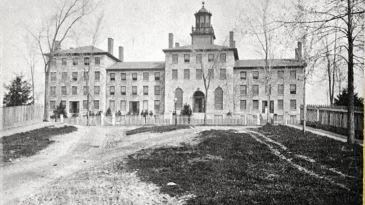
 Did you know that, but for the commissioners’ vote on the floor of a plenary session at General Assembly, our Presbyterian Church (U.S.A.) headquarters would be in Kansas City, Missouri, today instead of Louisville? It happened at the 1987 GA in Biloxi, Mississippi.
A task force charged with researching a post-reunion location had been hard at work for over two years, narrowing down finalists and eventually presenting their choice of Kansas City with great fanfare. It was a site where the cost of living was reasonable, near a major airline hub and it was closer to the country’s center than the Eastern time zone.
The responsible GA committee endorsed their choice and the whole team made a grand presentation: Kansas City dignitaries gave glowing welcomes, a video illustrated all that Kansas City had to offer and many balloons awaited overhead for dramatic release in the assembly hall.
But then something happened. A surprise substitute motion was offered from the floor to move the headquarters to Louisville, Kentucky, instead. Then president of Louisville Seminary, John Mulder, waged a floor fight, giving a fervent pitch for his town. It was comparably affordable to Kansas City. While still in the Eastern time zone, it was located west enough for an easy day’s flight to anywhere in the country. It came with a promise that Delta would put a hub in Louisville (that never materialized).
 In Mulder’s words, as borrowed from “The Godfather,” the cherry on top was “an offer we couldn’t refuse.” The president of the Humana corporation based in Louisville would “give” us a major office building for $1 – with no strings attached – if we’d pick Louisville that very day. They even handed out mini Louisville Slugger baseball bats to all the commissioners.
The vote was taken, followed by a stunned silence in the assembly hall. By a five-vote margin, we were bound for Louisville.
Commissioners should never ever think they are coming to the assembly merely to listen faithfully to wonderful reports by hardworking committees and then to rubberstamp their approval. They are anything but rubber-stampers! Rather, they have been chosen through prayer to listen for the voice of the Holy Spirit among the commissioners gathered at the assembly. Theirs is a job of real-time discernment.
Commissioners are there to push tough questions and to seek transparency, accountability and excellence. They are there to be certain that we stay the missional track of fulfilling our call. They are there to be as decent and orderly as possible while practicing the messy business of being “reformed and always reforming according to the Word of God.” They are to midwife new ways for us to be and do church, as God leads us.
Vision and structure at this assembly
What is front and center at the 2018 assembly is a deep consideration of how we are called to marry vision and structure for the sake of mission. Three different GA-appointed entities have been studying varied aspects of the challenge about how to be a denomination that best structures and governs itself to embody both a more post-modern, flatter social construct and the reality of dwindling denominational resources and membership.
The Way Forward Commission, the All Agency Review Committee and the Vision 2020 Team were our very Presbyterian way of acknowledging that transformative change is needed at every level of our denomination. The upside to having three groups studying the issues is that they will bring a variety of perspectives to the table. The potential downside is that they could turn out to be, as the fable goes, three blind people describing an elephant – communicating only what they have experienced without seeing the whole.
The challenge of adaptive change
J. Herbert Nelson, stated clerk of the PC(USA), recently wrote, “The most significant problem that we are facing at the national church level today is the belief that the corporate model of leading the church is the best leadership model.”
We think a secondary problem from which we suffer is how deeply our agencies and ministry areas are siloed from one another. This impression was confirmed in the listening campaigns conducted by former assembly moderator Heath Rada. Ron Heifetz, one of the godfathers of adaptive change theory, warns us that the biggest failure we can make when instituting change is to slap a technical fix on an adaptive problem.
Clearly deep adaptive change is called for as we seek a model for how we do ministry and mission more adapted to the post-Christendom context in which we serve.
The late church historian Phyllis Tickle said that every 500 years Christianity holds a giant rummage sale, completely changing how we “do” church. We sort through what to let go of and what to hold on to.
In modern parlance, we face a serious disruption in the way we “do” church. Our lives have been touched in every sector by creative disruptions. They have brought us the smartphone, Uber, Airbnb, Amazon as well as the Protestant Reformation. We are on the cusp of another disruption right now.
All change is hard because it represents loss. We mourn the absence of things we loved about the way church used to work for us: burgeoning Sunday schools, invigorated youth groups, filled pews, a corner on the Sunday morning market, a rising generation of leaders ready to take the baton. The denomination resourced our congregations based on these models. But they represent a cultural context that is rapidly fading away.
Here are three particular adaptive challenges this General Assembly is being asked to consider, pray over and vote on:
Have our task forces and committees offered up a vision and structure that breaks the corporate model and suggests a viable alternative?
Will our new structures reflect the diminished resources and membership available to support them? Does the new structure reflect an honest response to our rummage sale needs?
Does our newly proposed design correct the deep problem of our silos?
These are the kinds of hard, adaptive questions that need to be asked. The challenge is to avoid the pitfall of taping technical Band-Aids over deep adaptive wounds.
So, where will commissioners find the strength for this important task?
The difference between civic and ecclesial decision-making
When we elect elders to serve on a session, we don’t elect them to manage a small nonprofit (though they sometimes act as if we did). Rather, we ordain elders and set them aside to take on the representative task of discerning God’s will for our congregations. When presbyteries elect commissioners to General Assembly, they are similarly set aside to discern God’s will for our national church.
This is very different from the theory we use when electing civic government office holders. In the civic model, people are elected to vote the will of the majority of the constituency who elected them. We often mistakenly transfer this understanding to the role of GA commissioners. Commissioners are not to vote the will of their constituents, however; they are to discern God’s will.
Grasping the true nature of their calling is one of the most difficult things commissioners need to do, especially when hot button issues are prominent on the assembly’s agenda (as has been the case for most of the last decade). Commissioners come with their minds already made up about where they stand and see their primary role as making cogent arguments for their position in committees and on the assembly floor and to prevail in the vote.
This year’s General Assembly presents an opportunity for us to practice discernment together, instead. Other than the fossil fuel overture, there may not be another issue that has already captured the hearts and minds of most commissioners. The work of the three task forces raises issues in which most commissioners may not have a felt stake. This gives us an opportunity to decide these issues through spiritual discernment.
Preparing ourselves for prayerful discernment
If we want to let go of a more political approach to decision-making and open ourselves to discerning God’s will, how might we prepare ourselves for this process before we arrive in St. Louis?
Jim Kitchens has long used a process developed by Presbyterian minister Chuck Olsen and his United Methodist colleague Danny Morris and described in “Discerning God’s Will Together: A Spiritual Practice for the Church.” Their model combines insights from Ignatian and Quaker approaches to the practice of discernment.
The first step in their discernment process is to open ourselves to what Morris describes as: “Nothing more, nothing less, nothing else than the will of God.”
Is it God’s will that we adopt a task force’s recommendations? Is it God’s will that we divest of fossil fuel stocks? If committee leadership were to use similar language to pose the issues before their committees in this way, it would remind us that we are seeking the mind of God together, not trying to score a political win.
Quakers note the importance of a process they call “shedding.” We ask ourselves: What will we need to shed/let go of in order to listen for the will of God? What preconceived notions or commitments do we need to lay aside? What position will we find it hard to let go? Reflecting ahead of time where our own human will may be more important to us than God’s will allows us to hold our prior commitments more lightly when the time to vote arrives.
Practicing discernment also requires that we listen far more than we speak. Seeking God’s will means listening deeply to what others are saying. We will want to make sure we understand what they are saying. We will ask why that position is important to them. As we listen in this way to one another, we are also listening for the voice of the Holy Spirit, prompting us to pay attention to certain voices and not to others. These promptings may be subtle, which is why it is even more important that we listen deeply.
 One concrete suggestion we make is to invest in the inexpensive booklet “40 Days of Prayer: Preparing Ourselves for God’s Calling” by Mark Tidsworth. It provides a daily devotional for communities setting out on a process of discerning God’s will. Presbyteries could buy copies for all of their commissioners as a concrete way of equipping them for the prayerful work they will do at the St. Louis Assembly. Accepting the spiritual discipline of daily prayer during the assembly would also go a long way toward helping commissioners define their work as ongoing prayer.
Keeping in touch with the pulse of the larger church while at GA
While commissioners are discerning choices in real time, many others across the country will be witnessing that work in real time by live streaming the assembly’s meetings. In recent years Twitter feeds have given immediate indications of how the larger church is responding to the assembly’s actions. Naturally, such responses are random and self-selective, as they are spontaneous reactions that bubble up in the moment.
This year we are adding a more intentional method to solicit feedback via a planned Twitter response mechanism. Incorporating a tool developed by Deborah Wright 25 years ago, a series of daily Twitter blasts on the Outlook platform (@presoutlook) will solicit focused responses to the assembly’s actions, both from Presbyterians in the assembly hall and at home in real time. This exercise will help people create a live, interactive conversation while GA is going on. These Twitter feeds are intended not to persuade or dissuade commissioners but to help prompt their discernment of the issues.
We were all ordained to serve with energy, intelligence, imagination and love. Use of Twitter intentionally brings these qualities to the table in a collective fashion — your very own cloud of witnesses, as it were. Viva la Holy Spirit!
Jim Kitchens and Deborah Wright are Presbyterian ministers who founded PneuMatrix to help presbyteries and churches engage adaptive change. Jim has served congregations in California and Tennessee, chaired the Committee on Theological Education (COTE) and staffed the Company of New Pastors. Deborah served a San Francisco church, was development director at San Francisco Theological Seminary and worked as a corporate chaplain, helping companies integrate spirituality into the workplace.