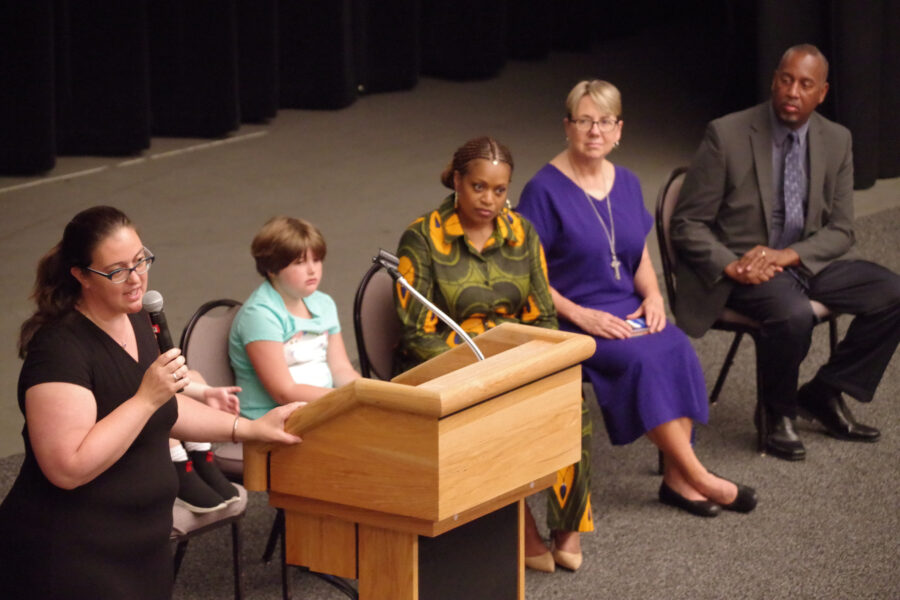
ST. LOUIS – J. Herbert Nelson, stated clerk of the Presbyterian Church (U.S.A.), introduced the speakers this way: “These Presbyterians are fresh out of jail. Really, they are fresh out of jail. Charged with righteous indignation. They are here today to tell the story of where we need to be as a denomination.”
Fresh out of jail.
Liz Theoharis, a PC(USA) minister and co-director with William Barber of the Poor People’s Campaign: A National Call for Moral Revival, was arrested June 11 while praying outside the U.S. Supreme Court.
Jimmie Hawkins, director of the PC(USA)’s Office of Public Witness, was arrested with Theoharis as they called for access for all to jobs, living wages, housing and health care.
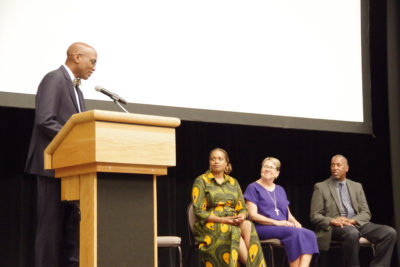
Nelson said they were “harassed, locked up, handcuffed, stayed in jail for an inordinate amount of time for praying on the Supreme Court steps. That’s the price we pay today in the United States for saying ‘we do not agree with what the government is pressing for.’ ”
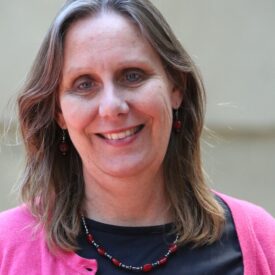
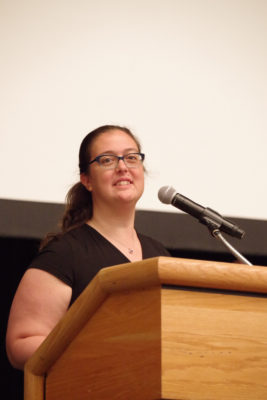
Theoharis – who is also co-director of the Kairos Center for Religions, Rights and Social Justice at Union Theological Seminary in New York – spoke to a crowd of hundreds on the morning of June 16, shortly before the 2018 General Assembly opened with worship in St. Louis. Her dark hair pulled back in a ponytail, her son and daughter playing quietly in the first row, Theoharis spoke in a calm, determined voice – raising a challenge for politicians and for people of faith in local churches to stand up for what the Bible really teaches.
The arrests came as part of a 40-day push by the Poor People’s Campaign to organize civil disobedience around the country – an effort that Theoharis described as “the most expansive and the largest wave of nonviolent civil disobedience in the 21stcentury.”
The action has involved more than 2,000 people in 35 states – organizing people to say “we can do better than this” on providing universal health care, living wages and protecting the environment, she said.
Theoharis told of pastors and community leaders linking arms with people living in poverty, people who lack housing, health care and jobs, who want the right to vote, “fighting for justice together.”
Together, they are speaking out against systemic racism, poverty, militarism “and a distorted moral narrative, a narrative that blames poor people for our problems,” Theoharis said, and against the sense that “there’s not enough to go around, when we really are living in absolute beauty and abundance,” with enough for everyone if those who have are willing to share.
Also arrested in this movement: Denise Anderson, co-moderator of the 2016 General Assembly, arrested in May at the statehouse in Annapolis, Maryland. Anderson, who serves on the Poor People’s Campaign steering committee in Maryland, said she was cited for two misdemeanors and released, with a pending court date.
“They are cracking down” on these protests, Anderson said. “They notice us now. They feel our presence throughout this country,” in places like Lansing, Michigan; Harrisburg, Pennsylvania; Albany, New York.
From the audience, Presbyterians shouted out more places: Sacramento. Tallahassee.
Theoharis praised the PC(USA) commitment to the Poor People’s Campaign – to being, as Nelson described it, a Matthew 25 church – and said: “I have never in my life been so proud to be a Presbyterian.”
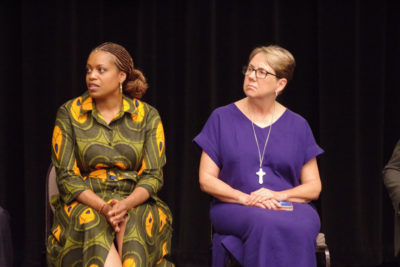
She also said, “I believe we are living in cruel and unjust times,” citing statistics. More than 40 million people living in poverty in the U.S., including children and the elderly. People living without food, without running water or, in Flint, Michigan, water that is safe to drink. “Thousands of immigrants who are crying out for hugs, not walls at the U.S.-Mexican border.” People whose voting rights are being suppressed.
“We say this is not right. This is not moral. This is not just. Our people are not free,” Theoharis said. “We won’t be silent anymore.”
She quoted the Bible – including the 15th chapter of Deuteronomy, where God calls on people to cancel the debts owed them every seven years and to end slavery.
“We have heard the cry ‘we want to be free.’ We need to organize. … We need a moral revival to save the soul of our democracy, to save the soul of our nation, and to make this country great for so many for whom it has never been.”
Theoharis said she had a message for politicians and for congregations “who justify inaction in the face of desperate poverty” – and that is “take away poverty, not our children.” Take away high water bills. Homelessness. Unjust immigration policies.

“We have the resources to feed, clothe, house, and educate everyone “in this entire world,” Theoharis said. “It is immoral for companies to make money out of other people’s poverty.”
Theoharis challenged politicians who quote the Bible while pushing policies that hurt immigrants and the poor; pastors who don’t preach about poverty and racism; those who claim they are Christian, yet stay silent when their faith should call them to speak out against injustice.
If Christians believe what the Bible says (to do justice, to love kindness, to walk humbly with God) and what Jesus stood for (the poor, the outcast, the least), then “we must question faith leaders who use the Bible to justify racism, to justify genocide, to build up walls and divisions than breaking all the chains of injustice,” she said.
People of faith should question public officials who attend church services, “but then make decisions to cut kids off from health care.”
She asked: “What Bible are you following? What Ten Commandments are you adhered to? What Sermon on the Mount di d you listen to? … Because justice for the poor, justice for the immigrant, justice for absolutely everybody is at the heart of our gospel.”
She challenged Christians too, to live out what their religion teaches.
Too few pastors preach about poverty and racism, violence and ecological degradation, Theoharis said.
Too few Christians talk about poverty as being a sin against God. “So many people quote ‘The poor will always be with you,’ to say that if God wanted to end poverty, he would do so.”
Too often, “we think the only way we address injustice is by doing charity work. By buying and selling and then donating to the poor.”
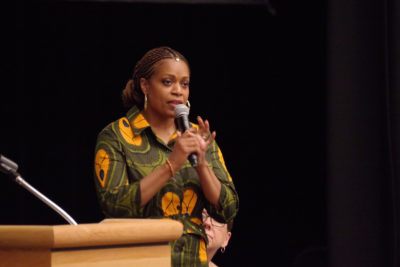
This is what she wants people of faith to do: to question how racism and poverty were created in the first place.
Theoharis and Hawkins also described their experience of being arrested. Theoharis said the Supreme Court police still have her favorite stole – the one that proclaims “Jesus was a poor man,” drawn from the 1968 Poor People’s Campaign, which the current campaign is using as a playbook.
Hawkins said the experience “was barbaric,” to be honest. After their arrest, their group was kept in handcuffs for about five hours; later placed two-by-two in roach-infested jail cells; rested on metal beds with no blankets, using their shoes for pillows. Of roughly 40 men in the holding cell that night, most were under age 30, arrested for misdemeanors, Hawkins said.
“There is a desperate need for reform of the criminal justice system,” he said. “People are treated like animals.”
Theoharis said that what the Bible teaches – to forgive debts, release slaves and organize society so there’s no unmet need – is not how Americans typically think of prosperity, but that needs to change.
When she feels tired and overwhelmed, “I really do go to our texts,” Theoharis said. “ ‘Do not worry about what you will wear or where you will sleep.’ It’s not that those things don’t matter. It’s that they matter so much, that by doing justice for everybody, we too will find justice.”