Recently, in a backyard near your house, a freshly-graduated high school student opened a present from her mom and dad. In it, contrary to her budding adulthood, she found Dr. Suess’ children’s book “Oh, The Places You’ll Go.” Neatly inscribed on the inside cover is a note from the parents – mom’s neat, curling cursive, encouraging the new graduate forward into the undoubtedly great life that she’ll have. Maybe there’s a small smudge where a tear fell onto the page.
The graduate will look sheepishly at her parents, maybe her own eyes fluttering with tears (though still self-conscious of all the assembled friends and family), and will read the first few lines of Seuss’ final published work:
Congratulations!
Today is your day.
You’re off to Great Places!
You’re off and away!
Later she’ll get to the lines that probed her parents’ subtext (and which caused them to buy this book, though their daughter was no longer the target audience):
With your head full of brains and your shoes full of feet,
You’re too smart to go down any not-so-good street.
These lines are both an affirmation and a warning: the daughter will do well (must do well) to avoid all the college-aged traps of sex, drugs and alcohol.
Ultimately there will be hugs and tears and thanks and then more gifts and cake.
What transpires in this (admittedly, predominantly white, suburban, educated) event is, however, not merely affirmation and encouragement, but rejection.
Whether the parents intend it or not (and likely they don’t), they have implicitly declared their child’s home – the house, the community, the city, the region – as something other than “Great Places!” Such places exist “out there” and it is incumbent upon the successful young person to chase after such a location with her head full of brains and her shoes full of feet.
This pursuit is somewhat akin to misguided charismatic Christians who proclaim our only true home to be in the heaven that awaits us (and thus eschews and ignores all things “earthly” or “of the flesh”), this young woman has been indoctrinated to chase after “heaven,” which means she has to leave home.
I am just like our proverbial young woman, as are so many of my generation (millennials who were born 1980-2000). I, too, had the “brains in your head … feet in your shoes” and thus I, too, was told to leave home and find the future that was clearly awaiting me. And I did just this. For half of my life. From 18-35 years old. I moved from rust-belt Mansfield, Ohio, to the “Berkeley of the East” – Kent State University. From there I traversed to Pittsburgh and the surrounding areas, picking up degrees and finding jobs.
All the while, I was chasing “Great Places.”
Never once did I consider that maybe I had left one.
All of this changed in spring of 2017 when I discovered the church where I was serving could no longer afford both me and the mortgage. Of the two, I’m more legally expendable. Thus I was searching for a new call after only three shorts years in my first one. It was then, for the first time, that I began to truly consider where I was from and – maybe – if it was important for me to return there.
Practically speaking, my return to Ohio was motivated by familial interests. My little sister has two children and I feared that my niece and nephew would only ever know me for guaranteed (if not misguided) Christmas and birthday gifts. Indeed, while I was chasing “Great Places!” my mother would show my niece and nephew photos of my wife and me, repeating our titles and names: “Aunt Bri and Uncle Jeff. Uncle Jeff and Aunt Bri.” I worried that our relationship would eventually prove as two-dimensional as Bri and I are in that photo.
My parents were also aging and, though in fine enough health now, we all knew the ravages of growing older. I loathed the thought of leaving my sister with the full practical and emotional baggage of caring for them when that became a necessity.
Yet my return to Ohio (where I now serve a congregation a short 80-minute drive from my hometown) was about more than these practical, familial considerations. It was about recognizing that I had been formed by a particular people and that I was, likely, best suited to minister to them. I knew them on intrinsic, in unspoken (and unspeakable), levels. They were my people; I was one of them.
One of my favorite theologians, Stanley Hauerwas, has long-since left his home in favor of the ivory towers of Notre Dame and Duke University, but that does not stop him from incessantly self-identifying as “a Texan” and “a bricklayer’s son.” Hauerwas knows where he’s from and part of both the charm and potency of his theology is just how incarnational it gets. Such incarnational theology is, after all, only possible if we reject the fallacy of “Great Places!”
So far my own little social experiment in returning home has proved more than fruitful. The shared culture, heritage and physical location (such as Midwestern county fairs, corn-and-potatoes-in-everything, flat land of green fields, fall leaves crunching under touch football players’ feet, and so on) has been a sort of missing ingredient to my previous non-ordained and ordained forays into ministry. I can speak and lead with a certain gravitas that comes from being one of and one with my people. At times I even feel I’m repaying a certain debt – having been formed by these people, I am now able to return the service by forming and re-forming them.
I wonder if success in ministry isn’t predetermined, on some level, by social location and cultural heritage.
Of course, no sooner do I pen such a sentence than I can hear the clicking and clacking of emails that all share their success stories from other places than those in which they were formed. Or from those whose lives moved about throughout their formative years, making “hometown” a dubious term at best. I get it.
Yet, in a culture that is shaped so profoundly by the heresy of “Oh, The Places You’ll Go,” I still want to commend a more positive appraisal of “Oh, The Places You Come From.” In the end, after all, I am not a “Buckeye” and a Midwesterner by accident, but rather by the will of God. God’s providence in my life is not coincidental to my place. And I’ve found great grace in accepting this.
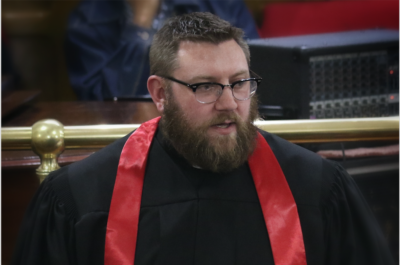 JEFFREY A. SCHOOLEY has just celebrated his one-year anniversary of returning home to Ohio. Naturally, he can’t help himself and regularly makes comparisons between himself and LeBron James (though with no interest in moving to Los Angeles!). For a full list of the 38 ways they are the same (or for other, more constructive reasons), you can contact him at [email protected].