
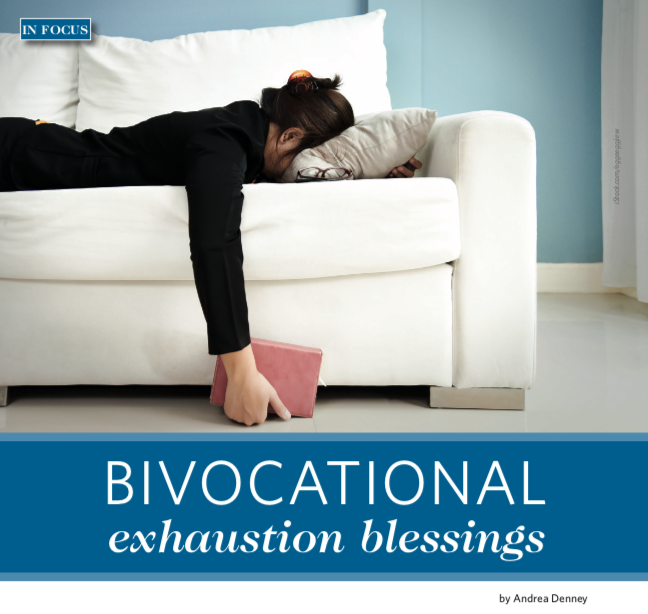
It started simply enough: I would take a couple of seminary classes and if I liked them, I’d take a couple more. I already had a full-time job as a vice president of finance and operations, was parenting three children who were seven, five and two — plus I was serving on our church’s governing board, was a youth group leader and coached my daughter’s softball team. The timing could not have been better. Thus began my journey toward bivocational ministry and perpetual exhaustion.
I continued to work full-time throughout seminary and, obviously, I continued to parent. Eventually I had to give up my church board and youth group work. While I’ve always arranged a jam-packed schedule, seminary taught me to squeeze even more productive time into my days. I became masterful at 4:30 a.m. study sessions. I read textbooks as I commuted to my job downtown (by train — not while driving) and I figured out how to memorize Greek vocabulary words between innings of my son’s baseball games. There was no waking moment that wasn’t scheduled and productive. It was perfect preparation for bivocational ministry.
I’ve been the half-time pastor at Calvary United Protestant Church, a Presbyterian Church (U.S.A.) church in Park Forest, Illinois, for about two years now. I’ve changed my day job and am now a vice president for a mid-sized supply chain management company. My kids are 15, 13 and 10 and each continue to play multiple sports, are involved in school plays and need things like homework help, clean laundry and family dinners. And my partner is an elementary school principal — also a demanding and time-consuming career. We describe our family calendar as a Rubik’s Cube or maybe a Jenga game.
I am incredibly fortunate to pursue multiple things that I love, and yet that doesn’t mean there aren’t challenges. Sometimes we cannot solve the Rubik’s Cube and sometimes the Jenga pieces crash. I refuse to be one of those people who claim that we can have it all and do it all well. I don’t think we can — at least not all at the same time. There are many nights when I fall into bed proclaiming that I got my money’s worth out of the day and an equal number of nights wondering if it’s selfish of me to have so many plates spinning. Yet I cannot imagine winnowing my schedule. (For the record, giving up parenting and partnering is not on the table.) I still feel challenged and fulfilled by both ministry and business.
 When I arrived at Calvary, the congregation was already accustomed to functioning with part-time pastoral leadership. The pastors who came before me helped them transition to a congregation-led community. I walked into a system where people regularly check on our homebound and elderly members. They speak to them almost daily, deliver meals and take them to appointments. During worship one Sunday, when a visitor stood up during prayers of the people and described how leaving a violent relationship had rendered her homeless, several members mobilized to find her a bed at a shelter, procured clothing and offered to take her to lunch — all before I said the benediction. They organize themselves to handle special projects and take care of the building and grounds. When I show up on Sunday morning, I often find things like a new flowerbed has been put in, handmade bluebird feeders have been placed around the yard and the community garden has been planted.
One Sunday each month the worship planning team takes full leadership of our brunch church. They select the theme, write the liturgy and lead the discussion. The mission committee does research and suggests projects to support. They organize giving campaigns and activities. And, this all happens whether or not I show up. I call them a DIY congregation (do-it-yourself).
Last summer we decided to offer free community cookouts every Sunday evening. Through a network of phone calls (none made by me), people volunteered to provide all the food each week. We took turns grilling burgers and brats. When someone discovered ground beef on sale at the neighborhood grocery, the call went out and our congregation descended to stock up on supplies for the rest of the summer’s cookouts. One of our folks was highly skeptical of the program and voiced her concerns. But she showed up each week to visit with our guests and to wash the dishes. By the end of the summer, she asked to be on the planning committee. This is the ethos of this congregation. We are all partners in ministry.
During session meetings we routinely discuss the best way to utilize my time and efforts. They worry when they think I’m spending too many hours on church work or if they think my family is suffering from my absence. As a group we discuss what they need from a pastor. They ask, “What are the things that a pastor does that none of us can do?”
Yet I often worry that I am falling short of what the congregation and community needs. In seminary I dreamt of sitting with family members during surgeries, of leisurely pastoral calls and deep involvement in the community. Instead I often spend my lunchtime making pastoral care phone calls. I text prayers to people before surgery. When a family is planning a funeral, I explain that it has to be on a Saturday or we have to find a different minister to cover. I just don’t have enough vacation time from my day job to accommodate weekday events. It feels as if I often miss out on the sacred moments.
While my congregation understands bivocational restrictions, I’ve found that the presbytery is still finding its way. When I was elected to serve on a committee, I explained that I could meet any evening of the week, all day on Saturday or on Sunday afternoons. The meetings were set for Thursdays at 9 a.m. When I protested, I was asked if this was the right time for me to serve. I appealed and thankfully we have negotiated to have half of our meetings by videoconference and the other half will begin no earlier than 6 p.m. on weekdays. Since half of our presbytery meetings are on Tuesdays, I have to use vacation time to attend. I realize that for others, a Saturday presbytery meeting means sacrificing time with their families. No time is ideal for all. I’m thankful that people are willing to have the conversations about how we manage our time.
My business colleagues find my pastoring gig to be an endearing, if somewhat puzzling, hobby. On Ash Wednesday I changed into my clerical collar before leaving the office. With rush hour traffic, I knew that I would have to race to arrive at church before the service was scheduled to begin. On the way to my car, one of my colleagues stopped me and asked for ashes. She explained that with her jam-packed schedule, she couldn’t make it to her church for worship. Of course I obliged — I understand jam-packed. It would be absurd to think that it doesn’t change your working relationship when you’ve looked into your colleague’s eyes and said: “From dust you came and to dust you shall return. In the meantime live as one beloved of God.”
In the safety of my business office, people have shared their health scares, family drama and mental illness challenges with me. They have asked me to pray for their children. I listen and I hold space, but I also know that I cannot be both their pastor and their manager. I often wrestle with what it means to hold that line.
I am in the unique position to preach about the need for a living wage on Sunday and work to make it so in my workplace on Monday. Each morning when I drive into the parking lot, I pray that I treat each person as the beloved of God and approach each situation with grace and kindness. I work in a fast-paced, high-stress environment. There are many days when I have to admit: “Well God, that didn’t go as planned! Forgive me and give me the courage, compassion and wisdom to try again.” I diligently work toward a more grace-filled, just and compassionate work environment but that does not always feel in alignment with corporate culture.
 My church crowd often asks me if I will eventually quit my business job. The most honest answer I can give is, “I’m not sure.” Right now it seems like I’m supposed to be doing both business and vocational ministry. Part of the reason is financial. My small congregation pays me half of the presbytery minimum. Still, my salary is the largest line item in the budget. We have 65 members and regularly worship with 45. Financially they could not sustain a full-time pastor and I could not sustain my family with the half-time pastor’s salary. My business job is financially necessary. Even if I served a larger church, I’m not sure I could give up business. I love the fast pace, I love working with teams to solve insurmountable problems and, truth be told, I love swimming upstream. I get a special thrill when during business budget meetings I ask questions like, “Why don’t our hourly wage workers deserve a living wage?”
I also struggle to keep my business sense in check during church budget meetings. This year when our pledges were short of our expenses, I suggested we begin looking for deeper cuts. One of the session members reminded me of God’s faithfulness in the community. He suggested that I have a little faith. I inwardly bristled at the unrealistic suggestion for managing a budget and imagined saying something like that during a business discussion. That evening, the finance committee sent email notification that enough last minute pledges came in to cover the shortfall. I know that God is faithful, but pragmatically I am conditioned to make decisions on the facts before me.
Some of my days are so completely disparate that it borders on ridiculous. One day last week, after my pre-dawn exegesis, I helped my daughter find her lost shin guard for her soccer game and avoided her meltdown. I fought rush hour traffic and was at my desk by 7:30 a.m. I had eight meetings scheduled for the day, including one with our human resources department to push them on whether we recognized racial bias in our hiring procedures and could make steps to approve our practices and evaluations. During lunch I had a phone call with one of the women from church who is planning our congregation’s 60th anniversary celebration then I put the finishing touches on the mailing list for the event. After I finished work, I headed to a soccer game. During the drive to the field I confirmed the rehearsal details for an upcoming wedding that I was to officiate. Between halves of the soccer game I worked on liturgy for Sunday’s worship. Then I headed home for a late family dinner and to recap the day with my partner and my kids.
The church work makes me a better business person and my business sense makes me a better pastor. I still get up at 4:30 a.m. to work on sermons and I am constantly trying to find ways to cram more into each day. Each night I fall into bed wondering if I have done enough. It may be delirious exhaustion, but I have to wonder if I have made the most of the hours I’ve been given. Does my family have enough of me? Am I a good business person and am I faithful to my ordination vows? Am I the pastor the congregation needs? Am I working for justice in our community? I never quite figure out the answer — mostly because as I am counting the blessings of the day, I fall into a deep, deep sleep.
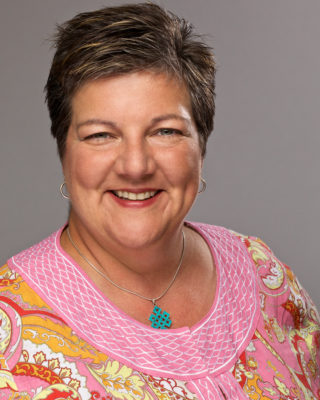 Andrea Denney is stretching the definition of bivocational to its absolute maximum threshold. She is a vice president at a supply chain management company, a part-time pastor at a Presbyterian church in the south suburbs of Chicago, a full-time mother to three very active children and fully present to her partner of 30 years. In her “spare time” she enjoys riding around town on her bright red scooter while wearing her clerical collar because it’s a hoot to watch people’s response.