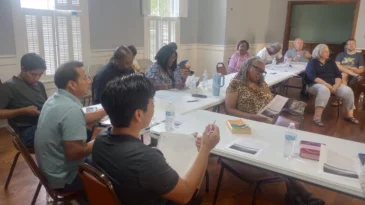
LOUISVILLE – The Moving Forward Implementation Commission is beginning to get a sense of the territory in which it’ll be working until the next General Assembly – somewhat familiar landscape, but with new challenges as well.
Some of this work involves monitoring to make sure that what the 2018 General Assembly instructed be done actually comes to pass – for example, to significantly expand translation of materials in the Presbyterian Church (U.S.A.) into languages other than English.
“Access is power,” said Julie Cox, a mid council executive from South Carolina who is leading a task force on translation services on behalf of the Presbyterian Church (U.S.A.), A Corporation – the corporate entity for the Office of the General Assembly and the Presbyterian Agency – and who joined the commission via conference call to discuss the work, just getting started. “I am wearing my necklace that says ‘Hope,’ on purpose,” Cox said.
Part of the commission’s work will be collaborative, working closely with the A Corporation board, the 2020 Vision Team and leaders of the six PC(USA) agencies.
There is likely to be generative work as well – with the commission possibly drafting recommendations to the 2020 General Assembly in Baltimore, and establishing a Vision Team in the PC(USA) structure that is responsible for “shepherding ongoing discernment work,” as the General Assembly action states.
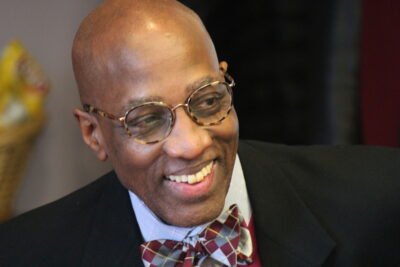
“This is going to be some heavy lifting,” the denomination’s stated clerk, J. Herbert Nelson, told the commission on the first day of its Jan. 14-15 meeting in Louisville, the commission’s first in-person meeting. Nelson spoke of the transformational work that’s needed in the PC(USA), saying the national church needs to be willing to try new things and fail, to lead the way for transformational ministry that responds to the needs in particular contexts.
“We don’t totally know what the future of the church will look like, because the world is changing every day,” Nelson said. On a trip to the border in McAllen, Texas, in December, he met asylum seekers who’ve been waiting for weeks on the bridges to enter the U.S., sleeping on the concrete. “I’ve never seen anything like that in my life,” Nelson said, with the U.S. government setting policy designed to keep most asylum seekers out.
For the commission, “this is not just a nuts-and-bolts, fix the church at the national level” kind of initiative, he said. “I don’t want us to take ourselves too seriously around this table. The world is not in this building,” but in the ministry being done in mid councils and local communities, including in places where immigrants from around the world are changing the ways Presbyterians do church.
Some ask questions, for example, about property – including whether the denomination should keep it headquarters building in downtown Louisville. Nelson spoke of the building being used as a training center and a place of worship, a church in the middle of a neighborhood of hotels and bourbon distilleries, a building “not of cubicles and desks” but “a place that trains and transforms and gives life,” becoming involved in local issues such as homelessness and an enduring racial gap in school performance.
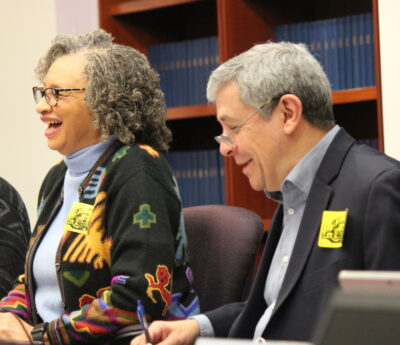
“This commission is more than doing the technical work,” said Debra Avery, a commission member and minister from California. “Our job is to move forward not just the letter of the law but the spirit of the law that was voted on” at the assembly, playing a role in shifting the PC(USA) “into totally new waters.” Nelson challenged the church, she said, to be a “lightning rod for transformative change.”
There is, however, an inherently detail-oriented focus to the work being done as well. For example, the commission went into closed session with the co-moderators of the PC(USA), A Corporation board (Bridget-Anne Hampden and Chris Mason, who participated via conference call) to discuss changes the A Corporation board is expected to announce Jan. 16 in the structure for how the denomination delivers administrative services such as payroll and information technology.
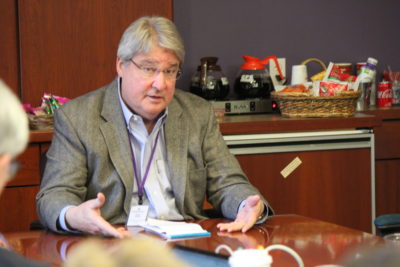
Mike Miller, the chief financial officer for the A Corporation, told the commission he expects that announcement to describe which departments will constitute the A Corporation, and will be responsible for providing administrative services for denominational agencies.
There are still questions to be resolved. The A Corporation, for example, does not technically have a budget for 2019 and 2020, as the General Assembly already has approved the per capita budget for the Office of the General Assembly and the mission budget for the Presbyterian Mission Agency.
Nelson said he expects to release an opinion soon about whether the commission has the power to change the Manual of Operations – whether that’s in the scope of the commission’s authority, and if so might give the commission the power to make budgetary realignments before the 2020 assembly convenes.
Miller said he’s been having conversations with representatives from the Presbyterian Mission Agency and the Office of the General Assembly about the fee structure for providing administrative services – something that’s been less than transparent and somewhat of a sticking point in the past.
“At the staff level, there’s a lot of passion and compassion and a willingness to make this work,” Miller said, saying he wants to build more collaborative approaches on issues such as setting administrative fees or establishing processes for making grants. Also underway is a review of existing policies, looking for ways to streamline and remove redundant or unnecessary policies. “We have a policy that you can’t ride a bike in the lobby,” Miller said.
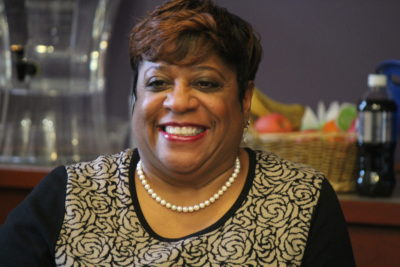
Diane Moffett, president and executive director of the Presbyterian Mission Agency, also spoke to the commission, saying “that we have an exciting vision,” focused on congregational vitality and combatting poverty and systemic racism. “We’ve got a lot of work to do,” Moffett said, and “we are moving forward with you.”
Kathy Francis, communications director for the Presbyterian Mission Agency, outlined work on which the communications directors from the six PC(USA) agencies are working collaboratively, including revamping the denomination’s website and developing a strategic communications plans.
Commission member Eric Beene, a pastor from Georgia, asked Moffett about “the feeling in the building,” at the PC(USA)’s national offices. Moffett described the staff as hard-working and committed, and on the path to healing. “God is at work in this place,” she said.
Much of the work that the 2018 General Assembly mandated in response to recommendations from the Way Forward Commission and All Agency Review Committee is in somewhat early stages. A new Diverse Voices Table, for example, with representation from the six PC(USA) agencies and from Presbyterian Women, is expected to hold its first meeting in late January.
It’s expected that committees the assembly asked to be created to examine the financial sustainability of the denomination and the per capita system will be combined into one entity, commission members said – they’re waiting to hear more details from assembly co-moderators Cindy Kohlmann and Vilmarie Cintrón-Olivieri on that.
“Those are two distinct and different issues,” said Jo Stewart, a ruling elder from North Carolina. “We want to see how that’s going to work with one committee,” and how the commission will interact with that entity. Another question: will the committee conducting a financial sustainability self-study, which is due by the end of 2019, make recommendations to the 2020 assembly as well?
While appreciating the upbeat nature of the reports from the denominational leaders, some commission members also raised a bit of skepticism about “what did we not hear,” as Cliff Lyda, a minster from Florida, put it.
The commission’s meeting will conclude Jan. 15, after discussion to identify next steps and future meeting dates.