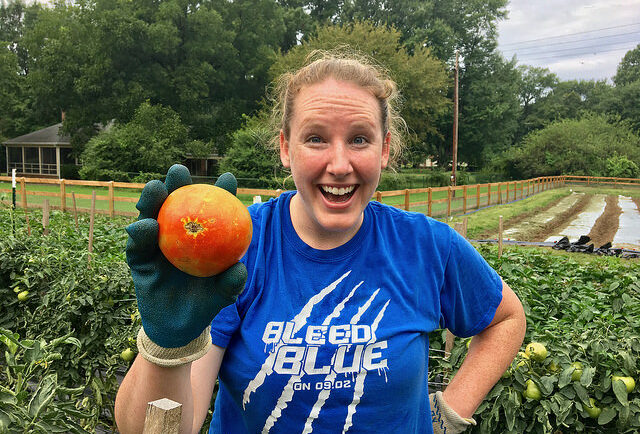
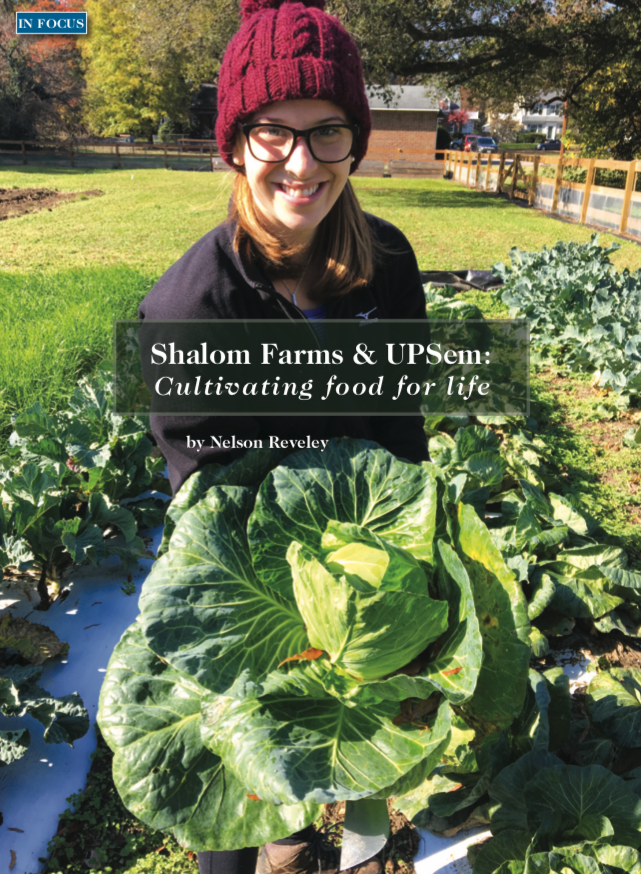
Since the late spring of 2017, five acres of Union Presbyterian Seminary’s (UPSem) land has been under the care and cultivation of Shalom Farms, a nonprofit dedicated to helping address issues of food justice in Richmond, Virginia. The seminary leases this land to Shalom Farms rent-free in a partnership that enables each organization to pursue its own mission in new and generative ways. The roots of this collaboration stretch back to early 2015 when UPSem’s president, Brian Blount, and Shalom Farms’ executive director, Dominic Barrett, began having informal conversations about the possibility of Shalom Farms using some of the seminary’s land to grow food. As a seminary alumnus and Shalom Farms volunteer, I helped spur these conversations.
 “We had long wanted to have a significant agricultural presence and operation somewhere in the heart of the city, but only if we could find land and an arrangement that met several key factors,” recalled Barrett. “We wanted a large plot, good soil, a medium-long-term free lease, in a central location, within a neighborhood that saw value in such a venture. That’s a lot to ask, but we found all those possible components in this plot of land at the seminary. Adding in the fact that UPSem would not simply be a friendly landlord but a deep and committed partner made this a no-brainer from our end.”
Blount added: “Faculty, students and staff were excited as soon as they heard about a potential partnership between the seminary and Shalom Farms. For years, we have been interested in strengthening relationships between the seminary and the Richmond community through service projects and justice initiatives. Given the seminary’s curricular and institutional focus on the mission and ministry of the church in the world, everyone at UPSem felt that the conversation with Dominic and the resulting agreement to build the farm were directed by God’s providence.”
Growing food and theological education might seem to live in completely separate missional and institutional silos, but they harbor enormous synergistic potential. At a basic level, in addition to being essential to life, food sits at the core of human relationships with God, one another and the rest of creation. In his book, “Food for Life: The Spirituality and Ethics of Eating,” Shannon Jung argues: “It is essential to notice that God creates in such a way that all beings are given food. … Food and all life, then, are created good, and the whole of creation works together to make for the good of each.” Jung further affirms: “[Eating] is how the world enters into us and how we become part of the world. … Food is revelatory of the goodness and joy of the earth; it is also how we come to taste the language of grace and love; it is how we come to know community.”
Given these connections, food provides fertile ground for engaging a variety of issues, including:
- Human health (physical, as well as psychological);
- Justice (equitable access to nutritious food, as well as fair trade, living wages and safe working conditions);
- Friendship (table fellowship within and across communities and cultures, along with shared commitment to the common good);
- Environmental stewardship (reduction of pollution as well as reliance on exhaustible resources); and
- Animal welfare (minimizing suffering).
These intersecting issues afford unique entry points for theological reflection regarding creation, goodness, theodicy, spiritual discipline, death, resurrection, worship, work, culture and recreation. Furthermore, growing food grants hands-on insights into the patient agricultural processes that permeate the world and imagery of Scripture, along with the vast majority of human history and culture.
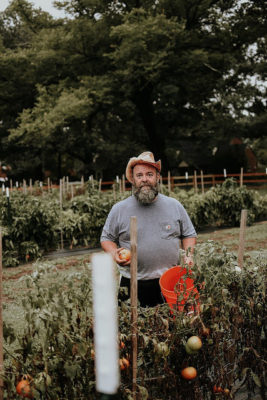 A focus on food justice also raises broader topics regarding public policy, sustainability, economics, transportation, development, housing and healthcare. As such, having the farm on the seminary’s land allows UPSem students the chance to engage not only Shalom Farms’ work, but also the network of issues, nonprofits and community groups seeking equity and justice in Richmond. While the connections on these fronts in seminary courses and internships are just beginning to develop, the opportunities are extensive and provide a dynamic way of living into UPSem’s mission “to equip Christian leaders for ministry in the world” through “deep learning, commitment to service, and an ability to read culture and circumstance in the light of the rich resources of Scripture and theological tradition.”
Highlighting the potential links, Barrett noted: “That a seminary would be interested in having an agricultural enterprise on its campus makes perfect sense to me, just like a public university wanting to have a quality lab space for its researchers and students. Agriculture is informed by and has implications for all aspects of our lives. As Ellen Davis writes in ‘Scripture, Culture, and Agriculture: An Agrarian Reading of the Bible’: ‘Sound agricultural practice depends upon knowledge that is at one and the same time chemical and biological, economic, cultural, philosophical and (following the understanding of most farms in most places and times) religious. Agriculture involves questions of value and therefore moral choice whether or not we care to admit it.’ ”
This city-site similarly enables Shalom Farms a unique opportunity to advance its mission “work[ing] with communities to ensure access to healthy food and the support to lead healthy lives.” With a quarter of the city’s population living at or below the poverty line and huge sections of the city lacking a grocery store in close proximity, thousands in Richmond do not have easy access to healthy food. While eating nutritiously is something with which Americans across socioeconomic lines struggle, it is especially difficult to do so when one has to deal with significant geographic and financial barriers to fresh produce. That lack of access often leads to unfamiliarity with vegetables and tasty ways to prepare them, creating additional barriers.
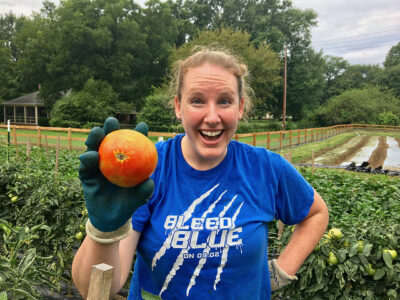
Shalom Farms has been working for a decade to help address these kinds of obstacles to healthy eating. In 2008, United Methodist Urban Ministries of Richmond launched Shalom Farms on about 10 acres of Camp Westview on the James (about 30 miles west of Richmond) as a way to “use Westview’s rural resources to better serve urban Richmond.” Through the hard work of staff and volunteers, Shalom Farms grew 542,277 servings in 2017, and this food is presently distributed to roughly 75 partners throughout the Richmond metropolitan area. In 2017, Shalom Farms moved to a larger rural farm site closer to but still outside the city. Between that move and the addition of the farm, it has been a busy few years for Shalom Farms. But through the help of many volunteers and educational groups, Shalom Farms was able to grow an additional 25,000 servings of fresh produce on the first cultivated acre of the new farm-site at the seminary. According to the farm’s manager, Katharine Wilson, “The produce harvested in this first pilot year was primarily distributed on our Grown to Go Community Mobile Market and to FeedMore.” Wilson further highlighted: “We are very lucky to have such supportive Northside neighbors. Two-thirds of the volunteers on Westwood Farm came from the adjacent neighborhoods, Union Presbyterian Seminary, Northside schools and community members who use the walking trail next to the farm. We are incredibly grateful for their support and help on the farm this first season.”
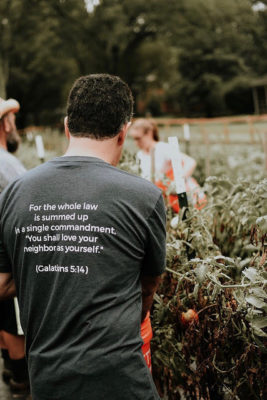 Two keys to this collaboration have been patience and trust cultivated through clear and regular communication and relationship building. The proposal took a year of development to get before UPSem’s board of trustees for a vote, a process that included many conversations from Shalom Farms with surrounding community members and organizational partners in addition to seminary staff, faculty and students. The lease took another year of friendly negotiations between the seminary and Shalom Farms before it was finalized and signed. Then Shalom Farms needed a year to build up plans, hire staff and start soil preparation to begin planting its first acre in 2018. The second phase of planting on remaining portions, as well as raising funds and building plans for simple farm-related structures, will likewise take another year to complete. Patience around steady progress has proven a virtue.
Another core aspect to this partnership’s success has been the freedom to think creatively about ways to best partner. Blount highlighted, “Because seminary faculty, staff and students were well aware of the farming success that Shalom Farms has achieved across the years at its former Goochland farm site, UPSem encouraged Dominic and his team to build from their experience and think as creatively as possible about ways to develop this unique urban site and enrich its land for food production.” Noting the complementary mix of expertise and resources between the seminary and Shalom, Blount added: “UPSem has available, fertile land. Shalom Farms has the expertise to cultivate land. And between the seminary and the Northside Richmond community, there are vast numbers of volunteers eager to support the work and mission of the farm. Dare I say it — it has seemed from the very start like a match made in heaven.”
Barrett concurred: “This partnership has worked so well for a number of reasons. From a practical perspective, UPSem has given us the autonomy and freedom we need to be successful without asking for control or credit. But ultimately, I think it has worked because we can each clearly see how the partnership benefits our own interests, the interests of the other, and the shared interest of building more healthy, just and regenerative communities.”
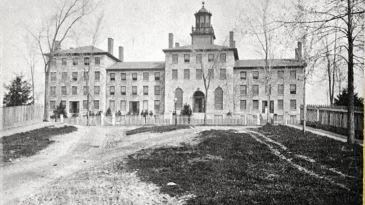
The location of the farm on the seminary’s land also has deep meaning given the history, demographics and ethical pull of this particular place in Northside Richmond. UPSem’s Richmond campus dates back to 1898, when the seminary moved from southside Virginia to be near the city, where its resources could be better utilized and its students could be better prepared as pastors. Seminary president W.W. Moore, who served the seminary from 1883 to 1926 and was instrumental in moving the seminary from Hampden-Sydney to Richmond, recognized how a more urban context could provide seminary students with broader community and practical ministry opportunities. In an 1892 report to the seminary’s board, he noted that being far from a city-setting prevented the seminary from embracing “the vital importance of planting our principal training school for ministers in some center of population and business influence, where its property would accumulate and increase rapidly in value, where its accessibility and metropolitan advantages would command a much larger patronage, [and] where the best methods of Christian work could be seen in actual operation.” Moore continued, “The church cannot afford to ignore the concentration of modern life and influence in the cities.” In this farming effort, the Christian mission to be in and for the world is being realized. In this particular way, UPSem of 2018 is bearing new fruit within the vision of Union Theological Seminary of 1898.
 While UPSem now sits squarely in Northside Richmond, the area at the time was still largely countryside, lying over a mile from the city limits and its busy markets, factories and neighborhoods. With the streetcar transportation revolution, the area around the seminary increasingly developed as a suburb. It was annexed by the city in 1914, but as the 20th century progressed, the next transportation shift, personal cars combined with public interstates, paired with white flight from de jure desegregation led to the creation of new suburbs, school systems and ultimately job and shopping centers beyond the city limits. For the last half-century the seminary has lived along the line that broadly separates east and west Richmond, with heavier concentrations of poverty to the east and far greater concentrations of wealth and white residents to the west.
This is a place in Richmond that harbors symbolic and geographic potential for connection across traditional lines of division to promote equitable flourishing. At a basic level, the question “Why doesn’t everyone have access to nutritious food?” simultaneously demands sharp theological analysis and committed moral action regarding broader, systematic issues of justice in Richmond — from access to employment, transportation, quality education and healthcare, to neighborhood affordability, economic development and racial reconciliation. For Richmond, like so many American cities, it remains imperative for people of faith to engage issues of race, class and opportunity and bring institutional resources to bear so that everyone can flourish as God intends. The seminary and Shalom Farms seek to be partners in this work.
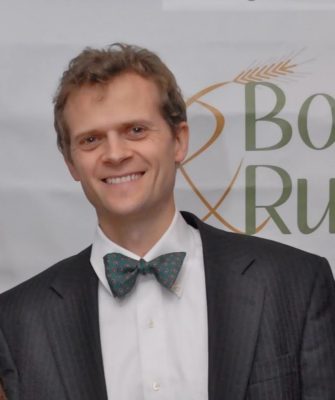 Nelson Reveley is parish associate at Grace Covenant Presbyterian Church in Richmond, Virginia. He is a UPSem alumnus and Shalom Farms volunteer, and currently engaged in advocacy work regarding job access, housing and public transportation.