LOUISVILLE – What assumptions do we make about poverty? As in:
People are to blame for their own poverty. It’s their fault.
Poor people grew up in a subculture of poverty. It’s not their fault.
Poor people live in the ghetto. They live in rural America. Not here.
Poverty is triggered by cyclical events: by the auto plant closing, the flood, the hurricane, the impact of war – things outside our control.
The poor will always be with us.
The Presbyterian Mission Agency is concentrating its mission focus on three things: congregational vitality, dismantling structural racism and eradicating systemic poverty. On March 28, the Presbyterian Mission Agency Board spent about two hours of its spring meeting talking about poverty and injustice — learning some of what the Presbyterian Church (U.S.A.) is doing to confront poverty and what Presbyterians need to do differently if they want to make an impact.
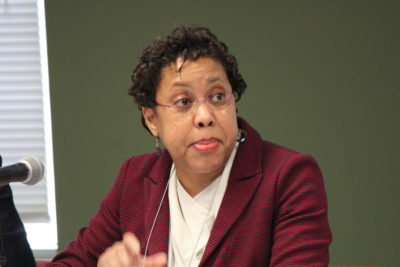
“We need to address the root cause of poverty,” said Rhashell Hunter, director of Racial Equity and Women’s Intercultural Ministries. “We’ve been writing checks and giving food out for a long time.”
Also, when there’s structural injustice, equality is not the same as equity, she said. “Sometimes equality actually reinforces privilege.”
And “nobody in this room made it by themselves,” Hunter said. “We assume we pull ourselves up by our bootstraps, because we buy that. And it’s not true.”
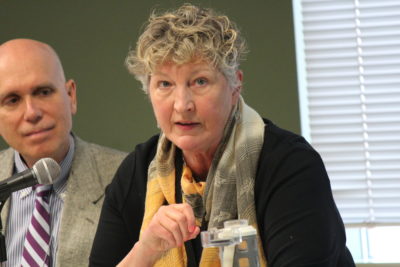
Leaders of the Presbyterian Mission Agency’s ministry areas started the discussion sharing stories. For example, Sara Lisherness, director of Compassion, Peace and Justice, described the work the West Africa Initiative is doing to help communities in Sierra Leone and Liberia devastated by civil war that killed 250,000 and displaced 2.5 million people, many of them women and children. “The war ruined the economy,” left young people without education, jobs or hope, Lisherness said.
The West Africa Initiative – involved in rebuilding communities affected by the conflict – has over the last decade provided leadership training that has helped people increase agricultural production, afford school fees for their children and respond to the Ebola crisis. The response highlighted important components of such justice work, Lisherness said – including partnership, collaboration and a focus on systemic issues.
Many of the 1001 New Worshipping Communities in the Presbyterian Church (U.S.A.) are finding ways to connect faith and justice – such as the Ebenezer Church in San Diego, where people are working in partnership with local schools to disrupt generational poverty among the poor and immigrants in the Linda Vista community, said Ray Jones, acting director of Theology, Formation and Evangelism.
Change comes in many ways, including “through the power of the Holy Spirit working in communities … to break the hearts of people,” Jones said. “To literally break the hearts of people, so that as our hearts break we begin wake up. … We become a woke people,” and through that “our faith communities begin to change, and so do our churches.”
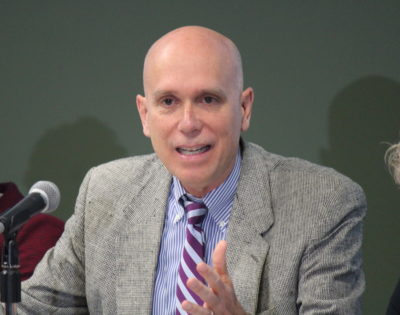
A tension that comes with that: “We want all our churches to be compassionate, we truly do,” Jones said. “But we don’t want it to just stay with compassion. We have to be partners” with those in the community who understand poverty. “We’ve got to be partners with people who are poor” and with those working “to disrupt the systems that hold people captive.” How can churches move beyond compassion “to engaging with organizations that are going to bring down the systems and transform the systems” that hold people captive?
José Luis Casal, director of World Mission, encouraged Presbyterians to support the Café Justo coffee cooperative in Chiapas, Mexico – not to keep filling their cups at Starbucks. In the poorest region of the country, Café Justo helps farmers grow, harvest, roast and sell their coffee for a fair price, Casal said.
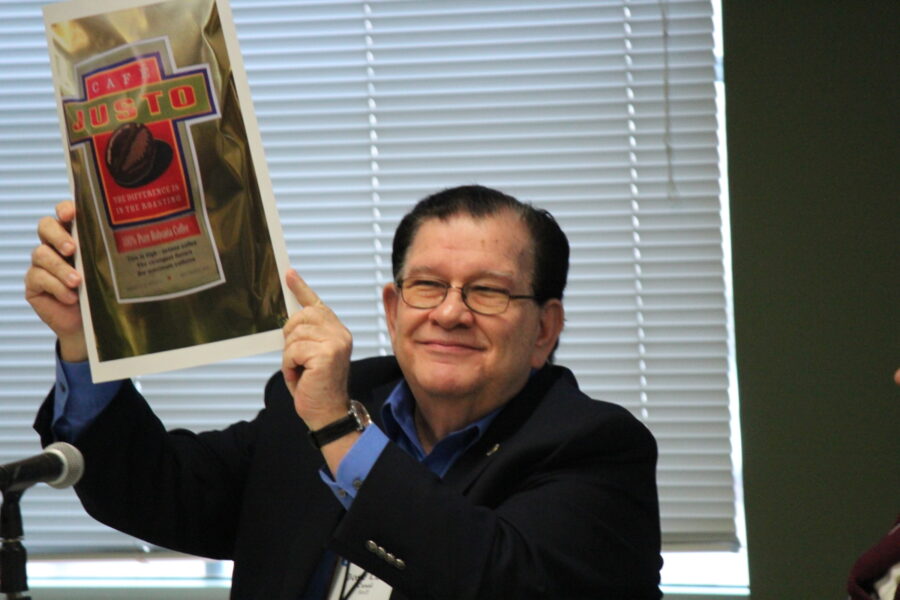
Support has to come in practical ways, not just words, Casal said. Through Café Justo, the coffee farmers know that “somebody heard our cry and saw the oppression in which we live. Somebody came to us to not give charity but practice solidarity with us, that is completely with us. Charity is the check. Solidarity is the presence and the accompaniment,” an ongoing partnership, not coming for “one week to paint the houses.”
Some also spoke of PMA’s new Matthew 25 campaign, which is being rolled out April 1 with a new website, advertising blitz and more.
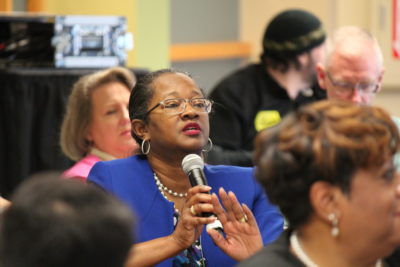
In his decades in the church, “I’veexperienced us change priorities on a regular basis,” Jones said. “They’re all good priorities.” But with the Matthew 25 program, “it’s got to saturate our lives and the lives of our churches and the lives of people in our communities. It can’t be a two to four year priority, and we move on to the next best thing. Somehow we’ve got to make a commitment that we’re going to stick with the priorities and work them.”
How to measure success?
Board member Patsy Smith of Oklahoma spoke of continuity in General Assembly priorities on a task as massive and complex as eradicating poverty – asking when the pattern of “getting swung back and forth as a pendulum from issue to issue will cease.”
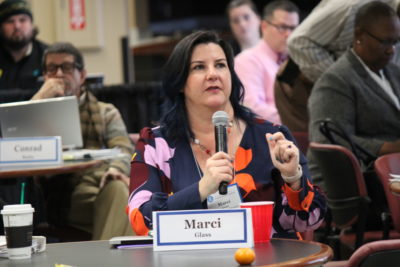
Marci Glass, a minister from Idaho, said success involves connection.
“We’ve learned to do mission without relationship,” without being in conversation with those we’re trying to help, Glass said. Success is “us not seeing mission as something we’re doing for somebody else,” but understanding that “if somebody else is poor, we’re poor as well.”
And the hardest question came from a new ecumenical representative to the board, Yvette Noble-Bloomfield, from the United Church in Jamaica and the Cayman Islands.
“As a denomination, how credible is your voice to speak against poverty?” Noble-Bloomfield asked.
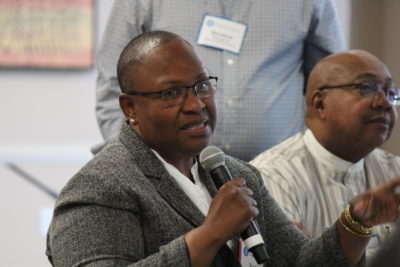
The board has been meeting in the Brown Hotel in downtown Louisville – and Noble-Bloomfield said she’d read on a brochure at the hotel the previous day that to enter the English Grille restaurant there, she had to dress a certain way. She walked to one of Louisville’s bridges, and thought of how those sleeping under the bridges could not enter the restaurant.
And when she saw that the board was holding a session on eradicating poverty, “I thought maybe a couple of people from under the bridge were coming,” Noble-Bloomfield said. “Now don’t throw me out yet. … I commend you seriously for even thinking about the poor” and creating a new focus on being a Matthew 25 church.
“I also challenge the reality when most of us may never know what it means to sleep under the bridge. Until we can feel what it’s like under the bridge, we might be challenged a little bit to really confront the powers that be about poverty.”