Guest commentary by Lara Hauser
What does grief have to do with stewardship and giving? They seem like pretty disparate subjects, but I find them to be deeply intertwined. In many churches, stewardship season is a time to talk about gratitude and generosity. I may be unique, but I think it is a good time to talk about grief as well, because, as a widow, I think it is always a good time to talk about grief. And I’d like to make a case that grief and gratitude can go hand in hand.
Last fall, our church offered a class on the theology of wealth. It was a really good class, taught by a gifted instructor and, like all good teachers, he asked provocative questions that refused to leave me alone. One question in particular really stuck with me: “What does how you live say about your theology?”
The question lingered in my mind, insisting on my attention. Another way to phrase that might be: What defines your life? What will people think about or talk about when your name comes up?
It would be easy for my defining characteristic to be grief. My husband, Scott, endured a brief, fierce and fairly public cancer illness and died in February 2017. He was the pastor at a large church, Crossroads Presbyterian in Mequon, Wisconsin, when he died. He was only 18 months into his tenure and much beloved; his death was shocking and traumatic for the whole church community. I am certainly not alone in grieving Scott.
Grief is a big part of my life. It’s a big part of the life of that congregation, where my children and I have continued to attend. That doesn’t make me unique, nor does it make Crossroads unique. Grief is a part of every church. It’s just a little closer to the surface at Crossroads.
Grief is not something our culture does well — not our secular culture, and often not our church culture. It’s understandable. Grief is hard. Grief is scary. And grief is not well understood. It’s not uncommon to think of grief as the opposite of happiness, but I disagree. Grief is the acute sense of absence, the acknowledgment of scarcity, the longing for something that is missing.
I’m OK with grief being a defining characteristic in my life, because I think that how we choose to grieve can tell an important story about what we believe. Grief, maybe better than almost anything, can expose our true theology, can reveal what we really, deeply hold to be true about God and God’s love for us and how we are to respond to that love.
I’m OK with grief being a defining characteristic because I don’t want to deny grief — to do so would be to deny the absence, the scarcity, the importance of what was, but is now gone. I don’t want to deny grief, but I do want to hold it in tension with its true opposite: gratitude.
Gratitude is the acute sense of presence, the acknowledgment of abundance, the joyful response to God’s gifts.
If I am defined by grief, in the same breath, I want to be defined by gratitude. Scott was defined by gratitude. If you knew him, then you know this to be true. Many people who encountered Scott, professionally or personally, received a thank you note from him. He made a point to offer thanks to and for his congregation in every letter he wrote for the weekly newsletter. He made a point to thank every person he came in contact with through his hospitalization, from the doctors to the nurses to the technicians and the people transported him to and from innumerable tests and procedures.
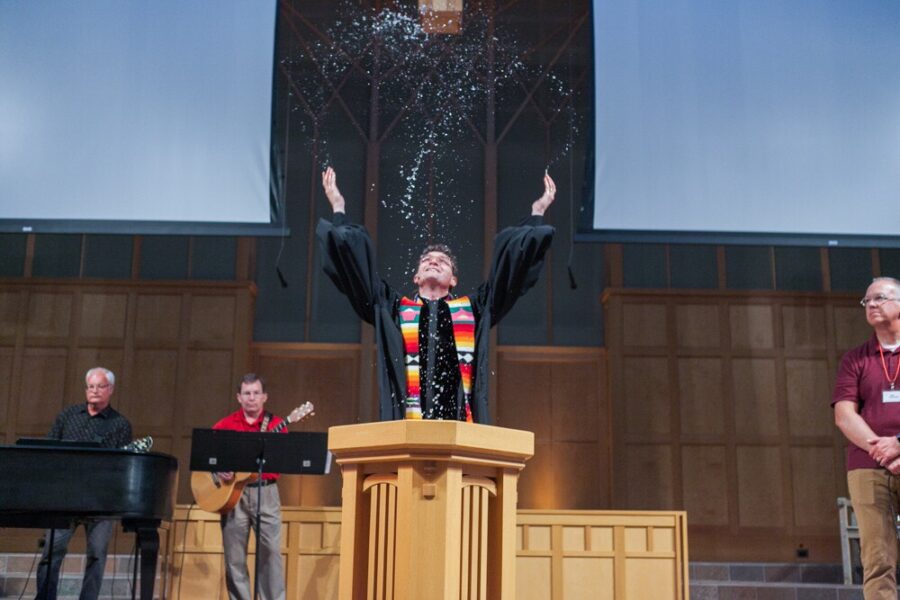
I love this photo. What a perfect picture of joyful acknowledgment of abundance! Throwing the baptismal waters was a playful thing for Scott — playfulness was a defining characteristic of his. But that playfulness, that deep joy you see there, came from a deep sense of the sweetness, the abundance of the gift of God’s grace for all of us.
I want gratitude to speak the loudest about what I believe. Even in grief, I am overwhelmed by the goodness and the abundance and the presence of God, shown to me in daily demonstrations of grace and support, both spiritual and material. The church – both Crossroads and the larger church – has been a conduit of that abundance. The people of God, who have filled our lives with love in action, have been the hands and feet of Jesus to me and to my kids as we have learned to live without Scott.
In my life, the people of God have been defined by generosity and grace and grief, all, as I have seen them come alongside me, and alongside each other in good times and hard times. I invite you to strive to be defined by gratitude as well. Let the way you live and give speak loudly to the world about what you believe about God’s sustaining grace and abundance even in grief.
 LARA HAUSER, a lifelong Presbyterian, lives in Mequon, Wisconsin with her four children and is a member of Crossroads Presbyterian Church. She is the widow of Scott Hauser and considers herself a “pastor’s wife emeritus.”