Revelation 22:12-14, 16-17, 20-21
Easter 7C
|
This week, we are grateful to guest contributor John Wurster for writing this week’s lectionary reflection.
|
Persistent grace.
By definition, subscribers to this list are interested in the lectionary. For many of us, I suspect it could be said that we are committed to the lectionary or perhaps even devoted to it. I appreciate how this calendar of biblical readings moves us through the Bible in a systematic way, helping us to hear more of the Bible than if the preacher simply made his or her own choices from week to week.
While the lectionary moves us through a lot of the Bible, it doesn’t move us through the whole Bible, and some of the selected passages are edited a bit. Occasionally, a verse is left out here and there. The difficult or the weird sections within a passage are sometimes dropped so that the passage might be read a bit more smoothly.
So it is in the lesson from Revelation 22. The lectionary would have us read verses 12-14, skip verse 15, read verses 16-17, skip verses 18-19, and then read verses 20-21. If we follow that recommendation, we have a Bible lesson that is relatively smooth and coherent, uncomplicated and uplifting.
What happens, though, if we are willing to modify our lectionary devotion and disregard the suggested edits so that we read the passage straight through from verse 12 to verse 21? We then find ourselves amidst hard and unsettling words about judgment, cautions to live righteously and warnings to attend carefully to all the words of this book. Including the recommended omissions makes the passage less smooth and more awkward. But the uncomfortable elements in the whole passage point us to the height, breadth and depth of the biblical witness, which covers comprehensively the range of human experience, motivations, and conditions.
We don’t do well to leave out the hard and unsettling words, mostly because we are not able to just skip over the hard and unsettling realities of life. Isn’t it good that the Bible includes all of these things? Isn’t this at least part of what makes Scripture holy and true? Look at all that is present in just this one passage: promise, yearning, evil, warning, fear, salvation, testimony, hope. Doesn’t that sound a lot like life the way we experience it? This passage is an even more uplifting text when the edited verses are included and the complications are acknowledged. More uplifting, more real, more true and more holy. After all, the gospel is not about some other world. It’s about this world, where Jesus came and walked and laughed and cried and bled and died. In Jesus, God has embraced the world in all of its complications.
For all the hard and unsettling words in this passage, for all of the cautions and the warnings, it is important to note that the last word in the passage is about grace: The grace of the Lord Jesus be with you. Indeed, the last word of the whole Bible is about grace. It’s not about our failings and our shortcomings and the things we did wrong or the words we didn’t get right or the actions we didn’t take. The last word is about grace. The grace of the Lord Jesus be with you. This is where the Bible ends up. This is the Big Finish. For all that the Bible is and for all that the Bible says, the last word is about grace.
When it’s all said and done, when the book of our lives has been written, what counts the most is not so much what we have done, but rather what God has done in Jesus Christ. As hard and as complicated and as unsettling as the story can be, whether it’s the Bible story or our own life story, the conclusion of that story rests in the hands of a God whose love for us has no boundary. It is a love stronger than death, stronger than our fears, stronger than our failures, stronger than our doubts. We don’t deserve it. We haven’t earned it. But this love seeks us out anyway. That’s what we mean by grace: God’s unmerited favor, bestowed on us in Jesus.
That the Bible should end with grace is not really surprising, since that’s how it begins in Genesis. In the beginning, when there is nothingness and darkness and chaos, God sets about creating and ordering the earth. Without any help from us, God graciously calls forth life and calls it good. From the Bible’s first page to its last page, from Alpha to Omega, grace persists.
Life, like the Bible, begins with grace and it ends with grace. And in between? Well, things can be complicated and unsettling, hard and painful, awkward and sorrowful. But the grace persists: in songs and smiles, in blue skies and bright flowers, in fresh opportunities and well-worn routines, in old friends and new companions, in water and word, in bread and wine, in sighs too deep for words, in peace that passes understanding, in a love that will not let us go. The grace persists, all the way to the end, and even beyond.
This week:
- How do you define grace? What has influenced your definition and understanding of grace?
- Where have you noticed signs of God’s grace recently in your life?
- What stories of grace in Scripture speak to you?
- How have you handled the “uncomfortable” verses in Scripture in preaching and study?What benefits have you found from spending time with passages or verses are that are easier to skip over?
- Jesus says that he is the “Alpha and Omega.” What does that mean for your faith?
- Why do you think unmerited, persistent grace lies at the heart of the Christian story?
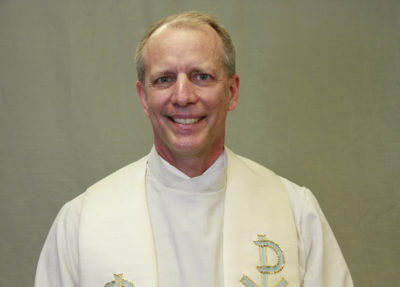 JOHN WURSTER is pastor of St. Philip Presbyterian Church in Houston.
Want to receive Looking into the Lectionary content in your inbox on Mondays? Click here to join our email list!