EL MONTE, California – With only about 70 students, International Theological Seminary in suburban Los Angeles doesn’t have an impressive campus, a big endowment or an affluent alumni base. It’s not a flashy seminary.
While relatively unknown, ITS is perched on the cutting edge of innovation for training church leaders from the global south – one of a number of small, relatively new seminaries that are in the United States, but whose focus is on educating students from other places. Many of those ITS students are mid-career in ministry from Africa or Asia – they already have a track record of leadership in their home countries, and are pursuing advanced theological education made affordable through forgivable loans.
During their seminary years, some students are building partnerships with California churches and entrepreneurs that will help them pursue innovative ministry initiatives once they return home, and which lay the foundation for ongoing ministry partnerships with U.S. congregations.
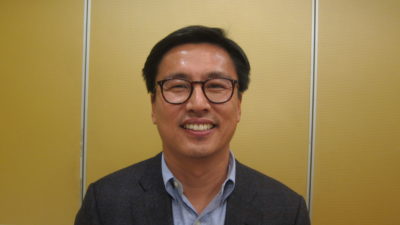
While not well known in broader Presbyterian circles, the seminary considers itself both Reformed and evangelical. Its president, James S. Lee, and the chair of its board of trustees, Jim Conner, are both Presbyterian Church (U.S.A.) ministers. Its students are beginning to connect with immigrant Presbyterian fellowships and congregations in the San Gabriel Valley.
And the seminary’s mission, according to Lee, has a big-picture perspective: “To raise local leaders for the majority world.”
ITS was founded in 1982 by a Korean-American pastor, John Eui-Whan Kim, who had a vision for starting a seminary for students from developing countries – students who after graduation could be theological leaders in their own settings. “Back then, the paradigm was training (American) people here and sending them to other countries as missionaries,” Lee said. But Kim had a sense that “the ultimate goal for mission work is training, empowering and raising up local leaders.”
At many U.S. seminaries, international students make up a relatively small percentage of the student body, and the focus often is on training for ministry in an American context. “It’s almost like they are invisible,” Lee said of those students.
At ITS, both the faculty and board are diverse and multicultural. Nearly all the students are international, coming from all over the global south – from Kenya, Indonesia, Thailand, Myanmar, India, Malawi and more, although relatively few from Latin America – with classes held in English, Korean and Mandarin. Under exploration: the idea of a distance-learning program in Arabic.
Most students receive financial aid to cover their tuition (grants that become forgivable loans if they serve in ministry in their home countries for five years after graduation), plus stipends to cover housing.
At ITS, “their whole financial system is set up so that the local indigenous churches will help send these people over, and as long as the students go back to their home churches, then their scholarship is waived,” said Wendy S. Tajima, executive presbyter of the Presbytery of San Gabriel. “So they’ve been able to get education for free, and they become really high-level leaders in their home churches,” rather than contributing to a brain drain by staying in the U.S.
 More than 1,000 alumni now serve around the world as Bible college presidents, denominational leaders, pastors, community leaders — as “agents of transformation turning their local communities into centers of mission, worship and justice,” Lee said.
When donors provide funding for forgivable loans, “they’re investing in someone who’s going to transform a community,” Conner said.
Having such a diverse student body can pose challenges — for example, in what language should chapel be held? The seminary tries to build a sense of inclusivity by having simultaneous translation at campus-wide events and by acknowledging the diversity — giving students chances to share the food and the traditions of their countries with others.
For financial reasons, many come without their families and live in on-campus dorms. “We have to be sensitive and we have to be compassionate to those students who are struggling financially,” Lee said.
But the diversity provides opportunities too — with students becoming exposed to many ways of looking at the Bible and creative approaches to doing ministry and practicing their faith. “When they come here, they really are free from all of these hierarchical and societal expectations” of their home cultures, Lee said. “Here, people don’t care what tribe you come from or what kind of education you have. You are respected for who you are.”
Entrepreneurial ministry
While at ITS, some students form connections with local congregations or entrepreneurs that lead to long-term mission partnerships down the road.
Conner, a Presbyterian minister who serves as chair of the ITS board, served as senior pastor of Arcadia Community Church until leaving that position in late 2018.
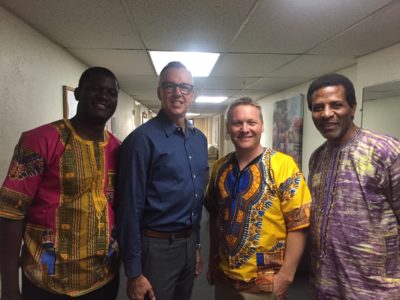
When he first arrived at Arcadia, the congregation was older and predominantly white. Now, as a reflection of the way immigration has transformed Los Angeles, those who attend the English-language service speak more than 30 languages, and Arcadia has birthed 10 churches or outreaches to serve immigrants — including Indonesian, Taiwanese, Arabic-speaking, Armenian, Filipino, Korean and Mandarin-speaking Chinese, with some of those daughter churches now beginning to start new congregations or fellowships on their own.
Along the way, Conner met students from ITS who started coming to Arcadia and sharing dreams of the ministry work they wanted to do when they returned home. At Arcadia, the ITS students asked for prayer for people and situations weighing on their hearts from home. Through prayer and conversation, relationships formed. “Now we are praying for people we know from these places,” Conner said.
When Conner’s daughter fell seriously ill and came close to death, the ITS students and their families and congregations back home prayed daily for her.
“The church was becoming multiethnic, the students were being welcomed,” Conner said. “It’s very hard traditionally to come to Los Angeles from Asia or Africa. LA is a cold place culturally. It’s very busy, it’s very rushed, and people don’t take time for you.”
At Arcadia, the students began making connections with church members who carry significant business, technical and entrepreneurial expertise. A model developed. The U.S. mentors get the students dreaming and talking about what they want to do in ministry — helping them hone and clarify their vision for ministry and community development projects that can support that work.
 Conner and others from ITS and Arcadia went to Africa with the students to learn more, build relationships, see the context, the needs and opportunities. “You need local ownership, and not outsiders coming in and doing stuff,” Conner said. “If you unleash people and let them run their show, it’s just amazing what they’ll do. … They’re passionate about it. It’s their heart. It’s what they think the Lord Jesus Christ has called them to do. They’ll find a way to get it done.”
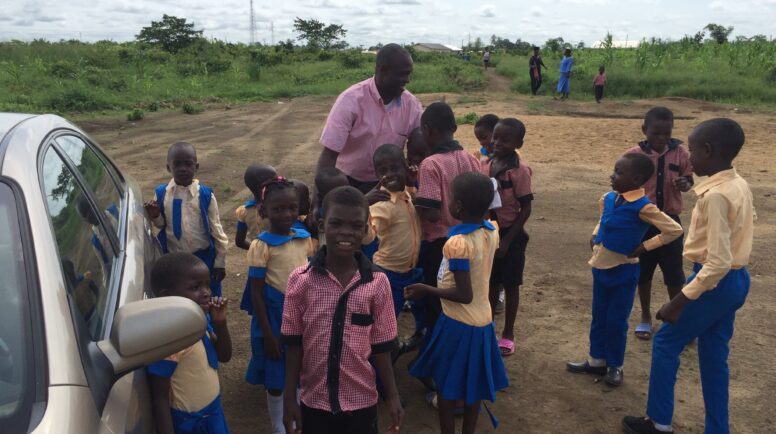
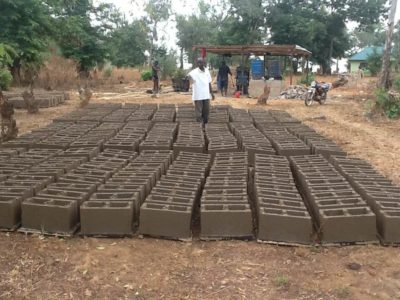
The Californians have provided financial and coaching resources for first steps —providing seed money for a school for polio victims in northern Nigeria, for example. A school at a military checkpoint in Cameroon, serving both Christians and Muslim children, started with two rooms.
If a student repays the initial investment, the money can be sunk back into new projects. “We don’t sustain them long-term,” Conner said. “The businesses and the business model will grow and sustain” with some front-end help.
Andrew Ngalle Junior, who earned a master of divinity degree from ITS, started Fountain of Hope Mission in a village near Tiko in Cameroon — working with orphans, widows and the elderly, including more than 140 children at a newly-constructed school. Fountain of Hope is a joint project with Arcadia (for example, Arcadia donated materials for the first school building, and local people built it), funded in part with revenue generated by a 25-acre cocoa and plantain farm.
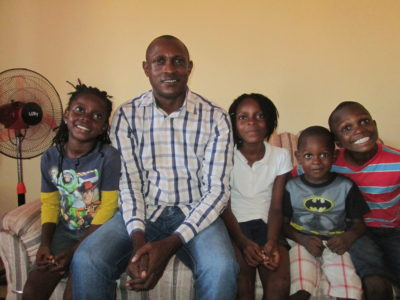
“The goal of what we are doing is to be able to support the ministry in a long-term basis, so that we won’t be dependent on funding from any other source,” Junior said in a video. “We invest in this land, just like we invest in the lives of the orphans, because with this, we will be able to transform lives. … We’ll be able to educate as many kids as we can.”
Using this type of model, ITS students have initiated
17 projects since 2014, all in Africa.
“The Presbyterian churches in Africa know about ITS, but the PC(USA) doesn’t, largely,” Conner said.
And the partnerships are growing — with conversations about what’s possible extending to the nearby Logos Evangelical Seminary, another internationally-focused seminary in El Monte, which draws students from China, Taiwan, Hong Kong and Malaysia.
Community connections
Bit by bit, ITS also is having an impact on Presbyterian churches in the Presbytery of San Gabriel.
The seminary currently rents space in El Monte, an area in the San Gabriel Valley with significant Latino and Asian populations. “Los Angeles is one of the most diverse cities in the United States,” Lee said. “There are many opportunities to minister to people from many different backgrounds,” as students begin to make connections with local congregations, including Arcadia, La Cañada Presbyterian Church and San Marino Community Presbyterian Church.
 “We are a presbytery of immigrants,” said Tajima, the presbytery executive. “More than half of our churches are either all immigrants or have significant immigrant populations. … One of the big issues for us is the pretty rapid growth of the mainland Chinese population.”
Many of the more established Chinese churches in the area serve Cantonese or Taiwanese immigrants, while more recent immigrants to the area speak Mandarin, Lee said. San Gabriel Presbytery has been searching for Mandarin-speaking pastoral leaders “who understand these people’s culture or their sense of faith,” he said.
ITS, with students enrolled in its Mandarin-language curriculum, can help make those connections.
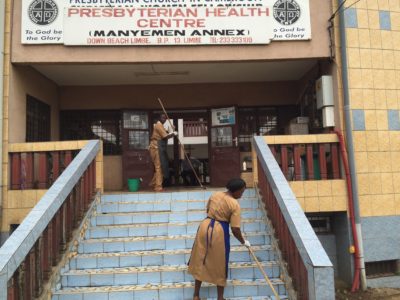
the Medical Benevolence Foundation, working to get medical equipment sent to Cameroon and build support for teaching in nursing schools.
Plans are also in progress for ITS to move from the building it currently rents in El Monte to the property that formerly housed Community Presbyterian of West Covina, a congregation that, with declining membership, has transitioned from being a church to a fellowship. The presbytery agreed to provide pastoral care and worship for the fellowship.
And the West Covina property, which includes three buildings, can now be used as a multipurpose ministry center — housing the presbytery offices, a preschool, a Taiwanese church and an Egyptian church that are sister congregations, and now, potentially, the seminary, although the details are still being worked out. The basic idea: the seminary could use the space, at a reduced rate, in exchange for maintaining the property. “With the cost of real estate in southern California, it really is negligent” if PC(USA) property isn’t fully used in creative ways, Tajima said.
The presbytery also hopes to take out a Restoring Creation Loan from the Presbyterian Investment and Loan Program to upgrade the property and make it more energy efficient. The seminary would use the property primarily during the week and churches would worship on the weekends, perhaps with ITS students participating in the ministry — for example, preaching for the fellowship.
“We’re really excited and hopeful that this will become a global ministry academic center,” Tajima said. “It would still be a place where some of our own churches can live and thrive. It would both upgrade and better utilize the material assets of the presbytery, and support ITS’ ministry, which we value greatly.”
Although ITS is small and relatively unknown, “our students are the best ambassadors,” Lee said. In a world in which Christianity is growing fastest in the global south and immigration is transforming many U.S cities, “our students are becoming blessings to our local churches.”