Congregation Anshe Poale Zedek gathered for worship on a Saturday in Manitowoc, Wisconsin, as Jews have been gathering for thousands of years. The scroll of the Torah was removed from the ark at the front of the sanctuary. Worshippers touched the scroll with the fringe of their tallitot, then touched the fringe to their mouths, signifying their desire to have the words of the Lord on their lips. Cantor Jerry Berkowitz was assisted by two other worshippers, rolling the scroll to the day’s portion. Several worshippers gathered at the bimah and recited the ancient prayers, thanking םלועה ךלמ, “the king of the universe” for the gift of Torah, among other things.
Jews around the world gathered in similar fashion and heard the Lord’s specifications for the construction of the tabernacle and temple as found in the Book of Exodus that day.
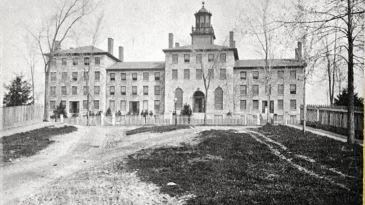
Congregation Anshe Poale Zedek (APZ) has worshipped in Manitowoc for more than a century. For the last six months, this congregation has called First Presbyterian Church home. Like many other faith communities, APZ’s membership has been declining for decades. In 2015 they came to the difficult decision to sell their building, which had been their home since 1954. Maintaining a large facility was becoming too much of a burden for the membership. They put their building up for sale.
The synagogue was faced with two daunting tasks: moving out of a building that had been their home for three generations, and finding a new place to worship.
Moving required the members to dispose of many memorials that had been given to the synagogue over the years, only a few of which would reside in the next facility. As they searched for a new place to worship, they also searched for faithful ways to dispose of all the rekush they had accumulated through the years.
Rekush (שוכר) is one of the few bits of Hebrew vocabulary I retain from my seminary years. One day in class we came across this word and found the dictionary defined it as “moveable property.” We asked what that meant, and our professor said with a sly smile, “Tupperware.” Rekush referred to the cookware used by nomadic people. If APZ was anything like its Presbyterian neighbor, they had amassed a lot of rekush since 1954.
Many members of churches, synagogues and mosques regard objects that they do not want anymore (but that could be useful to someone) as things that they should donate to their faith community. In Presbyterian churches these donations often happen clandestinely. “Didn’t the Sunday school superintendent request shoe boxes for a project once? I’ll drop these off at the church.” That the request came during the Carter administration is of no consequence; giving something to church is much better than having it “go to waste.” Midwesterners regard “perfectly good things going to waste” as a Deadly Sin up there with sloth (our favorite deadly sin). The month my congregation went without a custodian led me to coin a different term for rekush: “abandoned crap.” I would come across droppings of potential art supplies for the Sunday school just inside the main entrance or at the door to the education wing. They never came with a note, which was frustrating because I never knew whom to thank for this collection of 17 steel Hills Brothers coffee cans that I nearly tripped over. That painting from the starving artist sale we bought years ago at the Ramada Inn? Leave it at church; they’ll know what to do with it. The problem of accumulated rekush is so common in Presbyterian churches that some interim pastors arrange for a dumpster to arrive three days after their first day at a new church. Sometimes the commission to “clean house” is literal.
The members of APZ had some difficult decisions to make regarding their rekush. What to do with the stained glass windows given as memorials? Or the flatware, china and tables? Or the Torah scrolls? The members were sensitive about the strong attachment that they felt to their building and the memorial gifts it held; still, they had to make difficult choices.
Some of the congregation’s rekush was easy to place. The Lighthouse Recovery Community Center was happy to take the tables. The yacht club is the new home for the china and the Presbyterians took the flatware. Tricia Zimmerman had a chuckle remembering how scrupulously they used to keep the dairy and meat utensils separate. “Now look at me,” she remarked, “I’m throwing it all together to give to the Christians!”
APZ would only take four of their five Torahs in their new location. Cantor Jerry Berkowitz found a home for number five. In January he travelled to Uganda with other members of the Conservative Jewish Cantors Assembly to visit the Abayudaya community in Mbale. The Jewish community in Uganda numbers around 2,000 people. They were delighted to receive the Torah from APZ. APZ shares their delight, knowing that they are supporting future generations on another continent.
The search for the right physical space was more complicated than the disposition of moveable property. Some members thought it would be best to find space they could use just for the High Holy Days. Others felt they needed a place to settle. Howard Zimmerman said, “I won’t carry the Torahs like a vagabond!” They looked and discussed and thought and dreamed and imagined. Finding a suitable place for some of the stained-glass windows would be especially difficult.
The day the “for sale” sign appeared on 8th Street, the session of First Presbyterian met. At that meeting, the session instructed pastor Matt Sauer to contact the synagogue, which was kitty-corner from the church. The congregations had been neighbors for more than 60 years, since the synagogue purchased the building on 8th Street.
Shortly after Matt’s contact with the synagogue, Rabbi Sid Vineburg and Howard stopped at First Presbyterian Church to look at the chapel. The chapel had been given and furnished by memorials from members, but the congregation had not used it as a worship space for years. An agreement and lease between the church and the synagogue were drawn up, but they lay dormant for almost three years until the synagogue was finally sold.
 Howard Zimmerman was delighted with what they found at the church. “Oh my goodness,” he remembers saying, “it’s so warm, I feel comfortable right away!” When the others who were looking for a new space saw the chapel, they said, “The minute we got in here the difficulties ceased immediately.” The chapel was a good size for the congregation. Some pews were removed to accommodate the memorial plaques from their former home. There is even a place for some of the stained-glass windows to be hung in the hallway leading to the sanctuary. The large stained-glass Star of David that was on the north side of the former synagogue did not make the trip across the street. This happened once before, when the congregation moved to their second location in 1954. “Everywhere we go we leave a Star of David,” they say with pride.
The Jewish congregation is filled with gratitude for the Presbyterians opening their building to them, but they see the arrangement as much more than a rental agreement saying, “We share resources; we’re partners.” Matt sees the arrangement as a blessing for everyone. “It’s an example of faith moving beyond human-made rules.” He adds, “They are expressing thanks to us, but we feel we’re welcoming them as God’s messengers.” After all, Matt says with a gleam in his eye, “Jesus was Jewish until the day he died.”
I attended worship on Saturday, March 2
(25 Adar I 5779) to see the partnership in action. Cantor Berkowitz called out the page number for each reading and prayer. Drawing on the Hebrew I took in seminary, the year I lived in Brooklyn and memories of the three bar mitzvahs I have attended, I was able to follow the service fairly well. I marveled that believers on a cold winter day in Wisconsin gathered for worship as they have for centuries. The ancient words felt holy and divine — even those I did not understand.
Following worship we gathered for Oneg Shabbat, which to this Presbyterian felt like coffee hour with very sweet wine. We discussed where to find the best bagels — Panera got the nod, and they do a nice job slicing them too. I was not especially surprised to see the bottle of brandy on the table. It was close to noon and this is Wisconsin. I was, however, delighted when I spotted that it was Christian Brothers VS brandy next to the bottle of Mogen David blackberry wine.
As I drove home, I recalled the mezuzot (cases containing verses from the Torah) at each of the doorways to the chapel, tacit reminders that one is leaving the safe place and returning to the world. I thought of the ark being opened with such care and the Torah regarded with such reverence. One truly does not live by bread alone, but by every word that comes from the mouth of God.
My mind strayed to other arks. We had heard the specifications for the construction of the Ark of the Covenant in the morning’s Torah portion. And Moses was put in an ark among the bulrushes to escape Pharaoh’s slaughter of the Jewish babies recounted in Exodus. Who could forget Noah, who built the ark and stayed on it with his wife, his sons and their wives? And all those animals!

Matt shared part of APZ’s story with Winnebago Presbytery last fall. He recalled as the representatives from the church and synagogue were about to sign the formal agreement, he saw some people on the verge of tears. He said, “It must be difficult to give up a place that holds so many memories.” One person quickly corrected him: “These are not tears of sadness. These are tears of joy. We have a new home. In honor of all our forefathers we have place to worship!”
Arks are all about protecting something precious. Noah’s ark and Moses’ pitch-lined basket did not have oars or sails. There was no way to steer them. Their only purpose was protection. People need safe places too. Safe places like the former chapel of First Presbyterian Church in Manitowoc, Wisconsin, now the sanctuary of Congregation Anshe Paole Zedek.
 Tom Willadsen is the author of “OMG! LOL! Faith and Laughter.” He lives in Oshkosh, Wisconsin.