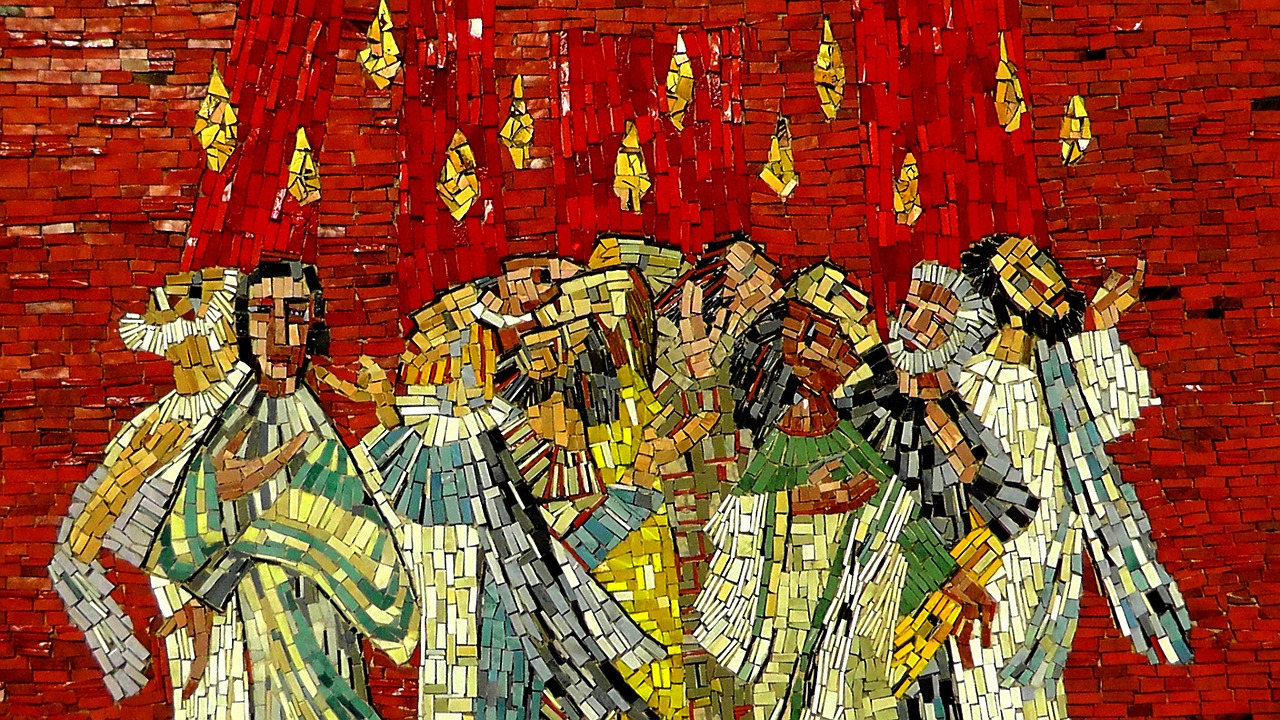
Acts 2:1-21
What would it mean for followers of Jesus Christ to speak of God in languages the world could understand?
I wonder if in this day and time we might want to do more listening than talking, at least at first and for a while. James Davison Hunter in his book, “To Change the World” writes: “In public discourse, the challenge is not to stifle robust debate, but rather to make sure that it is real debate. The first obligation for Christians is to listen carefully to opponents and if they are not willing to do so, then Christians should simply be silent. To engage in a war of words is to engage in symbolic violence that is fundamentally at odds with the gospel.” Would a contemporary Pentecost in our context entail disciples listening more than speaking? Getting together to seek a word from the Lord, rather than entering the sanctuary solidly convinced we know what God says? I wonder if being silent is a prerequisite for colluding with the Holy Spirit, or at least not obstructing the wind, flame and words given to us by God and about God.
The war of words and battle of rhetoric rages daily in our culture. Might this Pentecost be an opportunity to stop bloviating with our own opinions and instead gather together in worship and wait for the Holy Spirit to speak in the form of ideas and sentiments not solely of our own preferences and assumptions? Could it be possible that this Pentecost enables us to hear and understand languages that are not native to us? Perhaps the Holy Spirit yearns to expose us to experiences previously unknown to us, connecting us with people we assume have nothing in common with us.
Pentecost unsettles. Pentecost puts the word of the Lord in the mouth of those long silenced. Pentecost upends the tyranny of the possible and makes room for relationships and community heretofore unimaginable. What might such a Holy Spirit upheaval look like where you live? Are you willing to yield to that vision or do you dismiss such radical new connections, expansive divine agency and wild creativity as too perplexing to handle or merely the ramblings of drunkards? Ann M. Pendleton-Julian and John Seely Brown in volume one of their book, “Design Unbound” discuss the problem of the “tyranny of the possible.” They note, based on the work of Stephen Duncombe, that “our solutions to problems are limited when we think only within the constraints of what we currently accept as possible.” They believe that “the kind of world we are navigating now, the kinds of problems we want to have agency on, demand a new tool set in which imagination is not an embellishment or adjacency to real work in the world, but the keystone capacity upon which all other work depends because it supports sense making, and advances empathy, as much as it drives novelty.”
Pentecost obliterates the tyranny of the possible, or at least it should for Christians. Jesus’ resurrection, coupled with the coming of the Holy Spirit ought to convince us that through Christ all things truly are possible, not the least of which is reconciliation with God and neighbor that is made manifest in boundary-breaking, genuine community made up of people from every tribe and nation. If we don’t think God is capable and desiring of this revolution of intimacy, as Willie James Jennings calls Pentecost, then we should gather together, keep silent and wait for the Holy Spirit to give us first understanding and then words to express what God reveals.
In recent weeks, I’ve been gifted yet again to gather with Presbyterians in various places. Repeatedly, people ask how to speak a biblical and theological word into our cultural context of violence, fear and division. They ask how to respond around their dinner table with family and friends with whom they disagree. They ask how to be heard in the public square when other parts of the Body of Christ seem to use a bullhorn to spout beliefs they think are antithetical to the gospel. They lament the perception among many that Christians are judgmental and exclusive. They want to know how to make their faith in Jesus Christ matter in a context increasingly dismissive of the institution of the church. I think they (we!) need Pentecost, an unmistakable inbreaking of the Holy Spirit. I think they (we!) – as disciples of Jesus Christ – should gather this Sunday and be silent, eagerly, on-the-edge-of-our-seat anticipating the fire and wind, the word of the Lord that tell of God’s deeds of power not just when Jesus walked the earth but right here and now. The Body of Christ, this branch of it, must be willing to silence in it any voice but God’s, remembering that God’s words are not ours and that God speaks in a multitude of languages and through the people we often least expect. We need to stop being beholden to the tyranny of the possible, remember that through Christ all things are possible and trust that the Holy Spirit give us the words and the power and the courage to live that truth. What might that look like where you are? Can you begin to imagine it?
“The Color of Compromise,” by Jemar Tisby, ends with his admonishment to be people of courage. He writes: “Jesus crossed every barrier between people, including the greatest barrier of all — the division between God and humankind. He is our peace, and because of his life, death and resurrection, and coming return, those who believe in Jesus not only have God’s presence with us but in us through the Holy Spirit. Therefore, we have the power, through God, to leave behind the compromised Christianity that makes its compromise with racism and to live out Christ’s call to courageous faith.” This reminds us that the Holy Spirit enables us to practice an uncompromised and uncompromising faith. We have Pentecost possibility. Gather together in the name of Jesus Christ this Sunday. Be silent. Listen. Then speak words that are not your own, but God’s, knowing that the Spirit gives you ability to proclaim God’s deeds of power and experience them through others, too, even those you least expected.
This week:
- When have you had an experience of the inbreaking of the Holy Spirit? What happened? Why do you attribute it to the Holy Spirit?
- Are there barriers in your life, church or community that the Spirit is working to break down? How can you participate in that work of God?
- Have you intentionally spent time in silence either alone or with a group? If so, what was it like? What did you learn?
- Are you able to break free from the “tyranny of the possible”? What would be different if you truly believed that through Christ all things are possible?
- Do you speak more than one language? What is it like to move back and forth between languages? Have you ever been in a setting where you didn’t understand the language? What was that like?
- How can you collude with the Holy Spirit — or at least not obstruct her?
Want to receive Looking into the Lectionary content in your inbox on Mondays? Click here to join our email list!