STONY POINT, New York – Wanting to invest in the hope of Presbyterian transformation, the Presbyterian Mission Agency Board voted to support the first steps of a plan for significant redevelopment of Stony Point Center.
Stony Point Center is a Presbyterian Church (U.S.A.) conference center located about an hour north of New York City – a place that’s home to a multifaith community of Christians, Muslims and Jews, and has a track record of commitment to justice, peacemaking and earth care.
The board voted to “affirm the basic direction” of a 75-page vision plan for Stony Point – a report that’s the work of the Run River Enterprises consulting firm and that calls for making at least $10.3 million in capital improvements at Stony Point over the next decade.
The board’s vote Sept. 27, following a closed-session discussion, does not commit major dollars yet – the financial starting point is in endorsing the baseline phase totals of $295,000: providing $220,000 for additional staff positions at Stony Point in 2020 and $75,000 for a feasibility study to assess how much money could likely be raised in a capital campaign. (P.106 Stony Point Center Run River Consultation Report)
Ray Jones, who is director of Theology, Formation and Evangelism for the Presbyterian Mission Agency (PMA) and who led a work team that worked with Run River to draft the Stony Point proposal, described it as “a methodical, incremental approach” with “clearly identified checkpoints along the way for board approval.”

He said the feasibility study likely would be conclude by the board’s February meeting, so implications for future spending could be built into PMA’s mission budget for 2021 and 2022.
But the board’s vote also carries with it an affirmation of the vision that Diane Moffett, president and executive director of PMA, has presented for Stony Point – this week she called the conference center a “treasure” of the denomination.
The question of whether to make a major capital investment in Stony Point is complicated – as the center has not broken even in recent years, maintenance has been deferred and its finances have been one of the perennial issues before the board. Stony Point has obvious appeal – with a one-acre garden, its food is terrific, for example – but also limitations, including guest rooms with shared bathrooms and showers. Deed restrictions involving the property are complex, which means that the PC(USA) can’t just sell the property and pocket all the proceeds.
Moffett, however, made the case that Stony Point can be a place of transformation – where PMA can offer programming to support commitments to discipleship and justice that are at the heart of PMA’s work, and can give Presbyterians who visit here transforming “pilgrimage” experiences.
Stony Point has a rich history of justice work and of being hospitable to those “on the edge of the church and the edge of culture,” Moffett said. The plan calls for its multifaith community, the Community of Living Traditions, to seek nonprofit status and establish a formal partnership with PMA.
Moffett described Stony Point as a perfect place to focus on the commitments central to PMA’s Matthew 25 vision: developing congregational vitality, combatting structural racism and working to eradicate systemic poverty.
“It has been a place where the church has taken risk and we have been about change,” Jones said.
And “the marketing potential for Stony Point is enormous,” he said.
“What is unique about this land?” asked board member Michelle Hwang. “Why is it critical for the Matthew 25 vision to happen here and not elsewhere?”
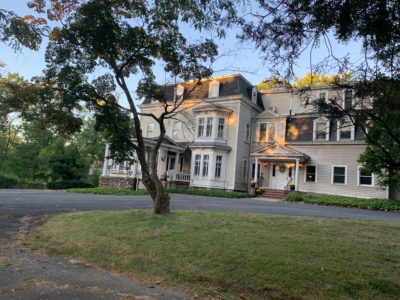
Moffett responded that “PMA needs a place and space we can call our own,” and that “God has given to the PMA this particular property. … This is a gift we have in our hand.”
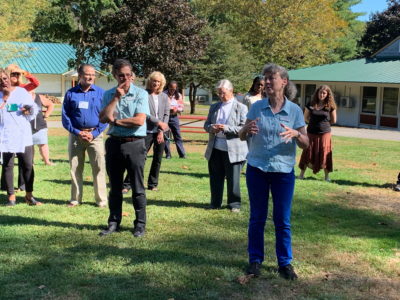
During a tour of the property that preceded the vote, Rick Ufford-Chase described improvements already made during the 11 years he and his wife, Kitty, have been co-directors, including replacing roofs that were more than 20 years old (using roof panels they manufacture themselves); replacing an old inefficient heating unit with heat pumps that will help in a planned transition to solar power; and a new electric lawnmower that the PMA helped to purchase and can run up to five hours on a single charge.
Rick Ufford-Chase, co-director of Stony Point Center, described some of the progress that has been made improving the property.
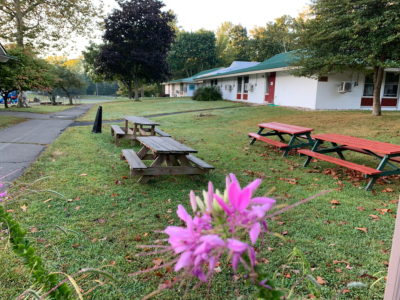
The roofs on the lodges no longer leak, he said, which means “no more telling guests, ‘It’s OK, we’re going to move your bed and place a bucket” to catch the drips. Using recycled plastic, volunteers have built chairs that are scattered in groups around the lawn.

Last spring, the board approved spending nearly $631,000 for “critical expenditures” on urgent capital needs.
Elise Bates Russell of Run River, who has architectural training, described some of the improvements the capital funding would make possible. A village green would be created with no vehicular traffic – space intended to foster conversation and community.
Renovations of lodges built in the 1970s would add “front porch hospitality,” more interior light and private bathrooms, she said.
“Friends, it’s 2019,” she said. “People don’t want to share restrooms.”
She asked board members to describe their reactions to the Meditation Space, a building lined with glass windows. Tranquil, light, inviting, connected to nature, they said — and Russell said those are qualities embedded in the entire modernization plan. Board member Lindsay Herren-Lewis said she’s been in that space with people from a variety of religious traditions, and “it’s a space that’s welcoming to all.
Jones earlier described Stony Point as becoming the “research and development arm” of PMA. Near the end of the tour, Russell spoke of the importance of outdoor ministry in the life of the PC(USA).
“We need people who believe in this place and all that happens here,” she said. “The rest of the nation is watching,” as people of faith consider what could also happen at their conference or retreat centers closer to home.
Stony Point Plan, in brief
The board voted approval of the baseline phase of the proposal now – with three additional phases to come later.
Phase 1 (2021-2023) – about $2.56 million in capital costs. Includes:
- Designing a fundraising plan for a major maintenance endowment.
- Initiating about $1 million in renovations to the Beech, Hickory and Walnut Lodges, to create private rooms with baths. Also in that phase: about $500,000 to add solar panels to those facilities.
- Capital improvements including creating a “village green” without vehicular traffic.
- Establishing a formal partnership with the Community of Living Traditions.
- Expanding programs offered at Stony Point to more fully support PMA priorities.

Phase 2 (2024-2026) – about $790,00 in capital costs. Includes:
- Designing and implementing a fundraising strategy for Caincroft, the new “state of the art” facility to be constructed for meeting, dining and administration.
- Continuing to develop marketing initiatives.
- Evaluating program efforts to match PMA priorities.
Phase 3 (2027-2029) – about $6.5 million in capital costs. Includes:
- Constructing Caincroft, which would have meeting space for up to 330 people and a dining facility for 250.
- Upgrading Maple Lodge to include private bathrooms.