How can Presbyterians respond in their own communities to concerns about immigration?
Those who live near the U.S.-Mexico border may feel they’re on the front-lines – seeing the human drama directly before them, with heartbreaking news day after day of families being separated and of people camped on the Mexico side of the border who aren’t allowed to stay in the United States as their asylum claims progress.
But the impact of federal immigration policy is also being felt across the country, in big cities and small towns – with deportations, immigration raids at plants in rural America, and the realities of an economy in which sectors such as agriculture and construction depend on migrant workers. Presbyterians who care about these issues and the human pain involved are looking for ways to respond close to home – sometimes in deeply contextual ways.
They’re visiting asylum seekers held in detention centers. They accompany immigrants to court hearings and medical appointments. Presbyterians work with community groups that provide “know your rights” training to immigrant groups and send letters and make phone calls to elected officials in attempts to influence policy.
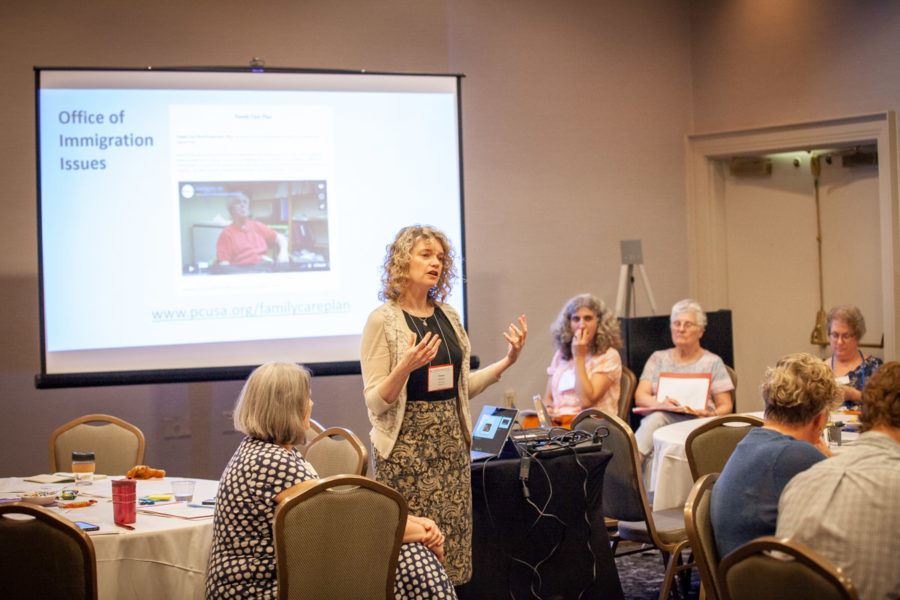
And sometimes, they’re not sure what to do. This summer, just before the start of the Big Tent conference in Baltimore, Presbyterians working on immigration issues in their local communities gathered for a workshop with representatives of the Presbyterian Church (U.S.A.) national staff and Presbyterian Disaster Assistance to brainstorm about effective responses.
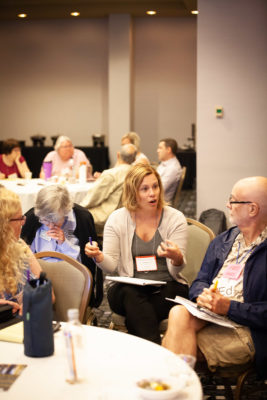
“Our church does nothing,” one Presbyterian said. “I’m looking to take something back so they can at least discuss it.” As he spoke, others in the circle nodded their heads, saying their congregations also were struggling to know what to do.
Some said that immigration is seen as controversial – too political and divisive for congregations to take on. Others just weren’t sure where to start.
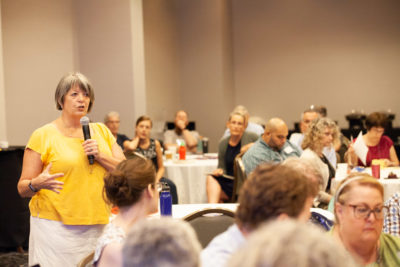
“There has to be a trusted individual who helps the congregation move,” said Amanda Craft, manager for advocacy with the PC(USA) Office of Immigration Issues. That person can help a congregation identify resources and organizations with which to partner, and report back on what’s already being done and what the local needs are.
“The beautiful piece I see coming out of this work is those who are at risk are leading the walk,” Craft said. “It’s not a political issue,” but a humanitarian one. “We are free as people of faith to respond out of a place of faith.”
So what can Presbyterians do? The answers will depend on local needs and resources; also, what feels right to one person may not be comfortable for another. Here’s some of how Presbyterians are getting involved close to home.
Support DACA students
A year ago, retired Presbyterian pastor Lyle Dykstra and his wife, Terry, invited a Deferred Action for Childhood Arrivals (DACA) student to live with them at their home in Wilmington, Delaware, during the summer. The student, Indira Islas, had come from Mexico to the United States when she was 6 with her parents and younger siblings, and had grown up in Georgia. She was now a pre-med student at Delaware State University, planning to become a doctor, and needed a place to live during the summer of 2018 while working at a hospital.
Delaware State is one of a relatively small number of universities that will accept Dreamers locked out of educational opportunities in other states through the Opportunity Scholarship program. And the Matthew 25 Action Committee of Newcastle Presbytery, of which Terry Dykstra is co-chair, has built connections with a Delaware State administrator. He’s invited DACA students to presbytery events to share their stories and alerted Presbyterians to particular needs; as a result, congregations have raised funds to pay for non-tuition expenses such as books or test fees.
Some suggestions from the Big Tent workshop: Get in touch with educators from local colleges and school systems who work with immigrants. Ask them what’s happening, what kind of help they need. Or reach out to congregations and fellowships where immigrants go to worship.
Just before Christmas last year, a Ghanaian congregation, Olivet Presbyterian in Newark, Delaware, held a holiday party with food, music and dancing for about 70 of the DACA students. The motivation? They said, “We remember coming to America and how wonderful it was when people welcomed us,” Lyle Dykstra said.
Training and accompaniment
Presbyterians are becoming involved in community efforts to offer “know your rights” training to immigrant groups and employers.
Congregants from Beechmont Presbyterian Church in Louisville, Kentucky, have helped immigrants draft family care plans – planning ahead for what would happen with the children if one or more parents were deported; getting the necessary paperwork notarized; and making sure trusted neighbors or friends have keys to the house and are willing to step in to help the children.
Some congregations, such as First Presbyterian in Mount Pleasant, Iowa, have provided support to families following immigration raids.
Other congregations go further: declaring themselves sanctuary churches for people facing deportation – although doing so can involve significant consequences and should involve careful discernment, national staff members said. More resources can be found here.
Craft, along with her colleague, lawyer Teresa Waggoner, is confronted every day by the pain of asylum seekers and immigrants facing deportation. She asked Presbyterians to “constantly be in prayer” around immigration issues. “There’s a lot of fear right now,” she said, and “in our silence, we are complicit.”
Be creative
In upstate New York, Dave Pepper, pastor of First Presbyterian Church of LeRoy, lives with his wife, Millie, about five miles outside of Stafford. “We’re out in the country and we’re surrounded by acres and acres of cropland,” he said. Anytime from dawn to dusk during the summer months, they could look out and see migrant farmworkers picking cabbage.
The Peppers don’t speak Spanish. But they wanted to show hospitality to the farmworkers, so decided to throw a picnic at the end of one work day – to share a meal together and offer some welcome. “They bend over, they cut a cabbage, they trim it, then they have to heave it in a big wagon,” Millie Pepper said. “It’s backbreaking work.”
“I wouldn’t last an hour,” her husband said.
So they made up some simple signs in Spanish — basically saying “neighbors” and “gracias” and “picnic” and “free food.” They rounded up some volunteer help, bought sub sandwiches, made side dishes, smoked ribs. They had no idea if anyone would show up – but after work on the day of the picnic, a bus pulled up and 16 guys got off.
The Peppers have spoken to the farmer who hires these men. They come from central Mexico, and the farmer has been hiring this same crew for the last half-dozen years. The men work from spring through the fall, 12-hour days, in the rain and the heat and the cold, picking cabbage and acorn squash, whatever’s ready. When the harvest season ends, they go back home.
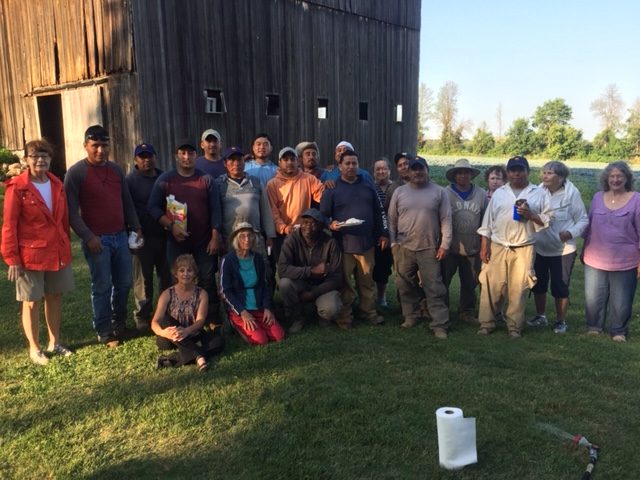
Millie Pepper, who is executive director of the local YWCA, offered her thanks to the men for their hard work, and her welcome as a neighbor. When they figured out it was one worker’s birthday, she ran into the house to grab candles to stick into the pie someone had brought. They sang “Happy Birthday” to the man; while not everyone knew the words, they celebrated his presence among them and wished him a good year.
At the end of the evening, as the men were leaving, the man whose birthday it was took Millie Pepper’s hand. He said, in broken English, “that when one person offers another person a glass of water” – but then he stopped, choked up.
Dave Pepper thinks the man may have been quoting from the 10th chapter of Matthew’s Gospel: “And whoever gives even a cup of cold water to one of these little ones in the name of a disciple – truly I tell you, none of these will lose their reward.”
He’s not sure. Even if he’s wrong, the connection that night was made.