LOUISVILLE – With deadlines looming for presenting reports to the 2020 General Assembly, the Special Committee on Per Capita Based Fundraising and National Church Financial Sustainability in the Presbyterian Church (U.S.A.) is beginning to hammer out the language it wants to use.
But a simmering question is this: How much change can groups currently at work in the PC(USA) reasonably expect to ask this assembly to push through next summer?
If the special committee thinks the denomination needs to be restructured to bring better accountability and try to make sure that all the agencies have adequate funding, should it go ahead and recommend that restructuring now (or maybe ask the Moving Forward Implementation Commission to come up with a restructuring plan)?
Or does it ask Moving Forward to join with it in recommending that the 2020 General Assembly create another commission to both come up with a restructuring plan and begin to implement it? Is that a smart way to make change happen – or just a version of kicking the can farther down the road?
The short answer may simply be that this is complicated stuff – and the committee is running out of time, with its financial sustainability report due by Dec. 31 and the committee’s full report due by Feb. 21.
“This is doable in two years,” said committee member Scott Lumsden, a presbytery executive from Seattle who’s been one of the voices calling for denominational restructuring. “It’s probably not doable in two months. But it’s doable in two years, easy.”
Representatives of the Moving Forward Implementation Commission spoke during the opening session of the committee’s Nov. 4-6 meeting at the denomination’s national offices in Louisville – with Debra Avery and Mathew Eardley saying the commission would like to work as closely as possible with other groups trying to chart the future of the denomination. Whenever possible, “joint recommendations are always going to be better,” Avery said.
What’s likely on the table, based on the work the committee’s Financial Sustainability work group has done so far, is some sort of a call for a structural reconfiguration of the denomination. That task force has at least tentatively concluded that the denomination has enough money to go around, but there are concerns about accountability and how decisions are made about how the funds are allocated, particularly with a shortage of funding for the Office of the General Assembly, said Laura Cheifetz, a minister who is assistant dean for admissions, vocation and stewardship at Vanderbilt Divinity School.
Cheifetz serves as co-moderator of the special committee, along with Valerie Young, synod leader and stated clerk of the Synod of the Sun.
Cheifetz has been leading a financial sustainability work team, and Young a per capita team. While final recommendations aren’t ready yet (Cheifetz at one point referred to “a very drafty draft”), here’s some of what emerged from the Nov. 4 discussion.
Per capita
The per capita team is nearly finished holding conversations with leaders of each of the 16 synods, and has begun to consider ideas for experimenting with alternatives to the current per capita system, said committee member Diane Kenning.
Some of the values regarding per capita that are emerging from the conversations with presbytery and synod leaders include these, she said:
- connectionalism;
- community;
- having a system that’s fair and equitable;
- providing services such as the system matching ministers seeking calls with congregations seeking pastoral leadership;
- a sense of abundance.
A question that’s emerged, she said, is: “Does the Reformed tradition or shared confessions actually connect us any longer” in the PC(USA)?
Disconnection
Committee member Sarah Moore-Nokes said presbytery and synod leaders have spoken frequently of the need for better communication and of feeling disconnected from the national church.
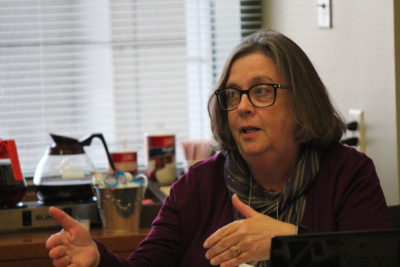
And committee member Jeanne Radak said many mid council leaders apparently don’t realize that the Presbyterian Mission Agency and the Office of the General Assembly are separate agencies with different sources of funding. “Everybody sees OGA and PMA as one,” Radak said.
Be specific
Repeatedly, PC(USA) staff members made pleas for any recommendations to be as specific as possible – including, for example, some sense of what a reconfigured denomination might look like, and what the evidence is that such a change is needed. “The more clear and concise and direct your language can be,” the less possibility “that someone could misconstrue your intent,” said Kerry Rice, the PC(USA)’s deputy stated clerk. If there’s a specific outcome the committee wants, “name it,” he said. Be very clear about “the things you’re open to and the things you’re not willing to compromise on.”
Another commission?
“There is some concern about a perpetual commission mentality,” said Eardley, who has served both on Moving Forward and on its predecessor, the Way Forward Commission. Some fear that with another two years, the sense of urgency for making change – or doing exactly what the committee thinks is necessary – may begin to dissipate or “get lost in translation,” as Moore-Nokes put it.
There are also some tricky spots in the financial conversations. The financial sustainability work group contends the PC(USA) has enough money – that it’s the decision-making structure and how the money gets allocated that’s the problem. But many presbyteries and congregations feel financial pressure and have experienced significant staff and budget cuts – so they may not share the sense that there’s enough dollars to go around.
Another question: As all of this gets sorted out, will the Office of the General Assembly ask the 2020 assembly to increase per capita? Per capita is the per-member rate that congregations are asked to pay to support the work of the broader church, currently set at $8.95 per member.
OGA is facing a budget shortfall, so a per capita increase is a possibility. The Moving Forward commission has instructed leaders from OGA, PMA and the PC(USA), A Corporation to meet together in the next few weeks to discuss developing a unified budget to present to the 2020 assembly – partly in response to the OGA budget difficulties.
What will emerge from that – and whether a request for a sizeable per capita increase will be forthcoming – remains to be seen.