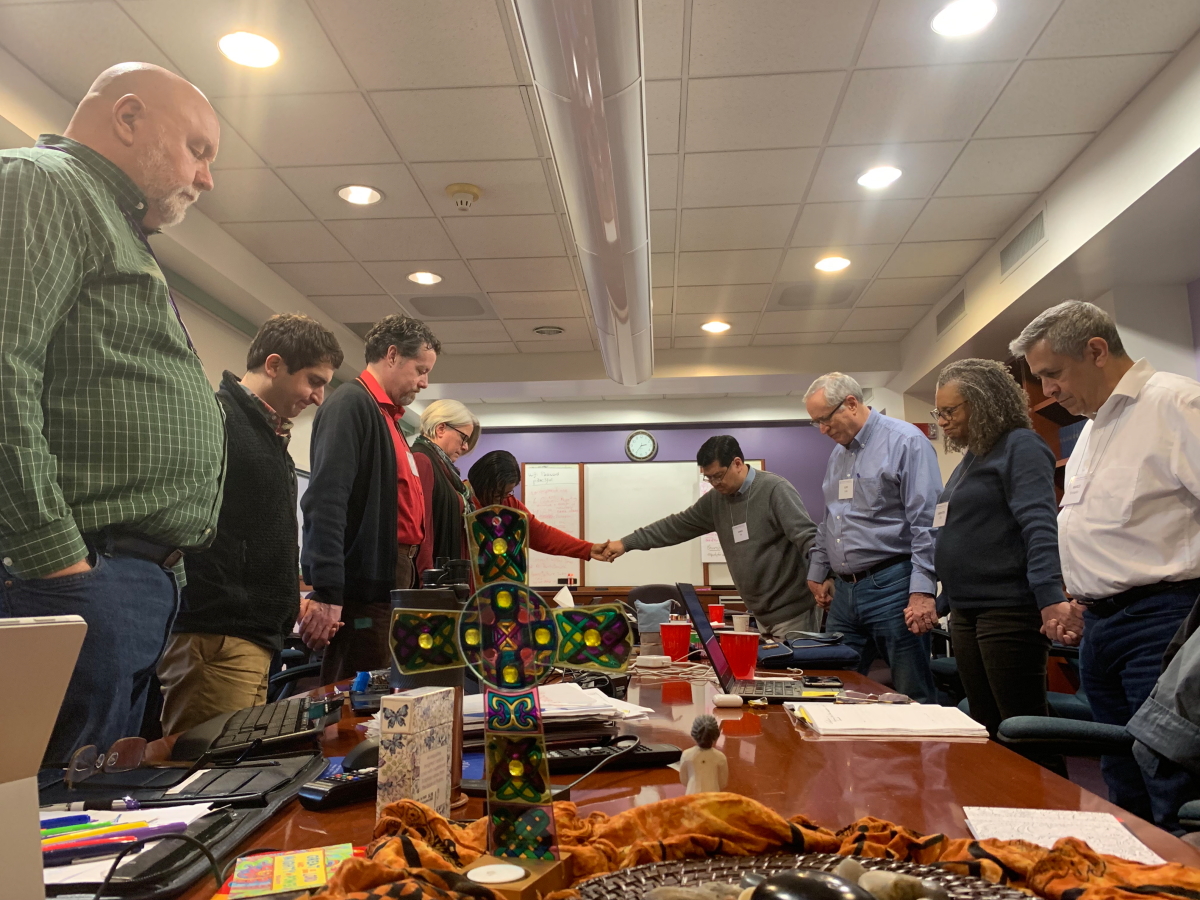
LOUISVILLE – The Moving Forward Implementation Commission is moving closer to finalizing its recommendations to the 2020 General Assembly.
During its Jan. 24 meeting in Louisville, the commission formally voted on one recommendation, and reached “agreement in principle” on others, with a final vote to come later via conference call. It’s leaning towards offering comments to the Special Committee on Per-Capita Based Funding and National Church Financial Sustainability – in part explaining how some of the special committee’s potential recommendations on denominational restructuring and creating campaigns to better explain per capita to Presbyterians in the pews could be answered by the commission’s own work.
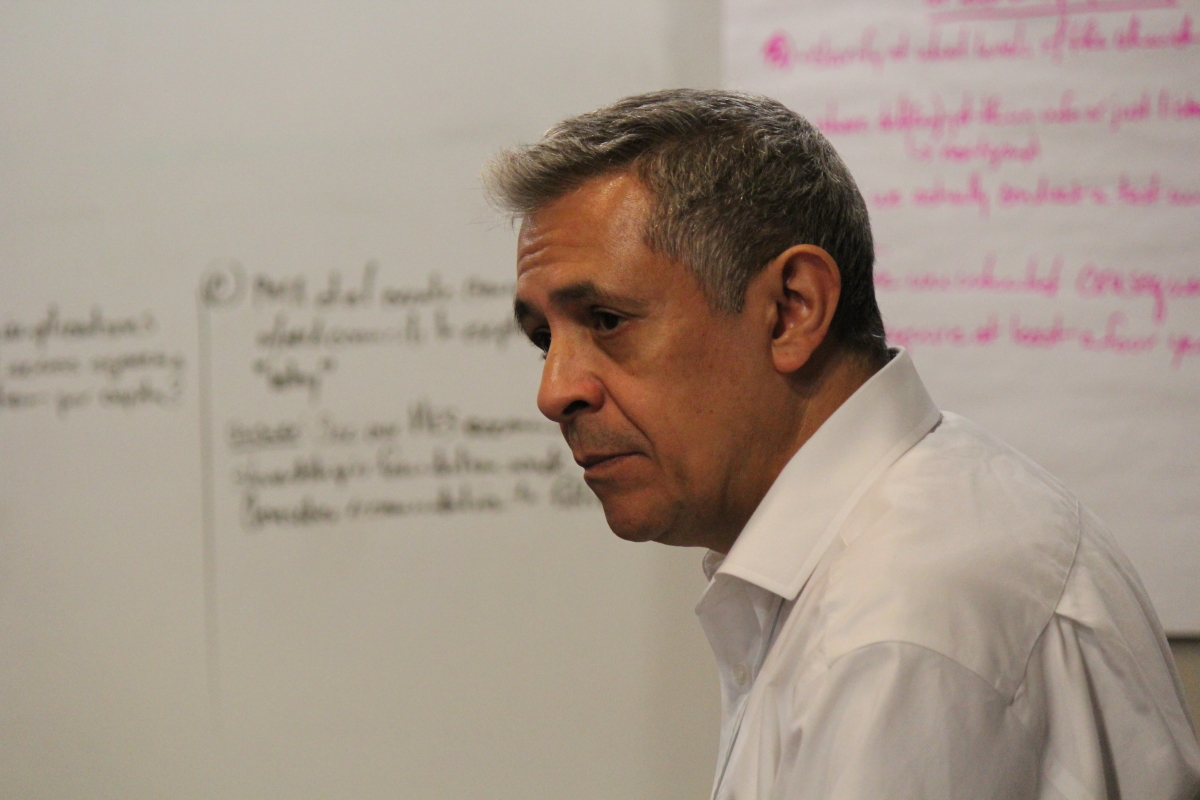
The commission may also draft its own recommendation, in response to ideas the special committee has been considering regarding creating experiments as potential alternatives to the current per capita funding model. That work was part of the special committee’s mandate from the 2018 General Assembly.
The essence of that draft recommendation is that Moving Forward would ask the General Assembly, meeting in June in Baltimore, to:
- Allow two years for a proposed “table for ongoing ministry collaboration” among the national agencies to get established – a forum for collaboration which would include work on developing a unified budget and more. That budget table would include representatives from the Presbyterian Mission Agency (PMA), Office of the General Assembly (OGA), and the PC(USA), A Corporation, which includes the Administrative Services Group.Give the denomination’s national staff the chance “to see where those synergies are,” said Marco Grimaldo, who serves as the commission’s co-chair, along with Larryetta Ellis.
- Share broadly the learnings from listening sessions the special committee held with more than 200 presbytery or synod leaders.
- Find a way to consult with other stakeholders in the per capita system – particularly pastors and possibly people who serve on the PC(USA)’s national staff.
- Somehow feed all of this into the 2022 General Assembly.
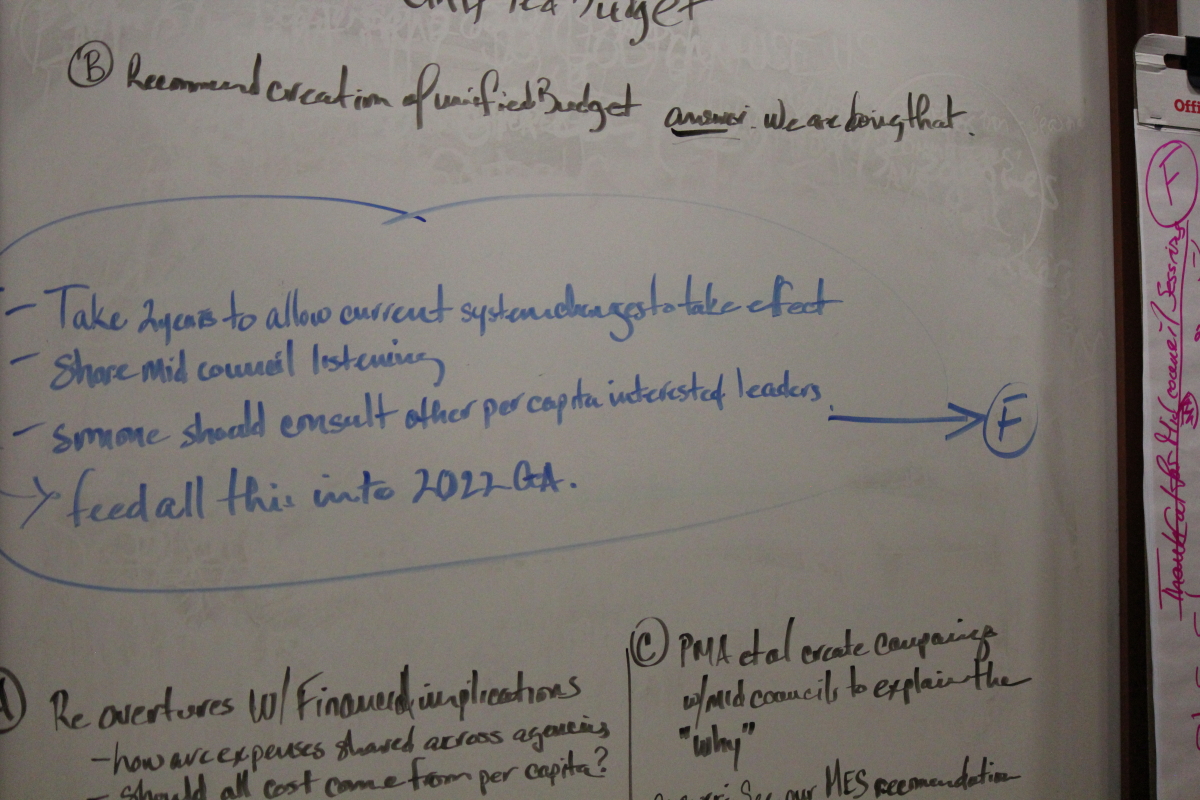
If the General Assembly approved that approach, “then when we’re ready to launch a test or an experiment (of a possible new funding system), now we have a good foundation to stand on,” said commission member Mathew Eardley of Idaho. “We’ve done our research,” and designed a process “that has a lot of integrity and insights and hopefully buy-in.”
In discussions Jan. 23, commission members voiced skepticism about some of the per capita and financial sustainability committee’s recommendations – raising concern about costs, clarity and whether the solutions proposed would fix any of the denomination’s problems.
Commission members plan to communicate to the special committee’s leadership that the commission is planning to make its own recommendations regarding a unified budget for the denomination and an enhanced mission engagement effort – including work to explain to Presbyterians in the pews what per capita is and why it’s needed.
Regarding a proposed merger of OGA and PMA, “why are they recommending that?” asked commission member James Tse of New York. “How does that solve the problem?”
And commission member Debra Avery of California said she thought creating a task force to consider experiments to provide funding alternative to per capita, as the special committee has considered, would take longer than two years and the cost would be too high. “It’s a sales job” to convince presbyteries and congregations to participate in the experiments, she said. “I can’t advocate in favor of it as it’s currently written.”
The commission is trying to communicate ways in which the commission’s own actions would address some of the special committee’s concerns –but it’s also refusing to support the committee’s draft recommendations. While willing to say “no,” some commission members were reluctant seem too heavy-handed.
“Can we find a way to affirm their work without saying, ‘Scratch it?’ ” Ellis asked.
“They’ve really tried hard, they’ve done their research, they’ve embraced their task,” said commission member Eric Beene of Georgia.
And “they are looking at it through the lens of mid councils,” Grimaldo said – not enough from the perspective of other levels.
In addition to considering how to respond to the draft recommendations from the per capita and financial sustainability committee, the commission also narrowed down at this meeting what recommendations it hopes to include in its own report – although the final wording isn’t set and no votes have been taken. Here are some of the recommendations Moving Forward is discussing.
Unrestricted bequests. The commission wants to recommend that when Presbyterians give new unrestricted gifts or bequests to the denomination, that that money be split between PMA and OGA, with roughly 80% going to PMA and 20% to OGA (the same ratio by which shared administrative costs are currently allocated between the agencies). Currently, all unrestricted gifts go to PMA for its use. But the commission contends that both the ecclesial and missional parts of the church should benefit from such unrestricted gifts.
Mission engagement. The commission is proposing moving the office of Mission Engagement and Support – which tries to connect and educate Presbyterians about giving to shared mission – from PMA to the Administrative Services Group. The draft recommendation also would call for adding education on per capita to the office’s portfolio; providing additional resources and staff as needed for the expanded work; and specifying that the work be funded through unrestricted receipts.
Equity and inclusion.The commission is considering reports on equity and inclusion in the PC(USA); on work done by the staff-run Diverse Voices Table; and surveys it’s done on agency culture. None of that is available yet.
Church growth. While there may not be a formal recommendation, the commission hopes to say something about church growth – to “challenge the church to really focus going forward” on how the church can grow, Grimaldo said, including the role that immigrant fellowships and new worshiping communities might play in that.
Because the per capita funding system is base on a per-member assessment – currently, $8.65 per member for the General Assembly per capita – there is a sense that per capita may not be a sustainable funding system for a denomination in which membership has long been declining.
But when the PC(USA)’s stated clerk, J. Herbert Nelson, talks about the importance of the PC(USA)’s counting of fellowships – as he did in remarks to the commission on Jan. 23 – “people see that as him wanting to get per capita” from those fellowships, which currently don’t have to pay because they’re not formally chartered as churches., Avery said.
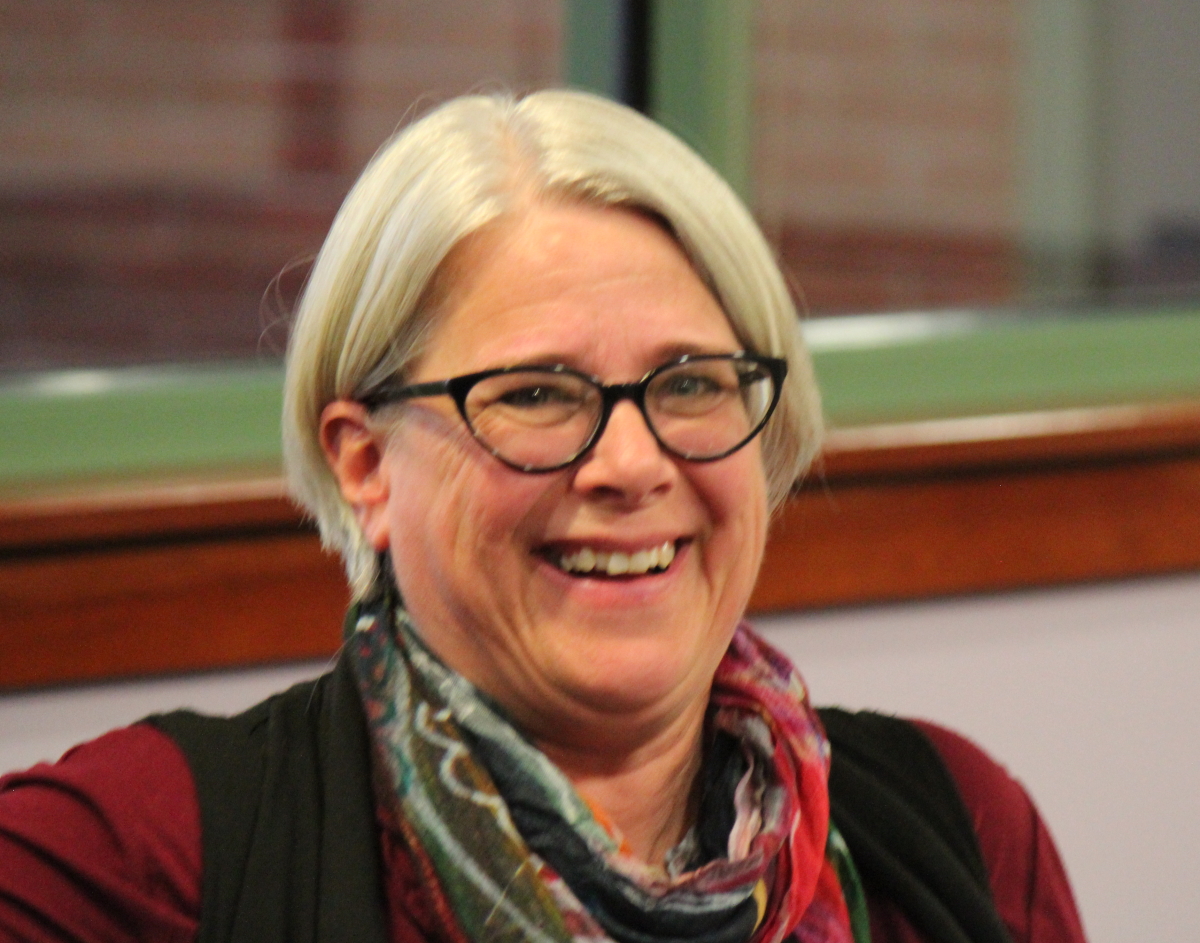
“What he’s talking about is an equity question. We treat our fellow siblings as crap, because we can.” For small congregations “led by a commissioned ruling elder, same thing. A lot of presbyteries don’t give those churches voice or vote.”
That raises polity questions, Tse said, because the rules say that to have voice or vote at a presbytery meeting, one must be ordained as a minister or ruling elder. “I’m all for participation,” he said. “But how do we give them standing?”
There may be ways to include fellowship representatives in presbytery conversations that come short of giving them standing to vote, Grimaldo said. There are spaces for participation “that haven’t been explored.”
He also said: “The places where the Presbyterian Church could grow, we’re not investing in.”
PC(USA), A Corporation board. The commission voted on this recommendation – to support an action the A Corporation board took in December to ask the 2020 General Assembly to increase the size of the boardfrom 11 to 13 voting members. One of the additional seats would be for a Board of Pensions representative, and the other an at-large member.
The problem with that: Frank Spencer, president of the Board of Pensions, has communicated that “going forward, we do not wish to be represented” on the A Corporation board, Grimaldo said.
“Is the presence of the Board of Pensions on the A Corporation board in the best interests of the church?” asked commission member Cliff Lyda of Florida. Should it be required?
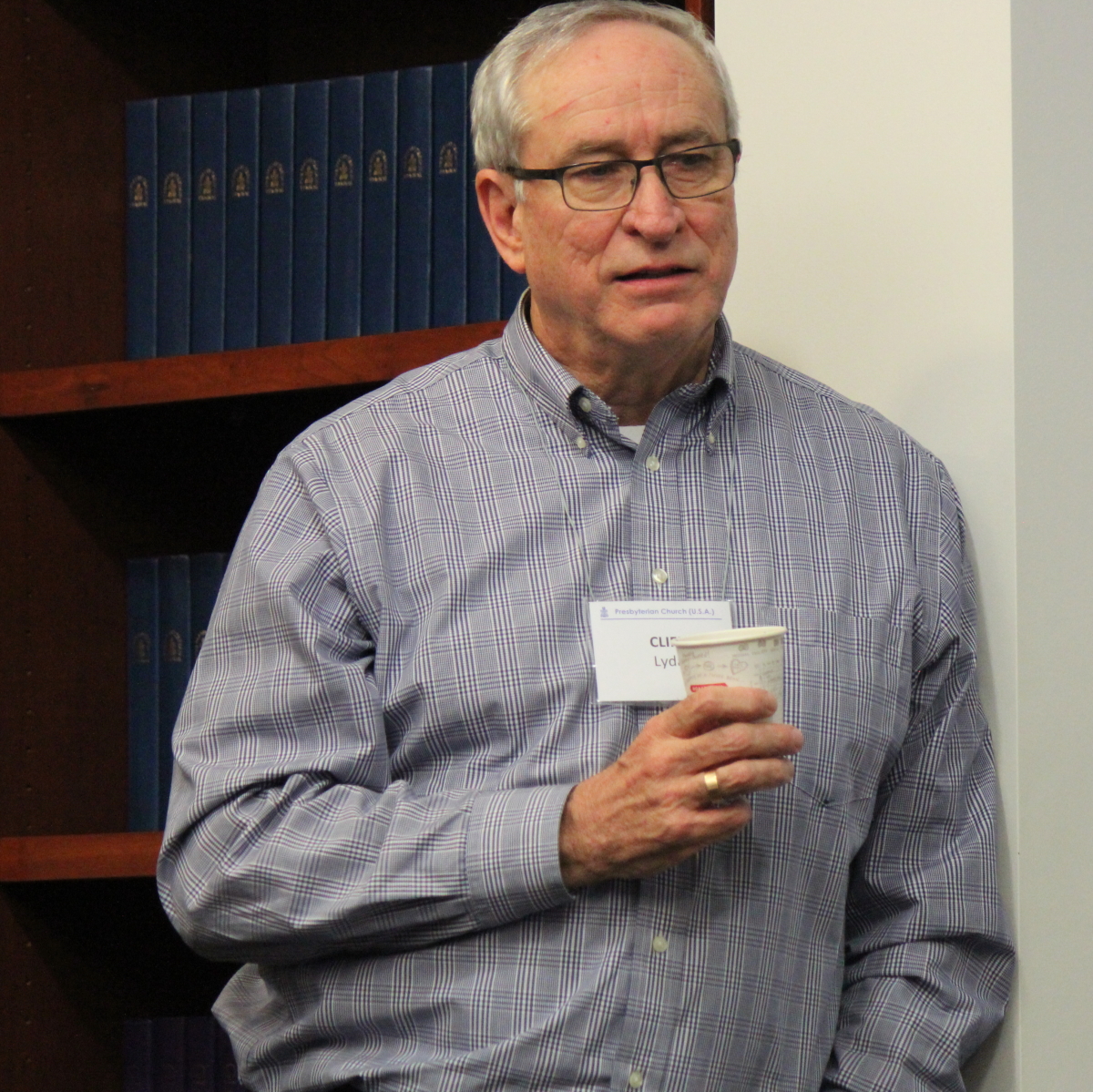
Alternately, why would the commission support a representation on the A Corporation board that the Board of Pensions organization doesn’t want, asked Tse.
“It feels like palace intrigue again,” one commission member said of the behind-the-scenes politics.
Ultimately, the commission voted to support the A Corporation board’s recommendation to the assembly. “They should go ahead and establish the position as they believe it should be established,” Grimaldo said. If the Board of Pensions decides not to nominate someone to that spot, he said, the A Corporation board could fill it with another at-large member.
Agency review. The commission would ask the assembly to appoint committees to review three of the six PC(USA) agencies by 2022; the other three by 2024; and to conduct an All Agency Review by 2026. Also, the review committees for PMA and OGA would be made bigger, so they could form subcommittees to review ASG.
Currently, PMA and OGA are required to use services provided by ASG (such as information technology and human resources) through 2022. A recommendation might call for extending that date to 2024.
Presbyterian Mission Agency Board. The commission is planning to send a letter to the Presbyterian Mission Agency Board, prior to the board’s meeting in Baltimore Feb. 12-14. The commission is raising the suggestion of whether the board is technically a committee (like the Committee on the Office of the General Assembly) and not a board.
Diane Moffett, PMA’s president and executive director, told the commission that a name change “is not a small thing. Your name is your identity.”
And Tse asked, “what’s the end goal for the name change?” With the reconfiguration of the A Corporation board in 2018, the Presbyterian Mission Agency Board has been “stripped of some authority,” he said. “That’s already been done. Why does it matter what the name is?”
Grimaldo said, “I feel we’ve made our point that things are changing at PMA, and the board needs to function differently.” This letter is to ask the board to consider history and context, to clarify its role and responsibilities, and whether it’s time to “change their public expression of who the are right now … and invite them not to be a board.”
What comes next? Will there be another commission after Moving Forward? Grimaldo said people ask him that question all the time. Some commission members said they’re tired – they need to step back from the work – and not sure that another commission is needed.

“If we’re committed to a decentralized authority, I think it’s good for the system not to have a commission in place,” Beene said. “It’s time for the little bird to get out and fly.”
The commission next will meet by conference call Feb. 4.