 A few weeks ago, just as our societal response to COVID-19 was ramping up, I snagged a few frenzied minutes to note – by bullet point – a few reflections.
At the time, I thought it was just the fatigue and chaos that was keeping me from more completed, formed reflections. Well, nearly a month in, I’m realizing that fragments of reflections are all that I can have because unprecedented times cut off our sense of continuity.
So, I present a few more scraps of my thinking with the hopes that we might cobble something better together.
- A microscopic organism has made me take a microscope to my own life. I never knew I touched my face – or wanted to touch my face – as much as I do. I never analyzed the hard surfaces around me with any eye toward the likelihood they held a viral load of COVID-19. But I do this now. All the time. I do this because I feel an existential threat from door handles, shopping carts and the like. All of this has made me wonder why I haven’t taken such an intense, scrutinizing look at the macro issues in our culture. If I can analyze invisible viral loads, why haven’t I analyzed the ultra-visible racism, sexism or classism in our society with the same level of scrutiny and intensity? But actually, I know why: privilege. So, my hope is that this season might train within me some new habits of heart that can be applied beyond a pandemic.
- The fortunate have been able to adjust to the “new normal” of life under a pandemic. But since there will be no clear end to this (at least short of finding, mass producing and distributing a vaccine), even once many states or municipalities lift their stay-at-home orders, we won’t just return to life like it was two or three months ago. I anticipate a whole host of ongoing measures that will become our new “new normal”:
- Continued caution for the elderly and immunocompromised, including recommendations against large gatherings. (How is that going to work for a denomination with a median age that is nearly “at risk”?)
- Prohibitions on gatherings larger than 50 (Does that mean even mid-sized churches have to move to two services? What about the church’s call to invite outsiders in to worship God? How do we account for visitors in our physical distancing calculus?)
- Recommendations to wear face masks when in public. (How will we embrace these as a symbol of love and not fear, especially because they all look straight out of season three of “The Handmaid’s Tale”!?)
- We should be prepared to see Advent/Christmas 2020 changed by COVID-19, as we may very likely see a reemergence of it at this time.
- This Easter – April 12 – was the 487th anniversary of the Roman Catholic Church beginning its heresy trial against Galileo. By June 22, 1633, he would be convicted, and ex communicated. For half a millennium, the church has perpetuated – in one manner or another – a resistance to science. Up until this time, the only ones (generally speaking) harmed by this ignorance was the church. A viral pandemic is revealing, now, how this willful ignorance is really – and probably has been all along – a failure to love our neighbors. This seen today in those churches who have flaunted their First Amendment privileges and continued – against good guidance – to meet, demonstrating again the church’s long-standing distrust of science.
- I hope the 224th General Assembly, currently scheduled for June 20-27 in Baltimore, will be suspended, even if we have to break our constitution to do it. That is all.
- Okay, that is not all. Even if we’re able to resume some sense of our old ways by June, everyone’s focus will necessarily be on their local churches and communities. Refocusing on national-level issues will be difficult, if not irresponsible. Coercing participation in GA this year is the least responsible thing the PC(USA) can do, even if commissioners and delegates are constrained to a virtual meeting. The time and energy necessary for GA can be better spent elsewhere, including in taking time away for a respite after the intensity of this season.
- Additionally, Presbyterian polity was not written for pandemics. Normally our rules are good guidance for pursuing life rather than death. In a pandemic? Not so much. We had better get good at following the spirit of the law, rather than the letter of it.
- This pandemic is a reminder of how contingent our lives are on our natural environments. Even though we say, “ashes to ashes, dust to dust,” it is clear that most Christians (myself included!) are only giving lip service. But, no, we really are contingent upon creation. Best example of this I’ve experienced? Stores have prohibiting shoppers from using reusable grocery bags right now. I always assumed that my ability to exercise creation care was primarily contingent upon my own ethics and will. Not so. An entire infrastructure has to be in place for me to complete this one, small moral action. This example is just a metonym for the whole of our lives. Sadly, our theology is far more ethereal than incarnational and so this reality is causing me more cognitive dissonance than it should. Maybe COVID-19 will guide us to a more holistic theology that accounts for the physical and social nature of our beliefs and ethics.
- “Loss” and “change” are deeply tangled up with each other. Did my church “lose” Holy Week this year or did we “change” it? Pretty much everything about how we’ll feel during this time is hinged on how we answer that question.
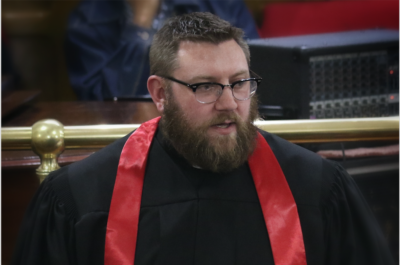 JEFFREY A. SCHOOLEY is the pastor at First Presbyterian Church in Marysville, Ohio, and can be reached at [email protected].