 “Hell,” Sartre has written, “is other people.” If so, then the current shutdown over the COVID-19 virus must seem almost paradisiacal. For an introvert like me, it definitely has its charms: no handshaking, no hugging, no exposure to large – or for that matter, small – crowds and, perhaps best of all, no “passing of the peace,” a ritual I find particularly difficult. And yet, Sartre’s dictum seems in the present crisis to be silly rather than profound, the luxury of one who is well-insulated from the sufferings and the needs of others. One wonders if hell, far from being “other people,” resembles instead the loneliness and isolation that are harbingers of death. Truly when seven walk to the grave and only six return, what it means to be “free” of other people will look less liberating than imprisoning, less like a personal triumph than a bitter defeat. Dante had it right: Hell is a very cold place.
These thoughts were generated by an effort near the beginning of the shut-down to deliver Meals on Wheels to older and indigent folks in our town, who would not be receiving a hot meal for two weeks. A large plastic bag full of canned goods, fruit, bread and vegetables (providing meals for 10 days) were to be delivered to the names on our list, explaining that given the present crisis, Meals on Wheels was going to shut down for two weeks, while trying to figure out how best to serve this population without contaminating them. My wife and I were assigned eight stops in a part of town that consisted largely of government housing and old homes in a neighborhood that was not so much impoverished as it was old and neglected — and in truth, a bit beaten up. The people on our route were old. Not old like 65 or 70, but old like 90 or more. Old like confused and infirm. Their homes, some well-kept and others in various states of disarray, smelled old. Often overheated, with well-worn couches and chairs piled with magazines and papers, and a half-finished breakfast on the kitchen counter, these homes, far from being empty were lived-in, smelly with the life of old people.
Usually, we deliver a hot meal, set it on the counter, offer a greeting and leave. But today, we had to explain the large, black plastic bags, the protocol for the next 10 days and indicate the general uncertainty for the program after that. Our explanations were often greeted with bafflement and required repeated attempts to clarify what we were bringing and what would be happening.
In almost every case, these dazed and confused recipients of our community’s largesse seemed receptive to our efforts but pleased most of all that someone was knocking on their door. A person. Someone with whom to speak, even to question, even to invite in. Standing on their front porches, entering their homes, we were the biggest thing that was going to happen to them that day. Some seemed grateful, others merely accepting, but all were more than ready to engage in some form of personal encounter. To have a real person to talk to was an unexpected gift.
My greatest fear about the COVID-19 shutdown is that we will get good at avoiding just such encounters. The technological wonders of virtuality, toward which we were already moving, now appear not only more attractive but also safer and, in many cases, just as effective. Soon, if not already, we will be able to live without “other people,” or at least, without engaging them in person.
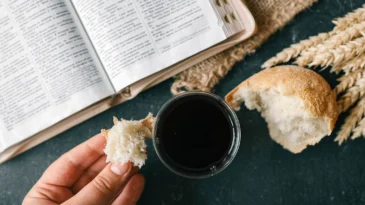
The congregation where my wife and I worship, like so many other congregations today, is livestreaming its services, which is a gift to the rest of us who are now “shut-in.” I am grateful for this option, which is far better than my private devotions and in truth, provides some measure of connection with others. But it is not the same. In fact, this experience of being “shut-in” has reminded me of how often Jesus touched those whom he healed, how the psalmist insisted that the goodness of the Lord was something that could be tasted and seen, how Jesus, in giving his disciples one last gift, shares with them his body and blood in bread and wine. Despite the efforts of some of the best theologians in our tradition, such gifts cannot be spiritualized or reduced to what memory can recall or dismissed altogether. “This is my body” is not a virtual reality.
Nor is it merely a liturgical or ecclesiastical inconvenience. What is being thrown at this stupid virus today is not just the intellectual or even spiritual gifts of medical experts, but precisely the bodies of nurses and doctors, orderlies and first responders, all of whom are sacrificing their bodies that others might be treated and even healed. Theirs is certainly no virtual reality but the all too stark reality of an embodied grace that cares for another.
So, yes, I know that the world will change as a result of this virus and the remarkable efforts, not least the technological efforts, employed to defeat it. And for all I know, the resulting world will be better and even more equitable than the one we currently inhabit. But I hope we will not forget what a privilege it is simply as Christians to meet together, to worship together, to engage with one another in person. There is something, as Dietrich Bonhoeffer knew, about the heart of the gospel that calls us into a life together— not a life of silent privacy or virtuality, but the smelly, fleshly, joyfully carnate life together. From the isolation of an underground seminary, and soon to be imprisoned, Bonhoeffer in “Life Together” reminds us:
“The physical presence of other Christians is a source of incomparable joy and strength to the believer. … The believer need not feel any shame when yearning for the physical presence of other Christians, as if one were still living too much in the flesh. A human being is created as a body; the Son of God appeared on earth in the body for our sake and, was raised in the body. In the sacrament the believer receives the Lord Christ in the body, and the resurrection of the dead will bring about the perfected community of God’s spiritual-physical creatures. … The prisoner, the sick person, the Christian in the diaspora recognizes in the nearness of a fellow Christian a physical sign of the gracious presence of the triune God. In their loneliness, both the visitor and the one visited recognize in each other the Christ who is present in the body. They receive and meet each other as one meets the Lord, in reverence, humility, and joy.”
So may we rightly long for what we do not have, looking forward to what one day we will have again, and celebrate with grateful hearts the life that is ours, even now, in the body of Christ.
 Thomas W. Currie is professor emeritus of theology at Union Presbyterian Seminary in Charlotte, North Carolina.