Never read the comments
There is an adage in the social media lexicon: Never read the comments. Media outlets frequently curate their comment sections. Many curators simply turn the comments off. The social media era counts long-held conventions of civil discourse among its casualties. Comments sections, which should have been places for ideas to be discussed and debated, have become snarky, mean-spirited clearinghouses for ad hominem attacks and clapbacks. Envisioned as spaces for dialogue, they quickly devolved to disproportionately serve anger, fear and outrage. Whenever I dare to read the comments, I am usually reminded of the words of Wendell Berry: “Praise ignorance, for what man has not encountered he has not destroyed.”
The old Reformers explained it well enough: The weight of sin and the errors of human nature make us susceptible to the corruption of our finest ideas and tools. The amount of information provided by the modern media and the internet should make them the greatest tools ever conceived for the bonding together of all people. Instead, their influence is most often lost in the barrage of charges of “fake news” and corrupted by peddlers of false information.
A still greater cause for concern is that the meanness that drives us apart and threatens the common good is not limited to the comments sections on the internet. The meanness is on display in our news, in our protests, in our commentary and in the offices of our highest elected officials. Political fundraising emails devote themselves not to championing a position so much as to evoking fear and outrage over the existence of the “other side.” In these emails, not only is the “other side” wrong, the “other side” is labeled as stupid and dangerous.
The literature is full of both parallel and disparate theories as to the origins of this current malaise. Each month brings new titles from psychologists, sociologists, theologians and political commentators accounting for the source of our deepening divisions. A greater matter of consequence for the pastor, preacher or theologian, though, is the effect of all the meanness and mistrust on the common good. From the moment Jesus said, “Love your neighbor as you love yourself,” he was setting up an architecture of the common good for those who followed him. The source of the dysfunction in our capacity to care about one another is of less consequence than the net effect of how our dislike of those who do not agree with us divides communities with growing speed. Our discord is a threat to the common good that Jesus called the church to champion.
Prophets and Law
Let us not be mistaken. Racial supremacies, immoral income inequalities, violence on our streets and in our schools and other similar societal challenges are the greatest threats to the common good. There is evil in the world. Evil must be condemned. This is not a matter of debate. The church must always condemn racism and the denial of dignity to our neighbors. We must always keep a keen eye upon systems of educational and economic inequity. But we do not have to acquiesce to the dominant cultural patterns of discord in order to consider theologically how our dysfunctional communication patterns across acceptable differences and divisions undermine our pursuit of the common good. We can be good neighbors and be committed to our causes at the same time. We can be tough and compassionate. We can talk with one another and even oppose others without vilifying our opponents.
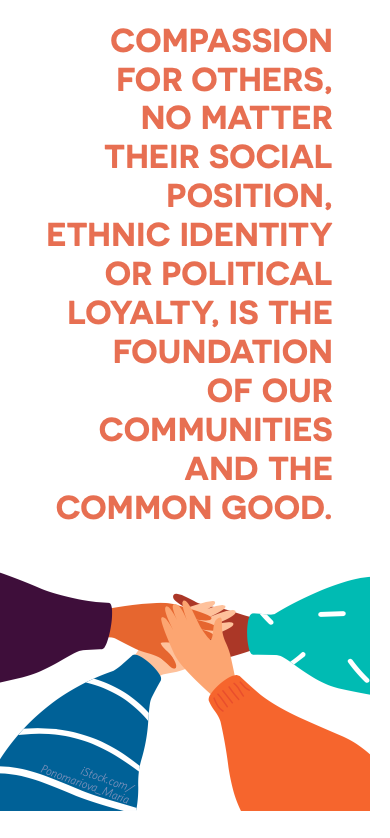 The words community, communication, communion and even the phrase common good share similar linguistic roots. Our community (literally common unity) is totally dependent upon our relationships with those around us, including those who vote differently than we do or who disagree with us on hot-button issues like immigration, gun safety or the implementation of health care reform. The operative question that drives our theological consideration is: What happens to our community, our sense of the God-inspired common good, if we feel disgust towards those who have different political signs in their yards than we do? What happens if we never communicate with those who might disagree with us? How do we love those around us who have offended us? It has long been said by theologians and sociologists alike that a lack of connection with our neighbors produces division. Conversely, knowing our neighbors and learning their stories produces compassion.
Compassion for others, no matter their social position, ethnic identity or political loyalty, is the foundation of our communities and the common good.
The most famous verse of the prophet Micah is instructive. Micah 6:8 says that God requires us to do justice, and to love kindness, and to walk humbly with God. Our great moral contests and debates are fought over justice, and rightly so. Our arguments over justice get intense precisely because the stakes for justice are so incredibly high. We can be justifiably outraged when we observe injustice harming those around us. We cannot love our neighbors and turn a blind eye to their suffering; justice requires action. But in their pursuit of justice, many around us too easily and too frequently gloss over kindness and humility. The common good requires equal parts of all three. Our culture of talking points and celebrity commentators rewards attacking points of view and draws our attention to the extremes. The extremes are extreme because they desire to be either the loudest voices or the only voices heard at the expense of compassion itself. Kindness and humility are never included in the vocabularies of the extremes. The society we inhabit, and sometimes the churches we serve, are experiencing crises of kindness and humility. The prophet required justice, kindness and humility because all three were necessary for personal and communal righteousness. Like a three-legged stool, take any one away and the stool tumbles. Take away any one of the three – justice, kindness, humility – and the common good itself is in danger.
In the Reformed tradition, the three uses of the law championed by John Calvin offer a similar three-legged construction. The first use of God’s law is to demonstrate the righteousness of God in reference to our shortcomings in our attempts to fulfill the fullness of the law; it defines God’s righteousness and our sinfulness. Second comes the ordering of civil life. The law was given not only for personal righteousness but for the maintenance of a common good that served everyone. Calvin rounded out his understanding of the law with a third use: to teach us how to please God by demonstrating the proper use of good works as a frame for the Christian life and the witness of the church. Many theologians in our tradition have pointed out that the law exists not just to make us good neighbors but to show us how we might be advocates for the building of good neighborhoods for all people. Like the prophets, the law guides our witness to the common good.
Enemies, friends and the common good
In a speech now made famous by the contrasting comments of the president immediately following his presentation, Roman Catholic political philosopher, Harvard professor and conservative columnist Arthur Brooks began the 2020 National Prayer Breakfast by quoting Jesus in Matthew 5:43: “You have heard that it was said, ‘You shall love your neighbor and hate your enemy.’ But I say to you, Love your enemies and pray for those who persecute you.” Brooks then went on to tell a story about a speech he once made in Seattle, during which he pleaded for civility and understanding. In the recollected speech, he said: “Political liberals are not stupid, and they’re not evil. They are simply Americans who disagree with you about public policy.” After the speech, a woman approached him and said: “You’re wrong. Liberals are stupid and evil.” At the National Prayer Breakfast, Brooks employed the tension between the words of Jesus in Matthew and the response of the woman in Seattle to demonstrate what he called “America’s crisis of contempt.” Concern over the health of our devotion to the common good is not limited to Presbyterians or liberals or conservatives. The evidence for grave concern commands everyone’s attention.
 It is the common good, compassion and empathy that are under assault. We have become adept at labels, and we have become experts in the marks of varying “tribal” identities. In his book “The War for Kindness: Building Empathy in a Fractured World,” Stanford psychologist Jamil Zaki explains how the emergence of empathy was foundational for the evolution of human families and societies. The difference between Jesus’ command for the “love of neighbor” and the necessity of human empathy is appropriately small. The fully human Jesus gives us a tool – love of neighbor and the resultant empathy for others – for community building. We were made for empathy; God has hard-wired it into us. This is why Zaki’s findings about the state of empathy in America today are troubling. He writes: “The news is not good. Empathy has dwindled steadily, especially in the twenty-first century. The average person in 2009 was less empathic than 75 percent of people in 1979.”
The questions psychologists ask to gauge empathy are not difficult to understand. They are simple and direct: “I try to look at everyone’s side of a disagreement before I make a decision.” From the data, psychologists have proven what the rest of us suspect to be true: We are more adept at naming enemies than we are at making friends. How can we participate in any healthy paradigm for the common good if our energies are increasingly directed away from empathy and devoted to naming and making enemies?
The common good does not turn its gaze away from injustice. It seeks to give ear to voices long silenced. It celebrates people in their amazing diversity as equally valued. It champions as a core value the idea that what is best for all is likely to be best for individuals. It expresses empathy towards others, considers their valid points of view and avoids cognitive dissonance and confirmation bias whenever it can. Most importantly, the common good requires greater investment in making friends than in condemning enemies. Without an empathetic investment in friendships across differences, authentic community is not possible. The crisis of contempt can only be matched by striving to love one another, which is among the most persistent callings and demands of the New Testament.
Changing minds, changing hearts
We should note that a real challenge to a utopian application for the common good is that some enemies are enemies not for a lack of understanding but because they are dangerous to others. It is not reasonable to expect people of color to become close friends with white supremacists. But it is equally unreasonable to pass categorical judgment upon our neighbors because of tweets or Facebook posts. A Christian ethic for the common good requires that we give others the benefit of reasonable doubts while cultivating opportunities for neighbors to love one another.
Question 65 of the Presbyterian Church (U.S.A.) Study Catechism champions the opportunity before us. To the question “Who are the needy?” the Study Catechism replies: “The hungry need bread, the homeless need a roof, the oppressed need justice, and the lonely need fellowship. At the same time – on another and deeper level – the hopeless need hope, sinners need forgiveness, and the world needs the gospel. On this level no one is excluded, and all the needy are one. Our mission as the church is to bring hope to a desperate world by declaring God’s undying love — as one beggar tells another where to find bread.”
 In these words we can decode the influences of Micah and Calvin. The emphasis upon justice is explicit. So too is a calling to kindness. Humility is ever implied. The question and answer bring to mind Calvin’s Geneva, which was as devoted to the common good as could possibly have been expected in the 16th century: refugees were cared for, education was made more accessible and clean water was given away regardless of nationality. The mission of the church is clearly declared: “to bring hope to a desperate world by declaring God’s undying love.”
It is “God’s undying love” to which we must devote our gaze. It is that love, exemplified through the high calling of Jesus, that fuels our hope for a renewed age of community. This calling gives us hope for a common good that lifts all people in its rising tide. God’s undying love is not unleashed upon the world in order that we might continue to splinter. Rather, it points us to the prayer of Jesus in John 17: that we all – emphasis all – might be one.
I recently asked my friend Katie Crowe, pastor of Trinity Avenue Presbyterian Church in Durham, North Carolina, how she speaks across the differences that fracture her city. Durham has challenges: town and gown, because Duke University influences all things in Durham; race and place, because her city has a troubled racial past and present; rich and poor, because Durham simultaneously claims many of North Carolina’s wealthiest and poorest communities. She told me that the work is hard. She takes the challenge of the common good across the divides to God in prayer. She said: “God has taught me that it is easier for Jesus to change a heart than it is for me to change a mind. God has called us to work the tool that Jesus gives us: love.”
She is one of the wisest and best pastors I know. Her words point us back to Jesus, who sets the parameters for the common good when he says that we are to “love one another as I have loved you.” It is both a high calling and hard work. We will fail repeatedly. But we have no other choice. Law, prophets and gospel ask nothing less from us. For there is something holy and good that occurs when we pray for our opponents and reach across our divides. The very divides that have, sadly, come to plague our time.
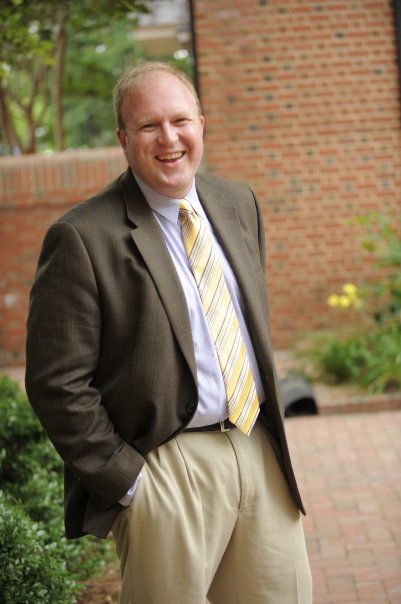 Christopher Edmonston is the pastor of White Memorial Presbyterian Church in Raleigh, North Carolina.