Guest commentary by Carolyn Click
Rain is falling on this dismal spring morning. Like tears, I think. For a moment, I can’t breathe as tears press against my eyelids. But I think that is silly because it is George Floyd who can’t breathe, couldn’t breathe, lying on a Minneapolis street with a brutal knee to the neck.
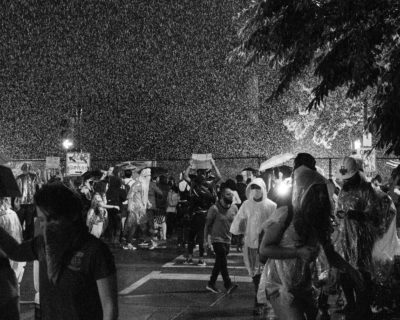
It is too much to bear hearing Floyd’s pleas, his cries for his mother, while the policeman kneels impassively, forcibly, while onlookers plead for Floyd’s life. The streets erupt in protest and violence, tear gas is lobbed, fires blaze.
“Why do the nations conspire and the peoples plot in vain?” The old psalm rises to mind, and I think what a godless, wicked world we live in when figures of authority abuse and disenfranchise the weak. I want to burn down something too, take a torch to attitudes and privilege that allow this atrocity to happen over and over again, a slow holocaust of fear and death.
I imagine myself a brave warrior woman – me, a 67-year-old suburban white woman, wife, mother, teacher, former journalist – springing into action, climbing onto Officer Derek Chauvin’s back, pounding on him until he releases his stranglehold.
I watch too much television.
The week that George Floyd died, I binged the Amazon Prime series “Bosch” about Harry Bosch, a Los Angeles police detective who doggedly pursues cold cases and brings justice to the oppressed. In the season 6 finale, Bosch’s partner J. Edgar is tormented by the murder of his confidential informant, Gary Wise, and the certainty that two of their fellow cops have gone rogue and had Gary killed to protect their drug and firearms dealings.
The drug dealers kill the corrupt officers too, a kind of rough justice, but still there are no answers to who killed Gary. Gary’s father, a retired detective, trails the dealers despite J. Edgar’s warning to stay away from the case. He ends up dead too but leaves a note for J. Edgar: “When the system fails, righteous men rise up.”
J. Edgar asks: What do you think he means?
The psalmist knew, and maybe I do too: “Therefore, you kings, be wise; be warned, you rulers of the earth. Serve the Lord with fear.” In short, do not turn away from injustice.
In his 1963 “Letter from a Birmingham Jail,” Martin Luther King Jr. reminded the white clergy of Birmingham why black people must continue to engage in peaceful protest even in the face of police brutality.
“I am in Birmingham because injustice is here. Just as the prophets of the eighth century B.C. left their villages and carried their ‘thus saith the Lord’ far beyond the boundaries of their home towns, and just as the Apostle Paul left his village of Tarsus and carried the gospel of Jesus Christ to the far corners of the Greco-Roman world, so am I compelled to carry the gospel of freedom beyond my own home town. Like Paul, I must constantly respond to the Macedonian call for aid.
“I cannot sit idly by in Atlanta and not be concerned about what happens in Birmingham. Injustice anywhere is a threat to justice everywhere. We are caught in an inescapable network of mutuality, tied in a single garment of destiny. Whatever affects one directly, affects all indirectly,” wrote King.
Now nearly six decades later, the world is again on fire and peaceful protesters must dodge violent rock-throwers and tear gas and rubber bullets. But they, and I, do not lose sight of the dying, handcuffed man on the ground.
In an interview, Donald Williams, who witnessed the killing of George Floyd and pleaded with police to release him, said he believed he was “chosen” for the task of witness.
The weight of that word, almost biblical, hangs in the air. I replay a clip a day later but the interview has been excised for brevity. Still, I know what I heard.
Instead of shielding his eyes, melting back into the crowd, Williams did not look away from the abyss. Like the prophets of old, he howled his pain against the wicked, not in the elegant language of the Old Testament, but in the street language of the day, live, on national television.
“Bro, they wanted to kill that man, bro,” Williams, keening in emotional pain, told CNN.
The police officer “had no feeling; I don’t even think he had a heart at that moment. And he is going to feel that for the rest of his life,” Williams said. “Just like I’m going to hear my man say this, ‘I can’t breathe, I want my mama.’ And I’m coming to find out that this man died two years and a day that his mama died? I’m a mama’s boy, bro. That shit hurts deep down inside, bro, and like, something needs to be done, something needs to be done.”
The national convulsion of violence is no answer. But good people, people like me who live by faith and “love your neighbor,” are now witnesses once again. What must we do?
We know what we can no longer do. We can no longer throw up our hands over history, over generational poverty, over failing schools, over minimum wage jobs, over mass incarceration as if that is the way things must always be.
Like Donald Williams, we cannot un-see what we have seen. Like him, we must howl our rage at injustice, at brutal, senseless death, at power corrupted. The old, tired, racist system must be dismantled, lest we, as the psalmist warns, are dashed into “pieces of pottery.”
King, writing from the Birmingham jail, said, “We will have to repent in this generation not merely for the hateful words and actions of the bad people but for the appalling silence of the good people.”
I weep as the rain falls.
 A former journalist in her native Virginia and South Carolina, CAROLYN CLICK has covered religion and civil rights in the South. She is an elder at Shandon Presbyterian Church in Columbia, South Carolina, and teaches journalism at the University of South Carolina.