Guest commentary by Liz Rasley
I, after all these years and visits to other churches, can now say with confidence that I grew up in a slightly strange Methodist church.
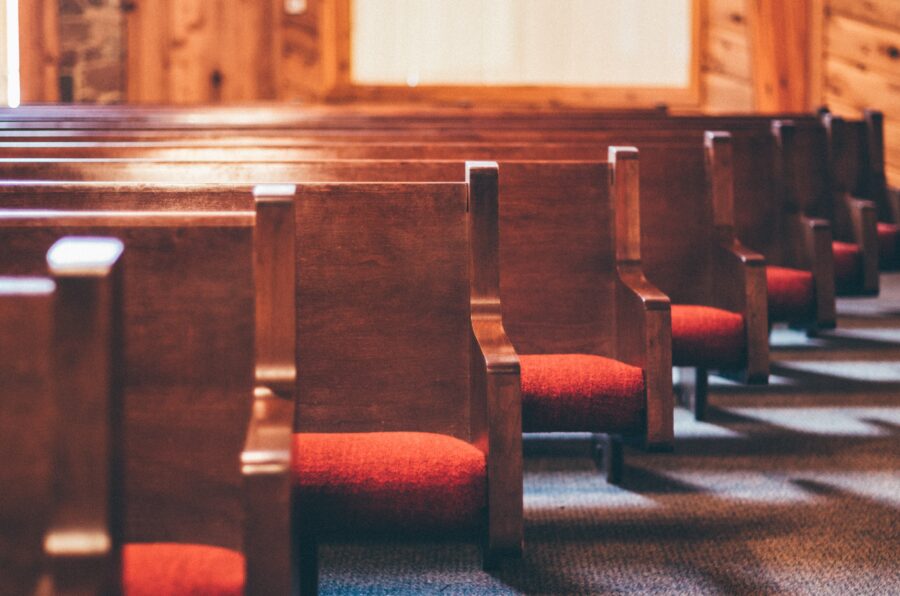
Somewhere along the way, the powers that be decided what we’d be known for was padded seats — yes, padded, separate seats, instead of pews.
That, combined with a minister that was actively balding like a Franciscan monk and leaned hard into it all the way right down to the rope belt, made for some interesting faith conversations at college, and later comparisons when looking for a church in my early 20s. After all, who could compete with that?
For years, I had always wondered why the hard line about chairs. Now, older and far removed, I don’t care so much anymore. I’ve learned that we all have things we hold on to, logical or normal or not. My theory, however, is that a committee was involved — and also, chairs probably pointed back to our “roots” of being founded in an elementary school cafeteria, reminiscent of metal chairs sliding on linoleum.
Now, of course, I’m pro-pew.
When I started dating (and later marrying) my Presbyterian husband, all these “frozen chosen” Presbyterian things were a wild ride. Pews? Like, next to people? Next to people where you could hear them breathe? And yet, despite that closeness, I found a contradiction: I had to try to keep a lid on my emotions and applause during service as I found out the hard way that not every denomination did that. Whoops. But, learning curves and all, it was comfortable. I would be lying if I said I went all in and enjoyed every last bit of it, as there was still some adjusting. Like the busy Sundays when the pews started to fill up and my arms began it itch. What if someone… sat next to us?
But the pews in our first church as a couple were long and generous. And despite hearing the negative side of things and seeing one too many movies depicting long, stuffy sermons in unforgiving stiff pews, overall the pews were not that bad.
Flash forward to 12 years later. We found our true church home, a Presbyterian church that my husband says on repeat to my disbelief, that yes, it is a Presbyterian church. I didn’t believe it at first. I wasn’t accustomed to so many “young people” and such a warm, inviting space with wonderful people and pews. Could all of those exist together?
Pews, I guess, I had in my head somewhere along the way, were for Ancients and Uptights.
This new church home of ours was none of those things. This church had such ease, vibrancy and strong undercurrents of a congregation that were real people with real life, who were real with each other, with a wide breadth of acceptance of one another. But it still had pews. There was still some emotional unpacking I had to do.
A couple of months later, we arrive at our new busy, bustling church, the sanctuary quickly getting packed for the Christmas Eve services. All the kids (plenty of them, everywhere) are excited and chattery and mobile, and families and adults alike are just looking for space to sit. I pat the slim space next to me, saying “here” to a family that looks unfamiliar, with a smile as big (but not too aggressive) as Texas. After all, I don’t want to scare the visitors away.
But when they sit down, my shoulders are scrunched and I feel like I have to hold my breath to make sure we all fit — knowing that does nothing to help the tightness or the size of my rear end.
I stiffen up, moody, and wishing for more space, but catch myself: Oh well.
Oh well, I remind myself. Pews are like this. Close, tight and what a realtor would upsell as “a very cozy space,” but I smile. It is different than what I grew up with to be sure, but it’s not so bad.
Cozy and close and pro-pew can be a great place to be.
 LIZ RASLEY is an elder and occasionally leads children’s moments at her church in Richardson, Texas. Her latest book is “Levity: Humor and Help for Hard Times.”