The Presbyterian Mission Agency Board on Oct. 9 approved budget documents that outline the reductions the Presbyterian Mission Agency (PMA) will make to cope with revenue losses expected in 2021 and 2022 because of the COVID-19 pandemic.
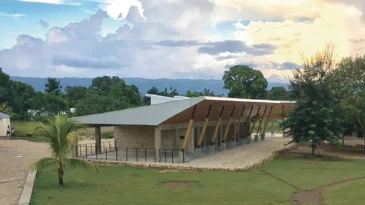
While there was no public discussion of this, immediately after the meeting concluded the Presbyterian Mission Agency announced that it was reducing operations at Stony Point Center and that the remaining 10 staff members would be losing their positions, including co-directors Kitty and Rick Ufford-Chase. The board held at least two closed sessions during the course of its three-day meeting.
Last summer, PMA had eliminated the jobs of 40 of the center’s employees, after the pandemic essentially wiped out Stony Point’s business as a retreat and conference center.
The decision now to let go all or most of the remaining staff – about 10 positions – is an extraordinary turn of direction for Stony Point. Just a year ago, the board approved the first step of a plan to plan to invest at least $10.3 million in capital improvements at Stony Point over 10 years – with Diane Moffett, PMA’s president and executive director, calling the conference center, located about an hour outside New York City, a “treasure” of the Presbyterian Church (U.S.A.) and saying she wanted to make it a center of transformation for PMA’s Matthew 25 vision.

This PMA meeting – held virtually Oct. 7-9 – was originally scheduled to be held at Stony Point. It has long been understood that the ownership of the property at Stony Point is legally complex. If a decision were made to close the center entirely and sell Stony Point, it would not be a simple matter of the PC(USA) selling the property and taking the proceeds.
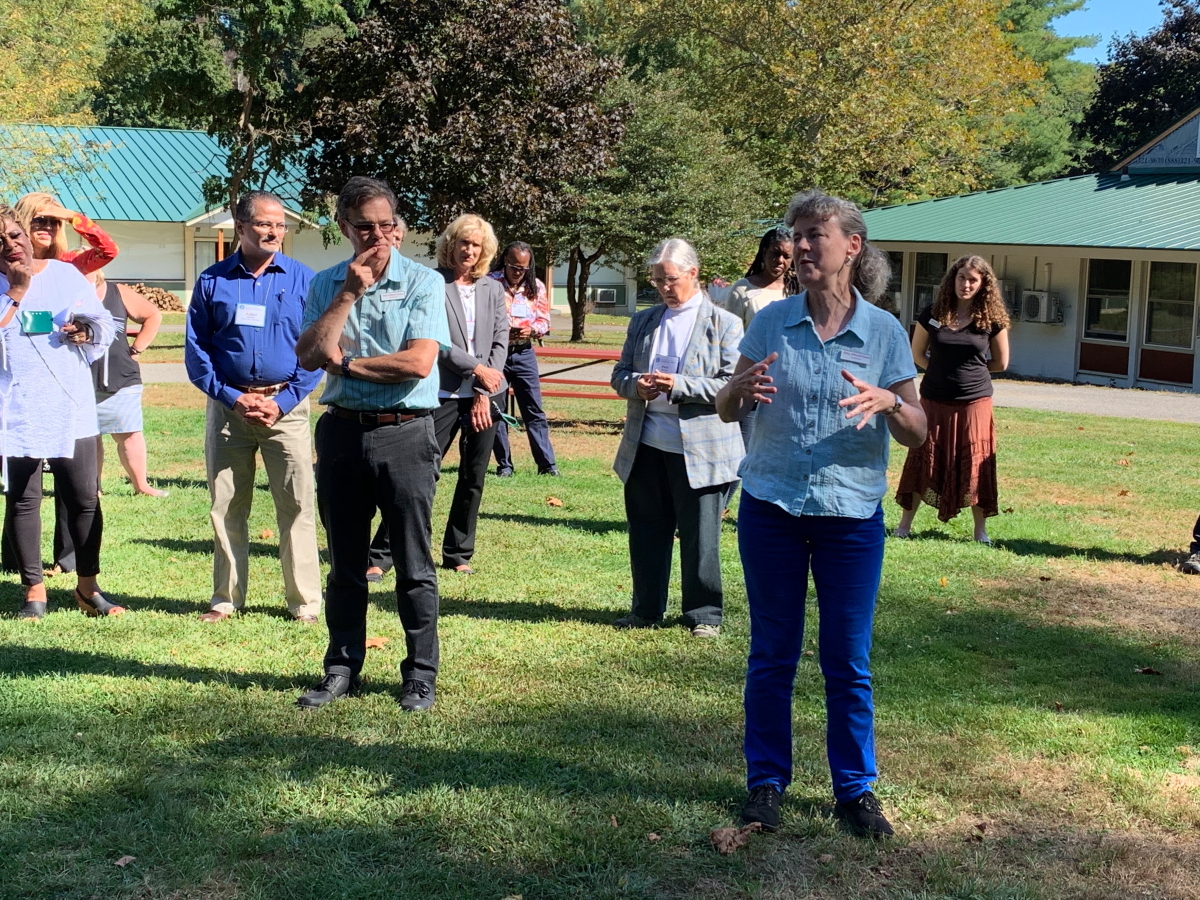
The board also received word Oct. 9 that PMA employees will not receive salary increases in 2021 – part of an effort to hold down costs and avoid layoffs at a time when the PC(USA) at the national level expects a pandemic-related reduction of revenue of 25% in 2021 and 20% in 2022.
“This has been a very tough year,” said board member Nicholas Yoda, in presenting the report of the board’s Personnel and Nominating Committee. The committee “voted with regret that there be no (salary) increases for staff for the 2021 year. All of this is due to the current COVID reality, the budget constraints. … It’s really not something that was done lightly.” The board did not need to approve the committee’s action on that.

Last June, the General Assembly approved budgets calling for reductions in the PMA budget of $8.2 million in 2021 and $6.8 million in 2022 – but gave PMA leaders the responsibility of determining how those budget cuts would be made.
The documents the board approved Oct.9 details where those cuts will be made – with savings coming in part through reduced travel costs, not filling staff vacancies, and reducing the number of grants being made. PMA also has offered an early retirement package to eligible employees, with eight employees from PMA’s national staff and 20 from World Mission accepting the offers.
PMA also avoided deep program cuts and layoffs in part by using $12 million in prior year assets in 2021 and $12.4 million in 2021 – mostly accumulated funds from Special Offerings and undesignated restricted gifts, said Denise Hampton, the PC(USA)’s controller.
But that’s not sustainable long term, Moffett told the board’s Resource Allocation and Stewardship Committee.
Although some program areas are drawing on those funds in response to the pandemic, “absorbing a multi-million dollar reduction cannot happen on a regular basis without long-term programmatic impact,” a budget report states. Read the report here: A.103 2021 2022 Revised Budget Narrative 100620.
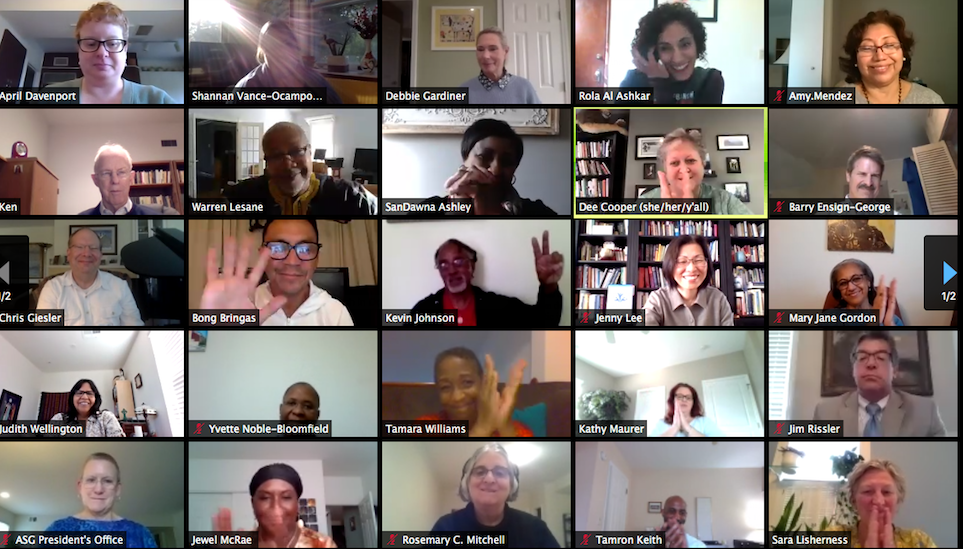
Here’s other action from the last day of the board’s Oct. 7-9 meeting, held via Zoom.
Online child exploitation. The board authorized the Committee on Mission Responsibility Through Investment (MRTI) to file or co-file a shareholder resolution involving an internet and communications firm. That represents a potential new area of activity for MRTI – an effort to address online sexual exploitation of children by corporate engagement with at least one company involved with registering .net and .com domain names.
Such a company could have “power and influence” in curbing online sexual exploitation of children by requiring accountability for domains set up by shell companies or limited liability companies, Katie Carter, MRTI’s associate for Research, Policy and Information, told the board’s Outreach to the World Committee Oct. 7.
The report to the board states that “the exact companies included in the overall ecumenical engagement strategy will be determined later this fall,” andMRTI is likely to discuss the matter further at its upcoming meeting later this month. Read the report here: G.102 MRTI re Online Sexual Exploitation.
Native American properties. The 2020 General Assembly directed PMA and the Office of the General Assembly to encourage the return of indigenous lands and territories – to identify properties held by the PC(USA), A Corporation, that can be transferred to Native American sovereign nations, said Ken Godshall, chair of the board’s Property and Legal Committee. “This is in effect a reparations initiative,” Godshall said.
April Davenport, a lawyer for the PC(USA), said that work had already been begun before the assembly acted, but that research to determine what properties are involved is still underway. An initial review of records from the Synods of Lakes and Prairies found that the information in the synod’s files about who owns particular property doesn’t necessarily match the records of the denomination, Davenport said. When there are discrepancies, “we need to conduct title searches on those properties,” to figure out the recorded title of ownership.
Asked what kinds of properties are involved, Davenport said there’s a range, including church buildings, cemeteries, and vacant land.
Korean church caucus.Board member Michelle Hwang spoke strongly about an issue on which PMA had submitted a comment to the 2020 General Assembly – the question of whether the assembly should officially recognize the National Caucus of Korean Presbyterian Churches as one of the racial ethnic caucuses of the PC(USA).

The Midwest Korean American Presbytery sent an overture to the 2020 General Assembly seeking to have that happen – but that overture was one of many forwarded to the General Assembly in 2022 when the 2020 assembly moved online because of the pandemic, and chose to limit the business it would consider in that virtual format.
Hwang said she wants the board to oppose creating that caucus, citing an incident at the 2008 General Assembly at which three young, female Korean-American pastors spoke against the idea of having a separate Korean presbytery. “Those three voices changed the minds of that assembly, and with that met physical and verbal assaults from the Korean American community,” she said.
Since then, the PC(USA)’s Racial Equity Advocacy Committee (REAC) has dealt with the issue “relentlessly, because there has been a relentless effort by the Korean American church to create a caucus,” Hwang said. “We don’t see the need to give them more power … when they continue not to ordain women in those churches,” and when female Korean-American pastors report discrimination and devaluing.
The comment the Presbyterian Mission Agency submitted in response to the overture states that “the National Caucus of Korean Presbyterian Churches, for all intents and purposes, has been functioning as a caucus in the PC(USA) without the official recognition as such from the General Assembly.”
Hwang said she wants the board to revisit the comment and change its tone, because it “appears to me an endorsement for a Korean American caucus,” and amounts to “a denial of our rights as Korean American women and our calls into ministry. … I would encourage this board to be prophetic and remain strong in asking them to change their ways.”
The board’s chair, Warren Lesane, responded: “We will address it. And hold me to this particular task.”
Floretta Barbee-Watkins also asked for consultation from the Advocacy Committee for Women’s Concerns as the comment is considered.

Grants from restricted funds. Each year, the Presbyterian Mission Agency considers applications from councils of the church for certain restricted funds that have not yet been assigned and whose uses have been limited by the donors – following a process the 1997 General Assembly established.
This year, $121,042 from 16 unassigned funds was available for such grants. And the board approved 12 proposals from among 20 applications, for amounts ranging from $759 to $35,615, and with work ranging from ministry for those with disabilities to training for ministers to migrant ministry. The full list of grants for 2020 can be found here: A.104 RFOS Committee Report 09-28-2020
It began and ended each plenary session with a time of prayer and devotion. During the opening session Oct. 9, board vice-chair Shannan Vance-Ocampo looked at the parable of the Good Samaritan and the question of “Who is my neighbor” through the lens of environmental ethics.

Can the idea of neighbor be expanded to include “a non-human lens” – seeing as neighbors animals, forests, ecosystems? She described the work being done at Soul Fire Farm in Petersburg, New York, which describes itself as a “BIPOC-centered community farm committed to ending racism and injustice in the food system.” (BIPOC stands for Black, Indigenous, People of Color.)
How might PMA’s Matthew 25 initiative be interpreted to include work centered around healing the land, feeding the hungry, and issues of land control, Vance-Ocampo asked. At home, her family has made an intentional effort to pay attention to environmental ethics, replacing the grass in the yard with native plants focused on feeding pollinators – birds, insects and bees – and cultivating a large, prolific garden that provides much of their food.


Last year, Vance-Ocampo and her husband added a small pond. In the first month, two frogs showed up. This year, they had 17. “It just goes to show what will happen if you really find ways to get back and do those healing practices – what God will do, what nature will do, what the spirit will do,” she said.
In the closing devotion, board member Rola Al Ashkar preached about the encounter between Jesus and the Syrophoenician woman – an unnamed woman who sought healing for her daughter, even though Jesus first insulted her. Al Ashkar said she identifies with the woman – she is Lebanese, where the Syrophoenician woman would have been from, and grew up in a culture where “sexism was part of my upbringing,” and in a part of the world where Christians are a religious minority.
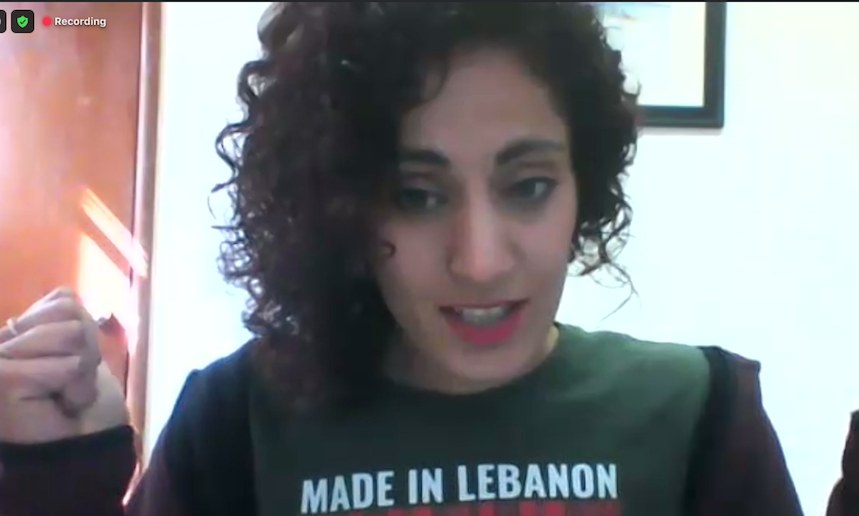
In the story, the woman is identified by what she is not – not Jewish; not male; she doesn’t have a name. But she challenges Jesus – even after he compares her to a dog – and after she refuses to accept his refusal, he heals her daughter.
In his humanity, “even Jesus fell victim to his normative system,” Al Ashkar said. The story is a reminder that all are flawed, all capable of receiving and extending grace.
Near the end of the meeting, the board returned to the concerns of the day, the unceasing cycle of the news – hearing a report from Laurie Kraus, director of Presbyterian Disaster Assistance, on Hurricane Delta approaching Louisiana and Texas. With this latest storm, “there’s a lot of storm surge, there’s a lot of flooding, and Lake Charles is not even close to being dried out from Hurricane Laura” some weeks ago, Kraus said. But “we’re on it,” she said – PDA is already reaching out to presbytery ands synod leaders from the area and extending help.
Vance-Ocampo spoke of the nearing election, of this “tough and tender time” for the nation.
“We have a first-time voter in my house,” Vance-Ocampo said, although “I’ve been taking her since she was two months old to the polls.”
Her final word to Presbyterians:
Vote.