After police officers shot and killed Breonna Taylor in her home in Louisville, what would it take for white Presbyterians to join the community’s push for justice — because she could have been their daughter or their sister?
Why is it so much easier to talk about reconciliation than reparations?
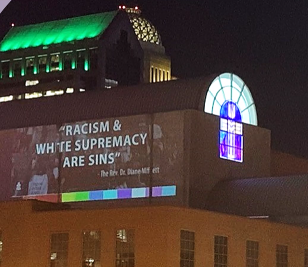
Dianne Moffett, president and executive director of the Presbyterian Mission Agency Board, told the board at the start of its Oct. 7-9 virtual meeting that when the Presbyterian Church (U.S.A.) declared a week of action in August in support of the Black Lives Matter movement, the PC(USA) received significant pushback on social media from white Presbyterians. “Racism is in the water that we swim in,” Moffett told the board.
To truly affirm that Black lives matter – through action and not just public statements – is “going to be a big challenge that is going to cost us if we will be liberated,” Moffett said.
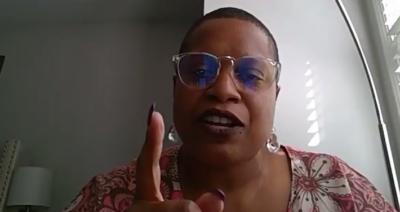
The board started its meeting with cultural humility training focused on economic justice from the Black church perspective. Denise Anderson, who is PMA’S coordinator for racial and intercultural justice, facilitated a panel of three speakers from PMA’s national staff:
- Alonzo Johnson, coordinator of the Self Development of People program;
- Michael Moore, associate for African American Intercultural Congregational Support;
- Carlton Johnson, associate for Vital Congregations.
Alonzo Johnson said he was drawn into the work of justice as a result of “growing up poor and black in north New Jersey.” He remembers asking his mother: “How can God possibly love us when we don’t have enough money to pay the electric bill” or to afford the fare to ride two buses to church?
“The poor are people with their backs constantly against the wall,” Alonzo Johnson said, and as people of faith, “it is our duty to do justice.”
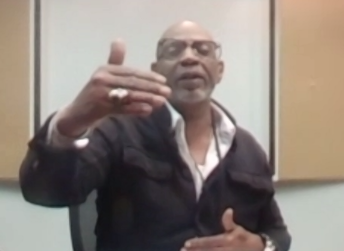
Moore comes to his new position following 25 years in pastoral ministry, including reconciliation work in Baltimore following the death of Freddie Gray in police custody. “I come as one of the traumatized” by the nation’s history of enslaving and oppressing Blacks, Moore said.
What do the history and practices of the Presbyterian Church suggest about the value of Black people and Black churches to the PC(USA)? Anderson asked.
“It’s almost as if we as the church have lost our values, our Christian values, that we are so desensitized,” Moore said. “Here we are in 2020 and yet Breonna Taylor could be shot down in her home, and police exonerated with no justice whatsoever for her and her family. And we seem so desensitized to what just happened.”
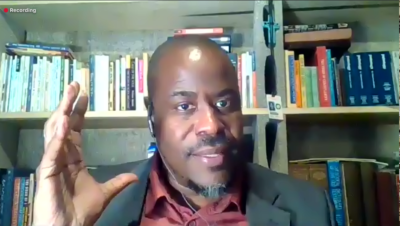
Alonzo Johnson said many white Presbyterians do not recognize or appreciate the contributions of Blacks in the church – people such as Thelma Adair, Robina Winbush, Gayraud Wilmore and Katie Geneva Cannon, to name a few – who have pushed the Presbyterian Church to work for liberation, freedom and economic justice.
“We have to look at how we have not treasured the Black lives in our church,” Alonzo Johnson said — including young African Americans who currently lead mid councils. “Black lives in the Presbyterian Church have not mattered.”
And both Moore and Carlton Johnson said it’s time for Presbyterians to talk directly about reparations.
“You can’t get to healing and reconciliation without reparations,” Moore said.
Christians say, “Jesus died on the cross,” Carlton Johnson said. “Jesus was killed. Jesus was lynched.”
Presbyterians are too inclined to intellectualize rather than take action — “our response to injustice is a letter,” he said. With reparations, the conversation quickly moves to “where are we going to get the money from? We’re sitting on it” — some Presbyterian churches have endowments with millions of dollars. “We are trying to avoid the only conversation there is to have,” that racial injustice demands reparations.
Board member Michelle Hwang encouraged Presbyterians to change their vocabulary, to speak not of reconciliation but of repair. For whites, “reconciliation is so much more comfortable,” Hwang said — they’d rather give dollars than change attitudes. “Reconciliation is too easy a way out.”
And Alonzo Johnson said he began to understand the limits of reconciliation when working with inner city teenagers on an urban arts project — the kind of young people that some older Presbyterians criticize for having saggy pants and an attitude. The teenagers on the streets and older people in congregations need to begin seeing each other as related, as “fictive kin” with a shared future in the human struggle, he said.
In other words, to say “when Breonna Taylor is shot, that’s our kid, that’s our sister” and recognize “that Jesus couldn’t breathe on the cross.”
Carlton Johnson asked Presbyterians to consider: “Are you wanting to follow Jesus? Or are you wanting to go to church?”