I’ve gotten into the strange habit of reading the first few pages of books at the bookstore downtown. I don’t read the author’s bio or look up critical reviews online, I just read the first page. You can tell a lot about a story by the way it begins.
The Old Testament story begins with a bang. There is silence, a brooding darkness and then a voice cutting through the void, giving the nascent world its first breath of life. There are sacred dichotomies, too: dark and light, day and night, creature and creator. It’s an exhilarating way to begin the story of the Bible.
And then there’s the Gospels, our first pages of the New Testament. Mark begins in the desolate wilderness with the camel-skin-wearing, locust-eating, firebrand-preaching John the Baptist. Luke begins with prophetic visions and the infertility of an elderly couple. John begins with a grandiose vision of the cosmos: In the beginning was the word, and the word was God, and the word was with God.
If I were on the fourth-century church council for the selection of canonical books, I would’ve begun the New Testament with one of these three. But that’s not where the story begins. In what seems like an unlikely choice, our New Testament begins with Matthew. Far from the flash of the other three, Matthew’s start is much more subdued, beginning with a long list of names known to the biblical world as a genealogy. Abraham was the father of Isaac, Isaac of Jacob, Jacob of Judah, Matthan of Jacob … Jacob of Joseph, the husband of Mary, of whom Jesus the Messiah was born.
Genealogies are a part of what I like to call the “flyover chapters” of the Bible. When’s the last time you sat down for devotions and thought, “I think I’ll just dive into that long list of names and see what God says”? If I picked up the New Testament at the bookstore and read its first page, I’m not sure I’d buy that book. You can tell a lot about a story by the way it begins.
But in the Bible, genealogy is always theology. These names carry with them histories and stories about people who are thrust into the chaos and pain of life, who play out the reality of God’s presence in a world bent and broken beyond repair. In Matthew’s genealogy there are names like Ruth: a woman caught in famine and grief, a woman from the wrong people, a woman who becomes the great-great-grandmother of Jesus. There are names like David: the underdog king, chief of all sinners, making every mistake in the book, and yet the one after God’s own heart.
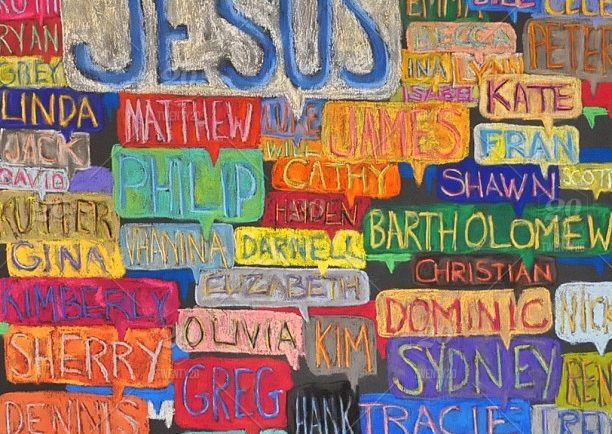
Perhaps the New Testament story begins in this way because this story is about a God whose name is placed next to ours. My wife and I have been talking about boy and girl names for our child lately. Our child’s name will be placed in Matthew’s genealogy, too, alongside all the names who’ve lived within the tragedy and beauty of our collective human story. I take great comfort in this. When the story of my child’s future life ruptures with sadness, when he or she is overwhelmed at the state of the world, this child can count God as one of the faces in the crowd.
The culmination of Matthew’s family tree is the naming of Joseph and Mary’s child-to-be. I was struck this last week as I read the phrase, “The birth of Jesus took place in this way.” The naming of God took place in this way. It took place like the early 2000s coming-of-age movie, “Juno,” a film where a young, quirky high school girl becomes accidentally pregnant by her equally quirky boyfriend. The more her baby bump grows, the more she is judged, the more people whisper, the more people call her cruel names. I cannot fathom the names Mary was called. If young teenage Mary walked into our youth group unmarried and “pregnant by the Holy Spirit,” I’m sure we’d whisper, too.
If you think the modern world would be cruel to a teen mom, you cannot imagine how the ancient Jewish world would’ve seen this young girl, Mary. Her presumed adultery would’ve not only violated one of the sacred laws of Jewish life, it would’ve also meant the possibility of public disgrace — even stoning. We tend to sentimentalize the first advent with our sanitized nativities, but I do not envy the young couple’s position. Maybe they had been planning their wedding for some time. Maybe it was just around the corner after the holidays. Maybe Joseph worked at a small shop just off Main Street, and Mary was a young student with her whole future in front of her. Neither of them came from much in the way of money, but they were overjoyed at the prospect of their future life together. Soon their names will be at the top of marital vows that Joseph will hang on the wall in his office. It took place in this way.
And then pregnancy does what pregnancy does — it changes everything. Joseph doesn’t know how or where or whom, but he does know that the baby in Mary’s belly isn’t his. Being a good man, Joseph decides to “dismiss her quietly,” and just as he’s getting up the courage to break it off, an angel visits him in a dream. “Hey, Joe, no worries, she’s pregnant by the Holy Spirit. Name the kid, Jesus, for he will save his people from their sins.”
Joseph and Mary never got to Google what the top 100 boys’ and girls’ names were; the name of their child was given to them. In the biblical story, names are not just titles. The meaning of a name is the destiny of the child to be. Moses was named “he will draw out,” for he would draw Israel up out of slavery, just as he was drawn out of the Nile. Jacob, father of the 12 sons and 12 tribes, wrestled with God face to face, and left with a limp and the new name, “Israel.” History has proven the name to be true, to be the people of God is to be in a constant wrestling match with suffering and the divine — and be left limping. And then there’s Mary, named after Moses’s prophet sister, Miriam, whose deft action at Moses’ birth led to the deliverance of the entire nation. There’s Jesus’ dad, Joseph, who is named after Jacob’s 11th son, Joseph, the son shoved violently into a pit and sold to spice traders. Joseph, the son who was imprisoned in Egypt and yet became the savior of the world during a time of famine. Joseph, the son who refuses to perpetuate Genesis’ cycle of brotherly violence.
Into this story of names comes the name Jesus. In Greek, his name is Jesus, in Hebrew, Yeshua, in English, Joshua. His name means “Yahweh saves.” His name bears the destiny of deliverance, of saving, of wrapping the world in his arms and taking it beyond death, beyond brokenness. This child-to-be, his name means he shall “save his people from their sins.” If I am honest, I can think of so much in my life that is in need of saving. There’s the endless list of things I feel I should be doing — should be doing more, should be a better person, should be a better pastor, should be in better shape, should be less anxious, should be more joyful, should be less angry, should be more positive, should be more. My guess is I’m not the only one who’s lived much of his life in the poisonous vortex of “should.” Should, says one podcast I love, is where grace goes to die.
And then there’s the loneliness of our days. Loneliness is when a world full of people suffering from the same condition don’t know one another. We tend to think our problems are unique to us, and that if anyone were to know our secret sins, our name would be blotted out from the story. But I believe what is most personal is also most universal. Most of our seething anger for one another, most of our inner sadness and most of our self-hatred is rooted in the universal heartache we all feel deep, deep down in the marrow of our souls. And we cannot stop our heart from hurting on our own. We need to be saved, rescued, healed.
It took place in this way. All of the heavy weight of our collective family stories, all the names we’ve been called, all the ways we’ve not lived up to the names we carry, all the grief and fatigue that have begun to wear us thin to the bone, all of the lights in our eyes that have begun to flicker off and on, all of it is taken from us into the name of this child, Yeshua, Jesus, he will save his people from their sins. He will save “his people,” not “those people.” His. God saves the world by becoming a name in the world, a name to put in the place of all our human strivings and failings, a name to cover our unforgiveness and despair, a name to embrace the whole of our shattered irredeemable selves and a name to speak the word grace into all of our names and destinies at once.
What makes this story more than fairy tale and greater than fiction, what makes it gospel, is the fact that all people are this child’s people — the righteous are his, but especially the unrighteous. The Forbes 500 CEO, but especially the man on death row. The woman who has everything, but especially the woman whose lost it all. The prodigious, 4.0-with-extracurriculars, Ivy-league-bound youth, but especially the lonely kid with a C average who gets bullied after school. The perfect, Instagram-followed church-growing pastor, but especially the pastor who has forgotten the meaning of calling, whose sermon well has gone dry with weary words. British theologian Francis Spufford talks about the surprise of this gospel as he explores the name “Yeshua” in his book beautiful book, “Unapologetic,” writing: “The doors of his heart are wedged open wide, and in rushes the whole flood, the vile and roiling tide of cruelties. Let me take that from you, he is saying. Give that to me instead. Let me carry it. Let me be to blame instead. I am big enough. I am not what you were told. I am the father who longs for every last one of his children. … I am gift without cost. I am. I am. I am. Before the foundations of the world, I am.”
You can tell a lot about a story by the way it begins. It took place in this way. The holy name of God plunged into our humiliation, the name of Jesus placed next to your name, placed next to mine, placed next to every name that ever was and ever will be.