Pastors find a place in my prayers every day, both those known to me and the many who are not. Pastoral ministry today – and that includes church educators and musicians – has to be undertaken in an environment quite unlike what church folk have been used to for generations. The COVID-19 pandemic is a dramatic version of the encounter with a changed and changing culture that has been creeping up on us for years. Before the pandemic, we might have succeeded in putting it out of mind; now we certainly cannot deny it.
On the Second Sunday in Lent, 2020, worshippers came to services as usual, even though some accommodations may have been made in light of the dawning awareness of possible contagion. On the Third Sunday in Lent, we stayed home. All at once, without any warning, pastors, musicians and educators found themselves needing to become instantly acquainted with technologies that few were prepared to tackle with acquired skill.
We are waiting, of course, for a vaccine, or a cure, or whatever will make it possible for us to assemble again as disciples of Jesus Christ have assembled ever since he gathered the first 12. When such a time arrives, we will reflect on what we have learned in a time of diaspora – the church scattered and dispersed – a time of dependency on technological substitutes for assembling. They serve a purpose, and yet lack something critically important: physical presence. Whatever we have learned from the experience of rethinking pastoral ministry virtually should serve to remind us that the church now finds itself in the cultural equivalent of a pandemic all the time. Those engaged in ministry today discover that the world as once imagined by those preparing for church vocations has nearly evaporated.
It used to be possible to assume that churches were a ubiquitous and stable presence in society, and that one could count on people joining and supporting them. The cultural default setting was to approve of religious faith, particularly the Christian variety, and at least tacitly encourage it. Now, society has become more or less indifferent, however benignly. From where Presbyterians stand, the landscape seems otherwise largely divided among evangelicals who look a lot like fundamentalists, religious skeptics who may seem to be the grown-ups in the room and so-called “mainline” Christians who appear to be grateful for whatever crumbs of respect may fall from the grown-ups’ table.
 The word that comes to mind to describe the current situation is “daunting.” To find oneself in pastoral ministry in these times requires bracing oneself against what must seem to be failures and disappointments in large doses. Nevertheless, it is possible to evaluate our situation and see it another way. That is, to see it as the kind of challenge capable of engaging the theological imagination more deeply than ever. In short, a challenge interesting enough to make it worth the effort.
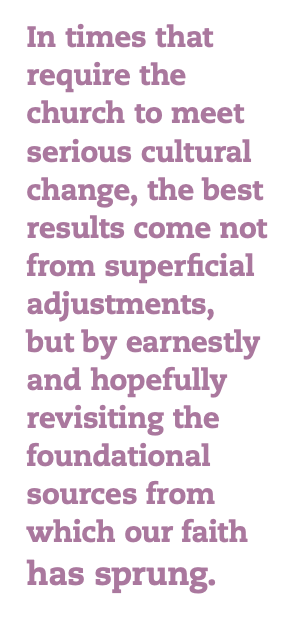
The moment in which we find ourselves is reminiscent of other such moments that have required more of the church than a little tweak here and there. The Reformation is but one example, but it serves pretty well as a kind of template for them all. In times that require the church to meet serious cultural change, the best results come not from superficial adjustments, but by earnestly and hopefully revisiting the foundational sources from which our faith has sprung.
The current pandemic has introduced us, willingly or not, to new technologies. That was also the case in the 16th century, when the new technology was the printing press. Gutenberg’s invention – and I would argue also Zoom and YouTube and Google Meeting and Skype – are supplemental forms of delivery and means of engagement. Supplement, yes; substitute, no. What matters is not the technology itself, but the experience to which it may offer access. In the long run, the technology itself is not the point. If you print a Bible in the vernacular, but no one learns how to engage it in such a way as to preach it and teach it in a new era, printing it has little effect. Likewise, even if one masters streaming technology, the vehicle of delivery is irrelevant if the result seems to amount to a routine replay of what might have worked well enough in 1950, 1985 or even 2009. Motivational speaking, reassuring consolations or demonstrations of “wokeness,” however worthy, will not prove sufficient in the long run, whatever the means of delivery.
The great instances of renewal in the church have been energized by reengaging with the sources in which Christian faith is grounded. In times of dramatic cultural change, a soul-deep longing begins to make itself manifest. Cultural turning points are spiritual turning points as well. They expose what is rightly discerned as a hunger for a vision of the big picture. Actually, nothing less than a longing for God, recognized as such or not. That longing and this sort of hunger are not to be satisfied with spiritual comfort food, not even when wrapped in impressive technological packages.
 The “sources” that are foundational for the Christian gospel include the ecumenical creeds created by and for the same church from which came the New Testament canon, as well as the living church itself, nourished by Word and Sacrament. And certainly they include that source most broadly recognized of all: the Bible itself. To refresh our faith, we need to go back in order to go forward. We revisit, reexamine and reexperience the sources, bringing with us our own contemporary discoveries, issues, concerns, conflicts and limitations.
The so-called “mainline” churches have enjoyed a sort of informal “establishment” status since colonial times. It has been presumed that if one is inclined to look for spiritual nurture, one might as well begin the search at the church one’s grandparents belonged to. Those churches have become accustomed to an almost automatic process of reproducing themselves. It has become easy to assume that those who walk in the door probably know the Christian story already and have been formed in it sufficiently as not to require any strenuous teaching or mentoring. To be fair, many who have presented themselves for membership might not have been patient with or even ready for a more demanding orientation to the faith and mission of the church. They perceived their need for the church differently. So, we have made do with the situation as we have found it. Entry is easy, accompanied by hope that over time and with exposure, newcomers might make use of the many ways of growing in faith that are on offer. Intentional or not, the impression is: low expectations.
But now we find ourselves in a watershed moment — maybe more than one watershed moment at the same time. It is not possible to predict what the future of the church in the U.S. will be, but it is certainly time to give up on the presumption that society is just going through a phase or that the congregation we love can just hire a consultant who will show us how to bring the numbers up again.
From history we can learn where moments of renewal come from — and learn as well that “renewal” does not necessarily equate with high profile “success” as conventionally defined. The critical moment has come to think about how to rebuild a base. A “base” includes both existing constituencies and those now at a distance who may find themselves drawn to the church’s gospel should we commit ourselves to revisiting the sources with confidence in their power to grip the imagination (such as seeing the world and our place in it in a way that is likely to be different from what the common culture sees). Think: higher expectations, to be addressed by more systematic and more personal mentoring processes along with what other generations called “catechesis” — exploring the roots of the faith, bringing with us all the troubling questions that are, and need to be, the norm today.
The historical moment calls for us to learn again how to think theologically, because theology is meant to lead us to God and the things of God. Without even being familiar with the word “theology,” people find themselves asking questions that turn out to be theological in nature. They may not be framing those questions in ways characteristic of academic theology, but the questions themselves are not all that different. Those who preach and teach need to rise to the challenge — not avoiding the big questions, presuming that congregations either aren’t going to be interested in deeper encounters or that they need to be sheltered from exposure to uncertainty or ambiguity. The task today is to identify the theological dimensions of questions not always recognized as such by the questioners, and to look for ways to engage with them at the intersection of personal experience and the experience of the greater, historical church, which has pondered similar questions before. It is even possible, after all, to engage profound questions in a variety of homely ways without the use of footnotes. Even when the most honest answer may be, “I don’t know.”
 Pressing contemporary issues that may be categorized under the heading of “social justice” need to be addressed foundationally; and foundationally means, for the church, theologically. Those who preach and teach can no longer permit ourselves to imagine that our constituents have necessarily made the faith of the church their own faith. James Sanders, when counseling preachers, once said that honesty “means making the effort, on reading any passage in the Bible, to theologize about it first rather than moralizing about it first.”
Whatever preaching and teaching may look like in this new era, it needs to be tuned to the context. The context is a culture that no longer gives the church a pass, not necessarily even a respectful hearing. It is a culture in which we cannot count on anyone knowing anything about Jesus Christ except what they have heard from a radio preacher or from irreverent caricatures. It is not a time, if ever there was a time, for “Jesus-lite.” The moment requires that Jesus Christ as most familiarly known in our Bible and hymnal needs to be front and center in the church that bears his name. You can probably have Confucianism without Confucius, but you cannot have Christianity without Jesus Christ. Jesus is what he taught, and taught what he is. He is the One to lead us as we address fundamentalisms directly, though not scornfully; meet skepticism sympathetically, but not uncritically; and take a hard look at mainline church culture itself, understanding that the day of taken-for-granted institutional immortality is past.
Those in pastoral ministry and their target audiences as well are called to a “conversion of the imagination.” In other words, to encounter the gospel again starting with the scriptural texts, expecting to find in them a meeting place with God and all the faithful, living and dead, as well as those for whom this faith or any other is unknown. Someone is looking for us in that place of meeting.
“You did not choose me, but I chose you” (John 15:16).
 Ronald Byars is professor emeritus at Union Presbyterian Seminary in Richmond, Virginia. His most recent book is “Believer on Sunday, Atheist by Thursday: Is Faith Still Possible?”