Guest commentary by Lou Nyiri
 A father was deep in thought as his child excitedly conveyed something important. The father acknowledged this child while composing an email.
“Yes.”
“Mm-hmm.”
Exasperated, his child, said, “Daddy, you’re not listening to me.”
“I am,” declared the father – not looking up – “I heard everything: Backyard. Playset. Caterpillar. Cocoon.”
He had heard the words.
Two smallish hands took hold of his cheeks – turned his heard downward to the right – staring into his child’s eyes, the child announced, “Listen with your eyes, Daddy.”
To a child, eyes reveal if a parent is fully present and participating in the conversation.
To a parent, eyes might reveal a child’s guilt — while declaring innocence.
To a friend, they reveal discontent — even if words purport that all is well with our soul.
Our eyes reveal a lot: Joy and pain, happiness and sadness, hope and despair.
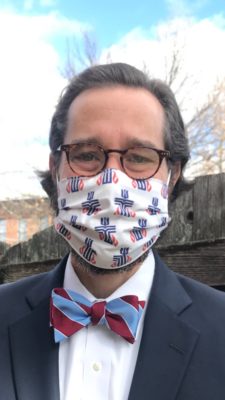
Agnes Pawlowski asked body language expert, Janine Driver: When the nose, mouth and chin disappear behind a covering, will we recognize if a person is friendly? If you smile, will the other person know it?
Driver answers, “Yes.”
“It’s still worth it to smile while wearing a mask,” Driver indicates, because “with true happiness, we see it with the wrinkles on the side of our eyes.”
As a preacher, I plan to use this information: Those aren’t wrinkles around my eyes. I’m just a truly happy person.
And, when a baby’s smile is covered by a pacifier — we know they’re smiling because it shows up in their eyes.
Driver continues:
- Relaxed eyes mean someone feels comfortable. Narrowing eyes, like threading a needle, raise concern: Is the person stressed, upset, threatened?
- Pupils dilate when we feel comfortable and constrict when we see something we don’t like.
The bottom line, Pawlowski indicates, is this: “Our face is huge when it comes to showing emotions, even when a large part of it is covered up. [So,] keep smiling behind the mask.”
Peter Marty, the editor of The Christian Century, wrote, “Our eyes serve as windows into the world.” He discusses how eyes can provide valuable information into someone’s thoughts or even what they may do next.
Think about this when someone speaks to you or another with kind words and harsh eyes.
The Presbyterian Church (U.S.A.)’s medical plan encourages annual participation in the Call to Health program. In addition to a preventive exam every 24 months, participants complete an online health assessment, which reveals areas one excels and those to recommended for improvement.
My recommendation? Take a break from the screen.
Computer, tablet and smartphone screens can leave eyes strained, tired or blurry. To protect and exercise vision, it is suggested to look away periodically and stare into the distance.
This rests the eyes and induces blinking, which rejuvenates them.
Eye doctors call this the “20-20-20 rule” — look up from your monitor, glance out a window and fix your eyes on something at least 20 feet away, for about 20 seconds, every 20 minutes.
Faith requires routine visits with our “spiritual ophthalmologist” — I suggest a 4-4-4 rule:
- Four days a week,
- Every four hours,
- Spend four minutes focusing on faith:
- One minute to look out the window and breathe,
- One minute to read the Bible or devotional,
- One minute to pray — remembering to listen and speak with God, and
- One minute to reflect — write or sketch your thoughts, or see them in your mind’s eye.
Early in the pandemic, the interim executive presbyter in the Presbytery of Carlisle encouraged pastors on a Zoom meeting to look out the window daily and note:
- What do you see?
- What is bringing joy?
- What nourishes you?
- Where is God’s Spirit billowing the sails of your soul?
Psalm 121 declares:
I lift up my eyes to the hills –
from where will my help come?
My help comes from the Lord,
Who made heaven and earth. …
The LORD will keep your going out …
and your coming in …
From this time on…
and forevermore.
We yearn for:
- Renewed vision.
- Relaxed nreath.
- Refocused outlook.
When we lift our eyes up to the hills – we know from where our help comes. We believe (even if our faith is as thin as a fishing line) that our help comes from the Lord who does not sleep and who will keep our lives from this time on and forevermore.
Even during pandemics and presidential elections, it is good to remember that we are God’s people who belong heart and soul to Almighty God.
While we physically distance and wear masks to keep each other safe, we remember our eyes reveal a lot — from tears of sadness to wrinkles conveying true happiness and joy.
United Church of Canada’s moderator, Richard Bott’s “A Prayer as I Put on My Mask,” has become my prayer as I don my mask to go out.
Creator,
as I prepare to go into the world,
help me to see the sacrament
in the wearing of this cloth —
let it be “an outward sign
of an inward grace” —
a tangible and visible way of living
love for my neighbors,
as I love myself.
Christ,
since my lips will be covered,
uncover my heart,
that people would see my smile
in the crinkles around my eyes.
Since my voice may be muffled,
help me to speak clearly,
not only with my words,
but with my actions.
Holy Spirit,
As the elastic touches my ears,
remind me to listen carefully —
and full of care —
to all those I meet.
May this simple piece of cloth be
shield and banner,
and each breath that it holds,
be filled with your love.
In your Name and
in that love,
I pray.
May it be so.
May it be so.
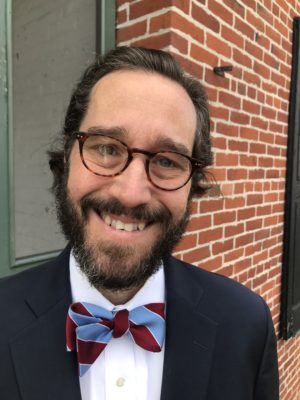 LOU NYIRI is associate pastor at Gettysburg Presbyterian Church in Pennsylvania. He enjoys laughing, coffee, “The Great British Baking Show” and hiking with his wife Candace, his son Alex, and Angus their Jack Russell terrier mix.