Quality mentors are in short supply. In the Harvard Business Review, longtime Wall Street executive Rick Woolworth revealed that while more than 75% of professional men and women want to have a mentor, only 37% have been able find one. What’s more, the mentors they do manage to locate focus narrowly on career advancement, missing opportunities for deeper discussions around behavior, values, relationships, parenting, finances and spiritual life. Concerned about the shortage of mentors, Woolworth founded Telemachus, an organization committed to developing holistic mentoring through intergenerational relationships among emerging and experienced leaders.
Here at the University of Virginia, we too are pursuing the power of holistic mentoring. Theological Horizons, centered at the Bonhoeffer House, is a campus ministry that supports Christians and seekers in academia by providing a welcoming community for engaging faith, thought and life. Through our Horizons Fellows and Perkins Fellows programs, we match undergraduates with older mentors across the university and the community and set them on a journey of relational discipleship.
The best mentors come alongside our fellows to ask big questions, questions of the spirit. “What’s your story? Who are you, really — and who is God calling you to become? What are your commitments? What are your constraints? How will you address the complex challenges of this moment in history — as a person of deep integrity and expansive imagination?” They go deep. And students are ready.
 We serve a generation of young adults who are preparing to launch into the arenas of career and calling — those who will, one day soon, become emerging leaders in the wider world (where, we hope, they will meet companions like Woolworth). Looking ahead, they aspire to more than a “normal life,” when “normal” is defined as, according to journalist Ellen Goodman, “getting dressed in clothes that you buy for work, driving through traffic in a car that you are still paying for, in order to get to the job you need so you can pay for the clothes, car and house that you leave empty all day in order to afford to live in it.”
Again and again, we encourage them to wonder, “What might more than normal look like?” In pursuit of answers, we step across the boundaries of one-on-one intentional friendships to imagine intergenerational mentoring relationships across time and space. We tell the stories of ancient Christians from different contexts and different cultures, embodied witnesses who followed Christ in their own times. They’re the people we sometimes call saints,but they were also sinners, just like each of us.
We have discovered that vintage sinner-saints are beautiful and broken companions for our everyday pilgrimage. They mentor us all, members of the community of saints. Christen Borgman Yates, director of our Horizons Fellows and Perkins Fellows programs, says this: “Vintage Christians are one of the greatest untapped resources of vocational discernment for young adults. These faithful sisters and brothers from diverse backgrounds have experienced it all, often under much worse conditions than any of us will ever know. Sharing their stories of courageous activism, contemplation, doubt as well as hope offers our students new narratives of what it means to live the Christian life.”
Each Friday you’ll find me gathered with undergraduates for a longstanding tradition called Vintage Lunch. Over plates of comfort food, I recount the story of one vintage saint and offer a selected reading for open conversation. As they imagine these faraway lives and discuss the ancient words, students discover rich points of connections with their own experiences, questions, dilemmas and hopes.
When he was about their age, the one who would go down in history as the great “Saint” Augustine cast off his mother’s suffocating Christianity to revel in the superior intellectual and social pleasures of the university. Julian of Norwich survived waves of the Black Death, war and a church in chaos, yet proclaimed God’s absolute goodness. Martin Luther endured lifelong anxiety, even after he’d embraced justification by faith. Brother Lawrence, lacking education and experience, was stuck in a dead-end job, learning, over decades down in the kitchen, to practice the presence of God. Clare and Francis of Assisi abandoned their wealth and privilege to live like Jesus did, impoverished yet free.
Amanda Berry Smith, born enslaved on a Maryland plantation, suffered the worst of systemic racism yet preached the gospel through her fear. Sophie Scholl and her brother Hans, promising college students with a future ahead, resisted the evil of Hitler’s Third Reich — and paid with their very lives. Young C.S. Lewis declared that Christianity was for idiots years before he would surrender to Christ, the most reluctant convert in all of England.
There are, it seems, endless ancient mentors standing near, eager to speak into our lives today.
 Vintage sinner-saints startle us. Shock us. Challenge us. Unnerve us. They show us what more than normal might look like. Sam Powers, a psychology grad student, says: “Sometimes I find I drift into a very routine and settled view of what it means to live the Christian life. Being in regular conversation with the saints muddies the water a bit — in a good way. What would have happened if Dorothy Day sat down with Augustine, John Calvin and Pauli Murray? Something beautiful, I hope, but I’d also wager there would be some shouting. I learn more from the simple fact that the saints diverge in their witness of God. Because if the Holy Spirit can dwell in each of them without God being in conflict with [Godself], it means God really is bigger and wider and deeper than I routinely imagine.”
“Sometimes Christians from the past just make me feel terrible about my non-radical life,” Kendall Gunter (a 2018 graduate) muses before he continues, “but when I can read them from the perspective of God’s causeless delight in me, I see in them a way toward joyful humility, solidarity with my neighbors and hope for God to act beyond my entanglements.”
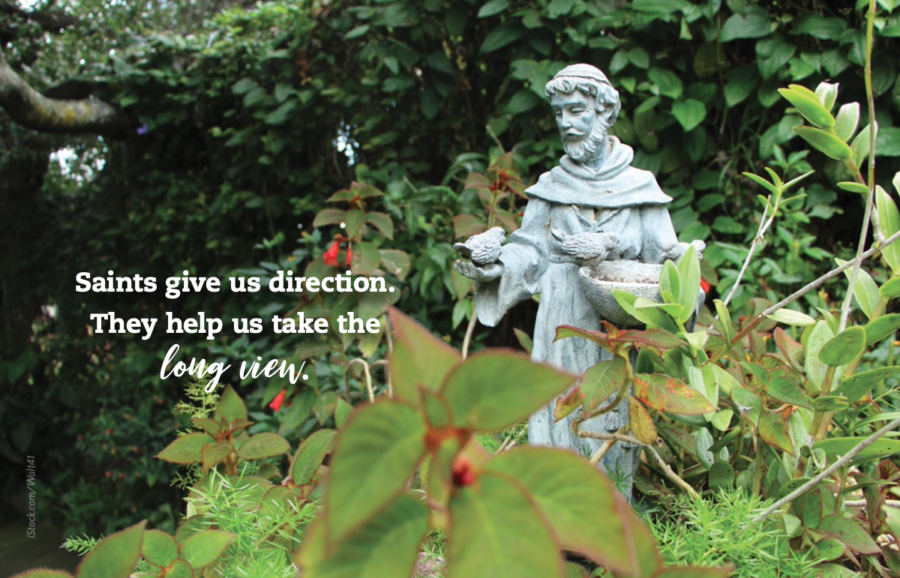
Saints give us direction. They help us take the long view. They expand our vision beyond the particularities of our cultural, historical, theological locations, taking us places where contemporary living, breathing mentors never could. “Reading about relatable historic Christian figures has served as a road map for me,” says Temi Akinola, past Horizons Fellow and global studies major. “I’m reminded that I’m not alone in my experiences or questions regarding the Christian faith.”
As I ask students about their “relationships” with ancient mentors, the theme of reassuring companionship often comes up. Harmony LaJeunesse, now in her second year with Theological Horizons, says: “Learning the stories of vintage Christians has comforted me in my anxieties and afflictions. They’ve shown me that my experiences are universal and have already been experienced and conquered.”
And who doesn’t love the diversion of a good old story, told around a table with food and friends? Katie Catone (a 2020 graduate), now a bilingual parent educator, never missed a Vintage Lunch. She explains: “The reflections and teachings of Vintage Christians offer a much-needed respite from present worries. Immersing myself in these words lifts me out of the whirlwind of my life and reminds me that faith is eternal — and that much of my own personal chaos has a lineage in Christian lives and histories. I believe that the contextualization of Christian thought is vital to a holistic understanding of spirituality; equally important is listening to and learning from the winding paths of those who came before me.”
It can take considerable effort to bring vintage sinner-saints to life. One may not immediately click with Benedict by cracking open his “Rule” for monastics, or may not grasp the genius of Therese of Lisieux’s Little Way by reading “The Story of a Soul.” Christian “classics” can feel inaccessible, dry and sometimes downright bizarre. You’ve got to dig deep to reclaim the palpable humanity in saints’ biographies, to uncover the often hidden vitality in their writings and to give voice to their particular spiritualities.
And of course, too many wise and faithful Jesus-followers are simply unknown to those of us formed in the traditions of Eurocentric church. Juana Ines de la Cruz. Pandita Ramabai. Mary Paik Lee. Mary of Egypt. Howard Thurman. Kateri Tekakwitha. Ephrem the Syrian. Long lost relatives from our family of faith. Mentors with much to teach us about God, the world, ourselves.
Go deeper with vintage mentors
For all of us at Theological Horizons, this journey into the ever-widening company of sinner-saints has been a long, generative one. We’ve searched out resources, written our own book, developed curricula and produced a podcast. Our Vintage Lunches moved to Zoom last spring and now a series of Virtual Vintage is archived on our Vimeo channel. Horizons Fellows and Perkins Fellows write about their experiences on our blog.
“Vintage Saints and Sinners: 25 Christians Who Transformed My Faith,” by Karen Marsh, with foreword by Lauren Winner
A companion to “Vintage Saints and Sinners: 25 Christians Who Transformed My Faith,” a free curriculum with 25 units of PDF readings and leaders’ guides can be found at: karenwrightmarsh.com/vintage-sessions
The “Vintage Saints and Sinners Podcast” with Karen Wright Marsh, is now in its second season. In less than 25 minutes, I tell the story of one ancient Christian and then have a conversation with special guests, including Philip Yancey, Lauren Winner, Larycia Hawkins, Fr. James Martin, Walter Kim and others. Explore the podcast at karenwrightmarsh.com/podcast or subscribe on iTunes, Spotify and elsewhere.
We’re happy to share the pdfs of readings from our ongoing weekly Vintage Lunches at theologicalhorizons.org/vintage.
Watch videos of past Virtual Vintage studies and conversations by searching for Theological Horizons on Vimeo.
Among the many books we find valuable:
“My Life with the Saints,” by James Martin
“Devotional Classics: Selected Readings for Individuals and Groups,” edited by Richard Foster and James Bryan Smith
“Spiritual Classics: Selected Readings on the Twelve Spiritual Disciplines,” edited by Richard J. and Emilie Griffin
“Titles in the Essential Writings” (Modern Spiritual Masters Series) from Orbis Books
Karen Wright Marsh is the executive director of Theological Horizons at the University of Virginia. She lives in Charlottesville, Virginia.