 Before top leaders in the Presbyterian Church (U.S.A.) get to work trying to develop a unified budget for the denomination – with all revenue streams and expenses considered together – how about spending some time discussing the idea of a common vision?
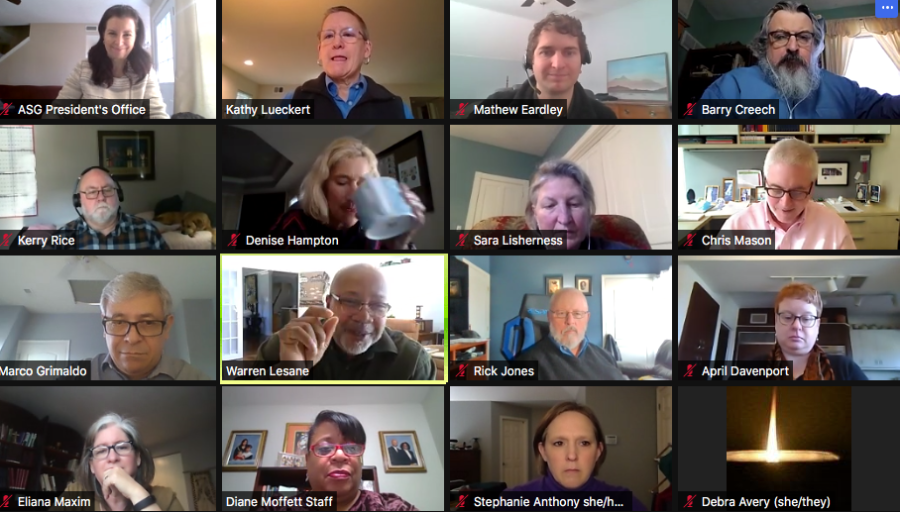
That was the heart of the discussion Jan. 14 during the third meeting of the new Coordinating Table — a group of 15 leaders from the Presbyterian Mission Agency (PMA), the Office of the General Assembly (OGA) and the PC(USA), A Corporation, which provides administrative services for the church.
This conversation was led by representatives from the Moving Forward Implementation Special Committee — formerly a commission with the power to act between General Assemblies, but now a committee with lesser powers. While the Moving Forward representatives are technically not members of the Coordinating Table, they are being given voice and leadership in that forum.
Moving Forward representatives are pushing for the idea of broader, substantive collaboration that goes beyond developing a unified budget.
And they have voiced some frustration — particularly that PMA is committed this year to its own “vision implementation” process regarding PMA’s Matthew 25 initiative, and is reluctant to engage in broader questions, such as the possibility of merging OGA and PMA until that is complete later in 2021.
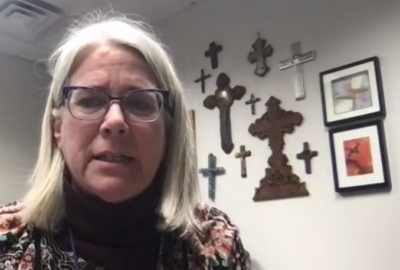
“That doesn’t lend itself to a coordinated conversation or a coordinated effort,” Moving Forward member Debra Avery said during a recent meeting of that committee.
“Silos are alive and well” in the PC(USA), said Moving Forward member Mathew Eardley. “We like to talk platitudes and then go back to our corners.” He wants the Coordinating Table to engage with what he called a simple, high-level question: “What’s best for the denomination and the larger church?”
So during the Jan. 14 meeting of the Coordinating Table, there was an effort to begin to do that — although questions also surfaced about the role that Moving Forward is playing in all this. “What is the role of the special committee” in the Coordinating Table, asked Warren Lesane, chair of the Presbyterian Mission Agency Board. “Are you an equal partner around the table?”
Lesane has several times raised the possibility of bringing in an “uninvolved party,” an outside consultant, to guide the Coordinating Table’s work.
Marco Grimaldo, moderator of Moving Forward, said the Coordinating Table was created through an administrative action the commission took the day before the 2020 General Assembly convened online. “We felt strongly that work that was going on among the agencies needed to be strengthened and reinforced,” Grimaldo said — adding that Moving Forward’s current authority “is more to convene than to compel.”
Then Grimaldo asked the Coordinating Table participants to think about values, through discussing in small groups a series of questions. Among them, what’s most important to them:
- Having one clear voice speaking for the church?
- Developing or reallocating financial resources that allow for both governance and mission?
- Complete independence for PMA?
- Funds development beyond per capita that is managed collaboratively by PMA and OGA?
What about sharing Special Offerings in a new way across the church? How about using unrestricted funds, which currently go to PMA, to pay for some of the expenses of OGA?
In this two-hour meeting, the Coordinating Table didn’t resolve any of the big questions — but the small-group conversation did reveal some PC(USA) realities.
While the General Assembly has said that the stated clerk is the ecclesial voice of the denomination, “in practice we still get mixed messages,” said Eliana Maxim, a presbytery executive and vice moderator of the Committee on the Office of the General Assembly. “For people in the pews, there’s still that muddiness. … They’re getting constantly bombarded by mailings and communications from different offices.”
For congregations, “a more coherent message would be a really good thing,” said Kathy Lueckert, president of the A Corporation.
And the COVID-19 pandemic has pointed out ways that “the traditional ways of doing thing really limit us,” Lueckert said. Throughout the pandemic, she’s been involved with a cross-agency team that meets weekly to make sure there’s an adequate cash flow to support PC(USA) work. From that, there’s a sense “we’re all in this together more than we realize,” Lueckert said. “Our current funding structure limits our ability to be flexible.”
Within the denomination, the origin of the divisions – the silos – seems to be more “where the money is” rather than a matter of programming, Lueckert said.
“It’s an issue of power,” Maxim said. “It is about money and it is about programming, but it’s (more) about power and who gets to determine what happens and with whom and how.”
Some of that power rests with “donors from long ago,” who gave money to the PC(USA) with specific restrictions on how it can be used, said April Davenport, associate general counsel for the PC(USA). That’s significant — because big chunk of PMA’s budget is funded with restricted dollars, whose use is limited by the donor’s intent.
“I’m not sure the law on changing restrictions will be as generous as we might like,” Davenport said. “That power exercised by those donors from long ago will still be with us.”
The church, like the nation as a whole, needs to deal honestly with its differences before trying to move too quickly to unity, Maxim said. “There’s been a lack of truth-telling, of naming some of the hard things we’re wrestling with and some of the things that are unjust” in the PC(USA).
“It’s really hard to move to the unity piece when we really haven’t taken an accounting of what is broken. As good church people, we like to talk in euphemisms and not hurt anybody’s feelings.” But “there have been some real death grips on power within the institutions of the church. And that’s what’s precluded us from making some healthy decisions for the good of the church.”
J. Herbert Nelson, the stated clerk, said the conversation “is often cordial, when we really need to be about truth-telling and dealing with some real issues. The cordiality of it is what prohibits that from happening,” from discussing how the PC(USA) got to this point and why. “We are not having the conversations we really need to have” — for example, “what does merger mean?”
In the end, “the question is whether or not there is a will internally to make it happen.”
How the PC(USA) answers these questions will be central to its witness to the nation at a tumultuous time, Maxim said. If the PC(USA) can’t confront its own struggles honestly, “does it really have any relevance in calling a nation into accountability, if we are not able to face our own history and our own struggles with power?”
The Coordinating Table plans to meet next in February, although a date hasn’t yet been set.