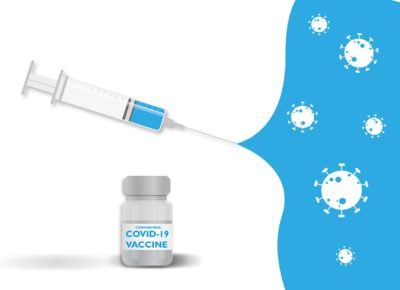
 I’m a 32-year-old pastor serving a wonderful congregation in the Commonwealth of Kentucky. As of the time of this writing, I have not received any COVID vaccinations. Mostly, that’s because they are not yet available (at least officially) for pastors, not to mention my age group. But to some extent, it’s because I am having an ethical dilemma about the whole situation.
Let me pause and state clearly: My dilemma is not about whether or not to be vaccinated. I’m wondering about my place in line. When it is my turn, you better believe I’ll have my sleeve rolled up and tears sliding down my face! I believe in the power of science to continue getting us through this pandemic. I believe in the power of vaccinations to protect all of us collectively, not just individually.
I learned this lesson right around this time last year. I was only a few months into my call when a young couple in my congregation had their first baby. I signed up to bring them dinner one evening and anxiously awaited my chance to lay eyes on this little one — the first baby born in my congregation since I’d arrived. When I got to the family’s house, the baby’s mom greeted me warmly, and said, “Oh, we’d love for you to come in and meet him if you’ve gotten your flu shot!”
My face fell. I had not, in fact, gotten a flu shot that season. And in that moment, I resolved to never again skip the shot so that I might not miss an opportunity as a pastor to celebrate life’s joys and sorrows with my people ever again. My congregant’s boundary, meant to keep her infant safe, made me realize that some of our personal health choices impact the people around us.
Of course, we’ve been talking about that for nearly a year now — mostly in terms of mask wearing. That conversation is expanding to include COVID-19 vaccinations — perhaps especially so when vaccines are available to anyone who wants one.
But in the meantime, this young pastor feels stuck between a rock in a hard place. In Kentucky, pastors have been quietly added to Phase 1C for vaccine distribution. This means we are eligible after healthcare workers, first responders, K-12 educators and individuals age 70 and older. We become eligible at the same time about one million Kentuckians do; our phase includes all essential workers (including pastors, though our profession is not explicitly listed in phase materials), individuals age 60 and older and anyone with the highest COVID-19 risk conditions. For context, that is estimated to be a quarter or more of our state’s population.
We’ve not quite officially made it into Phase 1C yet, even though the state’s target date was February 1. Therefore, I am technically not eligible to be vaccinated — at least according to the state. And yet, I can’t stop thinking about the people I know who are older or more at risk than I who have not yet had the privilege of receiving a COVID-19 vaccine. Who am I to get a jab before them?
You might be thinking, “What matters is shots in arms, not the order in which they are distributed.” I hear that argument. I understand that herd immunity relies on as many of us getting vaccinated as soon as possible. And yet over these past 11 months I have gotten pretty good at being a pastor without being near other people. I feel sad when I realize that, but I also believe it’s what adapting looks like. I do not consider myself high risk for COVID-19 simply because my exposure to other people is extremely limited.
Here’s another thing: If pastors were not deemed “essential workers,” I would not be eligible until Phase 3 of Kentucky’s vaccine rollout plan. That’s the last phase before children are eligible (of course, only if a vaccine is approved for them). And that’s a phase many people in my congregation fall into, too.
The church session recently decided to resume in-person worship and other activities once 70% or more of our city has been vaccinated. It’s a science-based approach, one we undertook based on advice from a public health professional in our congregation and materials from the Wisconsin Council of Churches. I am heartened by our decision because I think it keeps everyone as safe as possible. I also think it helps prevent us from excluding our younger congregants who find themselves in Phase 3, as I once did. Because if we were to resume in-person activities before folks under the age of 40, what kind of our message would that communicate to our young adults? That we don’t really need them present to be our congregation? That they need to put themselves at risk to participate in the life of the church, just because a majority of folks already had the opportunity to be vaccinated due to their age? The church has a hard enough time relating to my generation. The last thing we want to do is communicate that we don’t need them.
Pastoral leadership in this regard is a funny thing. I’ve seen many of friends who are pastors post “vaccies” — selfies on social media when they receive their first dose of a COVID-19 vaccine to encourage everyone else to get a shot when they are able. This is important, particularly given how the anti-vaccine movement has wreaked havoc on our country’s trust of vaccines. Half of me would like to post a “vaccie” too one day soon. But the other half of me wants to bring up the rear, be the caboose on the vaccine train, so that everyone else has their shot first.
Maybe there’s no “perfect” answer, beyond getting your shot when the opportunity presents itself. Maybe this Enneagram 1 needs to stop wishing the process was more decently in order to ensure those with greatest need are vaccinated first. Maybe “servant leadership” looks different in this scenario than I’ve ever imagined it. All I know for sure is I’ve been wrestling with the COVID-19 vaccine.
Until today. Today the congregation my spouse serves decided to resume in-person worship. Now, I am on a mission to get a shot in his arm as soon as humanly possible, so that I can make this situation that’s entirely out of my control even just a little bit safer, and more in control, for my family. And this right here is perhaps where I’ll land on my internal vaccine debate: You never know when your life circumstance will change, when your in-control life will shift and expose you to more people, or new situations. So because we are never entirely in control, when we get lucky enough to get a turn to get a vaccine, I hope each of us takes the opportunity to roll up our sleeve, as tears slide down our faces, and move our world one step closer to a post-pandemic state.
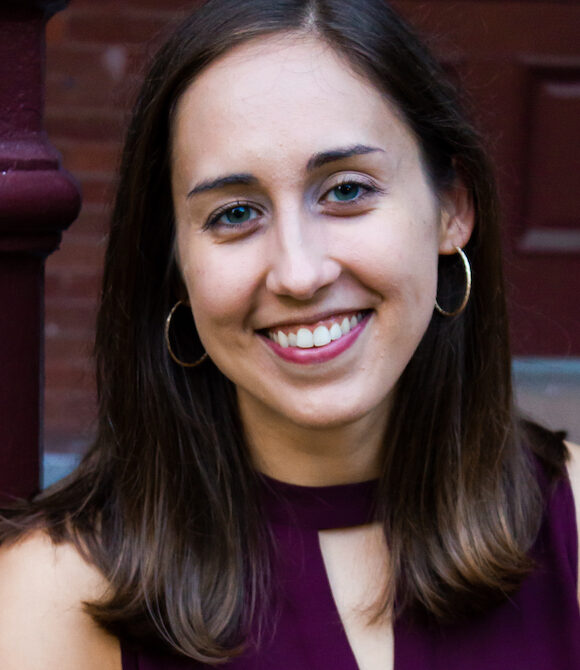 LINDA KURTZ is associate pastor for Christian formation at First Presbyterian Church in Lexington, Kentucky. She is newly married to Daniel, a Methodist pastor. Linda enjoys being outside, reading for fun, and taking photos of anything but people.