An adapted excerpt from Art Is How God Loves Us by Merideth Hite Estevez
$45. For parking. I silently cursed that half of my day’s paycheck would be dedicated to parking because I was running late. As I rushed out of the musty parking garage, I caught my reflection in a shop window: frizzy hair escaping a snow hat and a backpack hanging open. Looking for lip balm, I waded my hand through the “treasures” my 2-year-old daughter, Eva, had asked me to hold — rocks, sticks, and broken crayons. I wiped the fuzz off the tube, smeared it on my cracking lips, and kept walking.
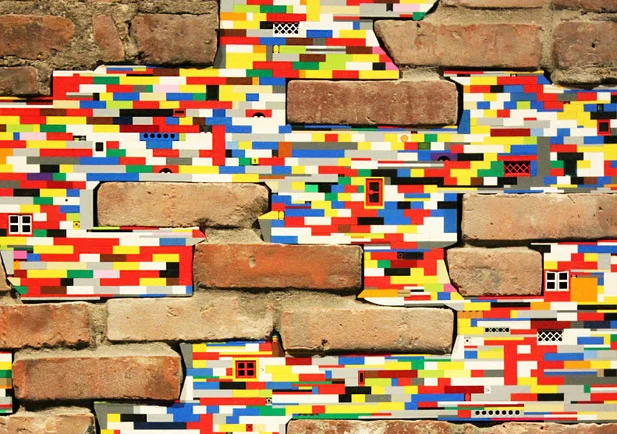
The winter wind made my eyes water as I rounded the corner. The gray afternoon light created a landscape I fit right into: dim and disheveled. But as I waited for the traffic light, my eye was drawn to a bright, colorful square on a brick building.
Wait, are those… LEGOs?
Someone had patched a hole the size of an AC unit with toy blocks. The primary colors glowed in the dreary evening. I paused and laughed out loud. I later learned of “Dispatchwork,” a global project where people mend crumbling facades with plastic bricks. It was chaotic, colorful, and childlike — everything I was currently resisting.
 The next day, under a forecast of more storms, Eva and I went for a walk. In the Genesis story, the raw material of the world is often described as tohu wa-bohu — the “formless void” or “watery chaos.” During a bleak mid-Atlantic winter, those words kept surfacing in my mind. As Eva jumped from one slushy void to the next, I ruminated on my own chaos. Between freelance gigs, infected ears, and snow days, I felt like a car on black ice. Just when I found a rhythm, I’d start skidding.
I was exhausted from trying to outrun the mess, convinced that the only way to find peace was to finally get ahead of it. I’d spent years attempting to make life less chaotic, from color-coding baby hangers to purging closets. Yet, the schedule always fell apart. The closet always returned to a mess of stained onesies and rogue socks.
A week later, during another snow day, Eva was surrounded by a cloud of glitter, glue, and paint. Exhausted by the “industrial-strength mess,” I jumped in to contain it.
“Mama, don’t,” she said. “Art is messy.”
That’s when it hit me: Chaos is the raw material of life. We can’t be creative without it. Ordering the chaos isn’t a problem to solve; it’s an invitation to accept. When we judge the mess, we miss the art asking to be born.
Using LEGOs to mend a crumbling wall is a divine wind across the surface of the deep. It’s an invitation to stop judging ourselves and let God call the mess “good.” What if we met our challenges not by tearing down the structure, but by mending what we can, with what we have?
Creating a life is an art, and art is messy. When there’s chaos, the energy of creation is brimming with possibility. So, here’s to finding the cap to the lip balm and the breath of God’s closeness in the beautiful, chaotic joy of the day. May we call it good—or, at least, good enough.
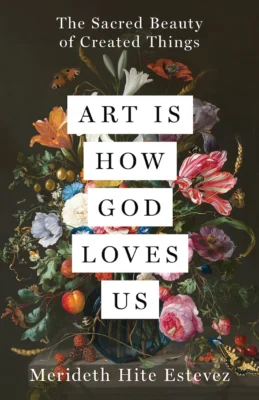
Excerpt from the book Art Is How God Loves Us: The Sacred Beauty of Created Things by Merideth Hite Estevez, copyright © 2026 Broadleaf Books. Available on July 7, 2026. Reproduced by permission.