Now, in early 2021, many people, including some who once doubted, know that the COVID-19 pandemic is deadly serious and distressingly persistent. There is good news: vaccines have been developed in record time, medical personnel and hospital workers continue to care for patients compassionately and bravely, treatment regimens have improved with additional knowledge and experience and some countries have succeeded in keeping case numbers low.
There is also bad news: surges in the number of cases threaten to overwhelm hospital capacity in the United States and elsewhere, wealthy nations snap up vaccines and leave others with short supplies, distribution of personal protective equipment and vaccines is beset with difficulties (some of which reflect government failures), public health guidelines are met with mixed responses and mutations of the virus are emerging.
A genuine Reformed theology claims neither to solve the current crisis nor to equip us to avoid all others in the future. Instead, it interprets our circumstance in the light of key theological rubrics and so helps support faithful living as we look forward to a post-pandemic era.
Consider the rubrics of creation, judgment and redemption or renewal.
 We humans are creatures who participate in a vast and interdependent cosmic ecology as well as its dynamic continuation, a sweeping movement encompassing all that is from galaxies to microbes. As John Calvin said, we experience the gift of existence as well as compelling presences and beauty in this world’s magnificent theater. We encounter important sustaining regularities, such as the brightness of the sun, genomic sequences, families and civil governments, many of which are beyond our own doing and control. But we also encounter destructive forces and occurrences, including alterations in earth’s climate, the deterioration of our bodies and the occasional dissolutions of societies and clans. These may furnish materials and conditions for new realities and possibilities, but there is no denying their destructive force.
As distinctively equipped and intelligent creatures, we can explore, imagine and appreciate the cosmos. We also wield significant powers to understand and to influence environments and courses of events through intentional practices and technologies, including systems of public health, medical research, treatments and vaccines. Even so, our powers of understanding and action are limited, and we are able neither to anticipate nor to control all relevant outcomes and consequences. We are not gods; we are significantly dependent, and so our actions take the form of responses to conditions and events. The search for truth and dependable information to inform our responses – so that we may support human well-being, planetary care and more – is a basic responsibility of human participants in God’s world, which we ignore at our peril.
Still, there is no action without risk, whether raising children, overseeing institutions, plowing fields or sheltering in place. Human life in the midst of interrelations, conditions, agents and events is characterized by uncertainties and anxieties.
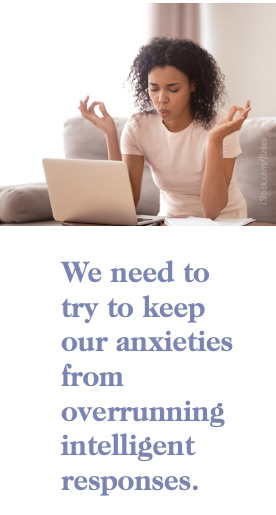
The pandemic has forcefully reminded us of all this. Caught in the grip of a destructive reality we do not entirely control, one pastoral point that needs emphasizing is this: Sometimes there are good reasons to feel anxious. Nevertheless, we need to try to keep our anxieties from overrunning intelligent responses. If we can, we also need to forego destructive tendencies to overconfidence and overreach, as well as to slothful denial and inattention to threatening circumstances.
 Do our experiences of the pandemic also have features that can be interpreted under the (often abused) rubric of judgment? They do if we understand judgment appropriately. The rubric refers not to random destructive happenings, but to deleterious consequences of our skewed devotions to partial interests and communities, our constricted fields of vision and attention and the destructive actions and practices they support. Viruses are for us destructive features of cosmic passage. They may overmatch us, though today we understand important things about them and can also draw on significant medical research and technology to defend against them. Judgment highlights not the emergence of the virus and its destructive force but our own destructive failures, of attitudes and actions — to prepare for public health disasters in general and for this pandemic in particular, and to respond with appropriate intelligence and care.
We need to recognize that when persons, communities and institutions respond to unprecedented situations, missteps and mistakes are inevitable. But we should also pause to consider those loyalties, commitments, attitudes and practices that have rendered us inattentive and uncooperative, and so placed many – especially those with fewer resources – at profound risk.
Think, for example, of long-term social decisions that make for underdeveloped systems of medical care, political disinclinations to recognize and communicate the danger, leaders who vacillate and sometimes balk at crossing ideological divides and conventional interests in order to obtain and organize needed medical tests, equipment and remedies, as well as to plan for trials and tasks ahead. Again, more than a few individuals have failed to practice appropriate measures of social distancing, and it also appears that comparatively little was done to address COVID-19’s potential toll in the poorer global south, in war zones and in refugee camps.
Judgment, when properly understood, focuses attention on the destructive, sometimes horrific consequences of our attitudes and actions that call us to reconsider and to turn. “We have followed too much the devices and desires of our own hearts … we have left undone those things which we ought to have done; and we have done those things which we ought not to have done,” the Book of Common Prayer reminds us.
In this case, the deleterious consequences call us to relinquish shortsighted politics as well as individualist and commercial mentalities and to take up more attentive, responsible and cooperative postures. They call us to re-examine ourselves, our attitudes, lifestyles and commitments, and to turn toward new levels of attention to others and to the general good by strengthening healthcare systems as well as international health organizations and agencies.
 This will not be easy. Recall the challenges of establishing and maintaining the United Nations, an international forum for dialogue and a degree of cooperation designed to include both powerful and less powerful countries, following the destruction of two world wars. When it comes to turning under duress toward more other-directed attitudes and devising more cooperative and responsible structures, humanity’s record is profoundly ambiguous but sometimes also significant. And it seems important not to let the perfect become the enemy of the better or even the good.
Finally, and not apart from anxieties, fears and terrible sufferings, we may also look and hope for traces of grace and the kingdom. Perhaps we shall come to a more accurate sense of our place as capable but also limited, dependent and anxious creatures. Perhaps we will be inspired by glimpses of gracious moral commitment. No doubt, in the face of pandemic, we have seen and shall yet see our share of destructive attitudes and actions — ones that are defensive, irresponsible, callous and xenophobic, ones that are beside the point and ones that put people at risk. But even as we struggle to avoid the cheap assurance borne of false pieties, we may look too for demonstrations, small and large, that show there is often much to admire in people, in their other-directed sensibilities, their impulses to solidarity and their responsible courage. My current incomplete and anecdotal list includes: hospital staff who work long shifts in dangerous circumstances; a divided Congress that sometimes manages to enact relief for persons struggling with layoffs and overdue rent, for small businesses and large employers; providers of essential services — from preschool staff to sanitation workers, supermarket employees, pharmacies, police and fire departments, janitors, government bureaucrats and news media personnel working from home; and schools, businesses, families and friends learning how to communicate remotely.
Are these harbingers? The God of grace willing, we may hope so and also look for better communities and a more humane world. “Comfort, O comfort my people … speak tenderly to Jerusalem and cry to her that she has served her term, that her penalty is paid.”
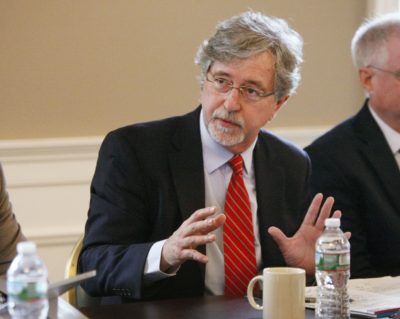 Douglas F. Ottati is the Craig Family Distinguished Professor of Reformed Theology and Justice at Davidson College in North Carolina. His latest book is “A Theology for the Twenty-First Century,” published by Eerdmans in 2020, and this article draws heavily on the “Addendum to the Preface” of that volume. (Reprinted by permission of the publisher.)