Eric messaged me that he would like to meet before he came to participate in the college class I teach. I was a little nervous both about the meeting and my new “big idea” for my Introduction to Peace Studies class. I had veterans visit in the past. They came and read creative nonfiction pieces, talked about their experiences in the military and in war and answered some questions. But they had always just come and gone. Students reported that the experience was important and enlightening, but it always felt too short. This year I had invited some of the veterans to hang out with us for a couple of weeks and do some reading with us — some co-learning.
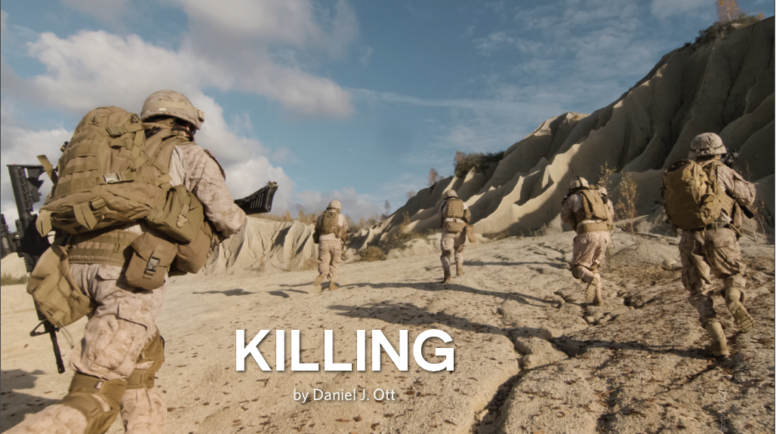
Eric ticks the boxes of what you’d expect of a West Point trained officer. He’s tall, strong, handsome and smart. He was carrying the book I had sent him as he entered the office. My immediate worry was that he was going to tell me what the author got wrong, so I was relieved when he began the conversation by saying that he liked it and found it helpful. I handed him the reading schedule for the class and we started to chat rather comfortably. We talked about his time at West Point and a little about his experience in combat in Afghanistan. At some point in the conversation, he glanced down at the reading schedule looking slightly startled. “Killing,” he said. I had used the shorthand “Killing” on the schedule to indicate that the reading for the day would be from Robert Meagher’s “Killing from the Inside Out: Moral Injury and Just War.” “Killing,” Eric said, “that just jumped out at me. That’s the thing, killing. That’s what war is.”
 Killing is the moral problem with which all warriors must wrestle and killing results in a moral burden, often a moral injury that warriors unfairly bear alone. In broad and general terms, moral injury results as warriors try to navigate multiple moral worlds. When the warrior enters the battlefield, the moral world in which most of us live is suspended. Killing is sanctioned, even required. Loyalty to one’s fellow warriors becomes the highest moral calling and killing the enemy is the clearest means to that end. When the warrior leaves the moral world of the battlefield and reenters the non-war moral world, the warrior is often disoriented. No calling seems to match the intensity and height of keeping one’s comrades alive. But more importantly, the killing haunts the warrior. The warrior struggles to hold together the two moral worlds: Was the warrior a different person in the different worlds? How could killing be wrong in one world and right in the other?
In “Afterwar: Healing the Moral Wounds of Our Soldiers,” Nancy Sherman gives this rough definition of moral injury: “it refers to experiences of serious inner conflict arising from what one takes to be grievous moral transgressions that can overwhelm one’s sense of goodness and humanity.” She insists, though, that “no single moral injury fits all.” Some warriors are haunted by particular, intentional actions like killing a noncombatant who they thought might be armed but wasn’t. Some warriors are haunted by sins of omission — not helping a bystander who was injured or not being able to save one’s compatriot. Some receive injuries “from bearing witness to the intense human suffering and detritus that is a part of the grotesquerie of war and its aftermath.” Moral injury also results when warriors come to believe that they were active participants in a war that was unjust or unnecessary.
Camillo is a veteran of the Iraq War who is featured by Rita Nakashima Brock and Gabriella Lettini in “Soul Repair: Recovering from Moral Injury after War.” He makes the distinction between post-traumatic stress disorder (PTSD) and moral injury. In clinical terms, PTSD is a mental health condition marked by certain symptoms like nightmares, flashbacks, anxiety and suicidal thoughts. Camillo describes it as “a breach of trust with the world.” Moral injury, on the other hand, is a violation of one’s own moral identity, a violation of one’s own internal world. Camillo “fought a war that he deemed to be illegal and immoral. He allowed prisoners of war to be tortured, and he killed unarmed civilians. He also participated in the violation of a land and a civilian population.” All of this was absolutely at odds with Camillo’s own internal moral world, a world left shattered by his experience of war.
 For much of the history of war there has been an effort to justify the killing that leaves warriors morally wounded. Warriors have been valorized, made to be heroes and heroines, even gods. Many times, their killing has been said to be blessed – even commissioned – by God. Many theories and philosophies have been developed to rectify the seeming contradictions of war and non-war moral worlds. Of course, in Christian thought, the just war theory has had a prominent place. While we should hasten to say that the just war tradition was always meant to be a way to limit war, to put moral constraints on the waging of war, it has also often been used as a tool to justify the killing.
The tradition of just war theory is rich and varied, but most philosophy encyclopedias or catechetical resources break it down into seven criteria. Five criteria address the morality of entering war (jus ad bellum): just cause, right intention, proper authority, last resort and reasonable expectation of success. Again, we should emphasize that many thinkers set these bars rather high. Augustine, for example, argued that mere self-defense was not a sufficiently just cause. The goal would need to be to inhibit the aggression of an enemy or, in other words, the goal must be peace not mere self-preservation. The other two criteria justify the actions taken on the battlefield (jus in bellum): discrimination and proportion. Noncombatants should be protected and no more force than is necessary should be employed. The reader may already be thinking of the obvious violations of these criteria that seem inherent to modern warfare. How were the criteria of discrimination and proportion honored in the bombing of Dresden, let alone Hiroshima and Nagasaki? How does one properly guard noncombatants in an age of terrorism, guerilla warfare and suicide bombings? When the United States government characterizes its strategies as “shock and awe” or terrorizes communities with the relentless buzz of its drones, what accounting of proportionality is there?
 Robert Meagher argues that there is an even more egregious blind spot in the just war tradition: the moral injury of warriors. In “Killing from the Inside Out,” Meagher points out that the just war tradition was heavy on jus ad bellum, light on jus in bellum and nearly silent on jus post bellum. We can say that there are basically two classes of participants in war: sovereigns and soldiers. Sovereigns are the rulers who decide when to go to war and whether a war is just. Soldiers obey orders. Just war theory is really for the sovereigns, then. It’s for rulers and church authorities and theologians to justify the killing. The soldier may not ask about the morality of the war. Even in battle, the tactics and strategies come down the chain of command and the soldier has no say in weighing the thin and shaky criteria for just combat. Yet, it is the soldier who is left with the aftermath of war. It is the soldier who is left to deal with the killing after war. Meagher prophetically asks the questions of whether the sovereigns ever consider the wounds of those who survive war and whether they themselves ever suffer from moral injury. “How many emperors, kings, princes, presidents, politicians, or, yes, popes, who have put their lips to the horn of war have suffered from, or at least complained of, moral injury from war? Closer to home, in the recent wars of the twentieth and twenty-first centuries, how many American presidents or members of Congress have suffered from PTSD or taken their own lives rather than live any longer with the burden of having declared a war and sent other men and women off to fight it? I believe the answer to be none.”
In 2010, the Presbyterian Church (U.S.A.) entered into a six-year discernment process regarding its stance on peace and peacemaking. The result was a report to the 222nd General Assembly (GA) called “Risking Peace in a Violent World” and the adoption of five peacemaking affirmations. Chris Iosso, in his book “Five Risks Presbyterians Must Take for Peace,” explains that our internal debates about peacemaking are still reflected in one of the affirmations from the GA report: “Learning from nonviolent struggles and counting the costs of war, we draw upon the traditions of Just War, Christian pacifism, and Just Peacemaking to cultivate moral imagination and discern God’s redemptive work in history.” Here we see an affirmation of several approaches to peacemaking, but the tensions among them are underemphasized in the report and in Iosso’s book. To be sure, these texts helpfully mine all of these traditions for invaluable resources and active approaches to the pursuit of peace. We might be able to piece together some of the strategies of nonviolent direct action with the emphasis on promoting democracy and human rights and working with international systems that we glean from the principles of just peacemaking. But how do we justify any war if we are committed to nonviolence? How do we affirm the often absolutist stances of Christian pacifists if we intend to be pragmatic in our approach to peace? For my small part in drafting the GA report, I tried to push for an emphasis on nonviolence. Nonviolence gives us strategies for dealing with conflict, tactics for combatting injustice and a philosophy that affirms the sanctity of human personhood. In hindsight, I wish I had been more active and pushed for a resolution of these tensions. More specifically, I wish I had raised my voice on behalf of the warriors and asked the church to deal with the question of jus post bellum.
 Herman Keizer, a decorated, retired colonel and chaplain, asks the church to be “a place of grace” for veterans. He suggests that warriors are themselves a kind of stranger that must be welcomed in. But Nakashima Brock and Lettini helpfully clarify what this welcome will need to look like. Creating a place of grace for combat veterans would require the church “to claim our personal and collective moral integrity.” Of course, some injuries like PTSD have individual and clinical remedies. But moral injury can only be healed by communities addressing pressing moral issues. Combat veterans need spaces and media through which they can tell their stories and press their moral questions. They need the support of fellow veterans who better understand what they’ve experienced, but they also need the rest of us to listen hard and begin to hear the moral wrestling that is almost always part of these stories. As Nakashima Brock and Lettini write: “When such dialogues occur, they mine a deeper level of moral questioning in which language moves from being descriptive to being deeply transformative. Speaking about moral injury places morality, justice, and human dignity at the center of public attention and exposes a collective amnesia about war, its victims, and its aftermath.”
One of the peacemaking affirmations adopted by the General Assembly also contains these words: “Even as we actively engage in a peace discernment process, we commit ourselves to continuing the long tradition of support by the Presbyterian Church (U.S.A.) for our sisters and brothers who serve in the United States military, veterans, and their families. We promise to support materially and socially veterans of war who suffer injury in body, mind, or spirit, even as we work toward the day when they will need to fight no more.” In his analysis, Iosso perhaps rightly sees in this phrasing a tacit assumption of a present “need to fight” and a tension that results with our affirmations of nonviolence and peacemaking. But perhaps there is a larger opportunity in this language regarding attending to veterans’ injuries in body, mind and spirit. Perhaps this attention to and support of veterans can lead to the kind of moral questioning and dialogue that Nakashima Brock and Lettini advocate. Perhaps this dialogue will lead us to joining with Meagher and declaring just war a dead letter due to its inattention to moral injury. Perhaps this dialogue will cause sovereigns to finally face the killing.