In its first in-person meeting in more than two years, the Presbyterian Mission Agency Board is filling in the outlines of how the agency will live into the Matthew 25 initiative over the next two years.
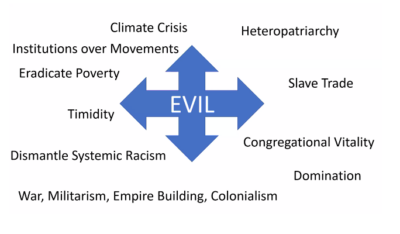
That work centers around the goals of ending systemic poverty, dismantling structural racism and creating congregational vitality. Three other intersectional pieces – addressing climate change, militarism, and gender justice and heteropatriarchy – also are central to the work, according to the Mission Work Plan for 2023 and 2024 that the Presbyterian Mission Agency (PMA) crafted and which the General Assembly of the Presbyterian Church (U.S.A.) approved last summer.
“It’s time for us to step it up,” said Shannan Vance-Ocampo, who along with Michelle Hwang is co-chair of the PMA board. “We may have a lot of people upset with us, but this is who we are supposed to be.”
Vance-Ocampo said, “Matthew 25 work is meant to be transformational for the church” and to be prophetic. She described a church out in the streets, out in the world, “making good trouble.” That can mean partnering ecumenically, partnering with community organizers, and expecting resistance, she said.
“It may not be easy,” Vance-Ocampo said. “It might be confrontational. But it will be gospel work.”
Executive director’s report. Diane Moffett, PMA’s president and executive director, said the theme for PMA’s work this year is “Evolve.”
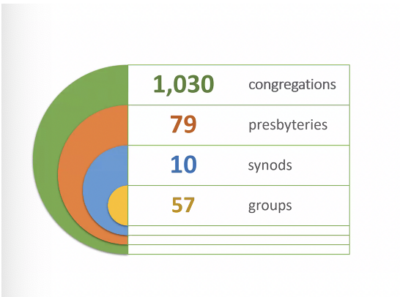
As of Sept. 19, about 12% of PC(USA) congregations and just under half the presbyteries have officially signed onto the Matthew 25 vision, with the numbers growing, Moffett said.
Moffett encouraged congregations and mid councils to use Matthew 25 resources, including:
- a new “Being Matthew 25” iPhone app;
- new lectionary resources;
- and a weekly Matthew 25 podcast focused on that week’s lectionary passages.
Moffett also said the PC(USA) will be featured in a brief segment that will be filmed later this fall for a PBS show called Viewpoint — a segment that is expected to air early in 2023.
And she said PMA is developing an organizational culture code to address the kind of culture (open, loving, patient, kind) that PMA wants to cultivate. “We know there are many positive and negative aspects of PMA culture,” she said. “We are looking squarely at the whole culture,” and expect to have a draft of the code ready by late October.
What’s next? The PMA board now is smaller than it used to be and is reorganizing with new work teams — for administration, Matthew 25 and vision implementation.
Shavon Starling-Louis, co-moderator of the 2022 General Assembly along with Ruth Santana-Grace, asked board members to encourage talented people to apply to serve on a new commission to unify PMA and the Office of the General Assembly and other committees the 2022 General Assembly created — saying applications will be accepted until Oct. 14. The co-moderators need people with heart to apply because “it will be Holy Spirit work,” Starling-Louis said.
Corey Schlosser-Hall, PMA’s deputy executive director of vision, rebuilding and innovation, said PMA leaders hope to announce in October the name of the new director of the Center for Repair of Historical Harm. Schlosser-Hall said he’ll be the start-up director for the Office of Innovation — but in time a new director will be appointed for that office as well.
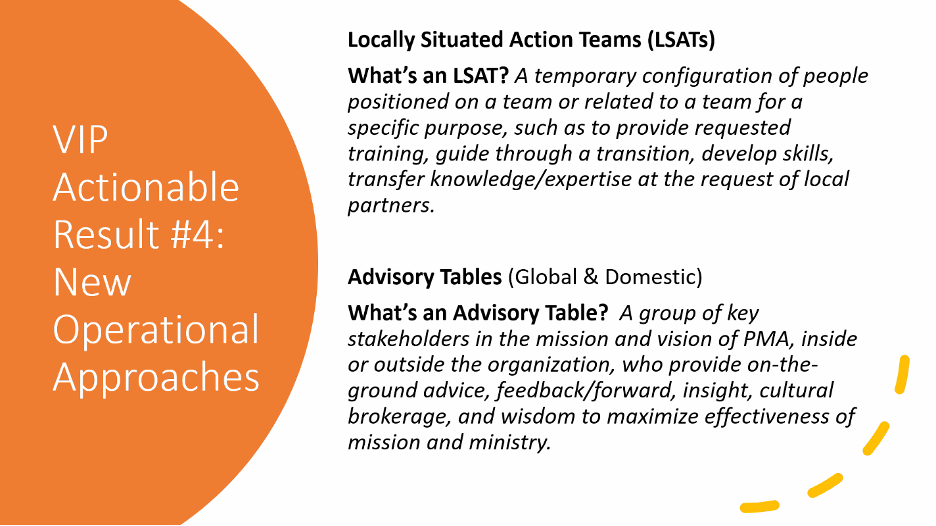
Three locally situated action teams (known as LSATs) are in development, he said — teams that will work intensively in particular places, having been invited in by local partners involved in community organizing. The first three sites: Taiwan, Southern California, and Denver Presbytery.
Moffett asked the board members – some of whom are just beginning their terms – to pray for the work of PMA and for its staff, and to contribute both financially and with their energy to the work. “We’ve got to be really centered in God,” she said. “Add us to your daily prayers,” because “we need the power of the Holy Spirit. We need discernment of God, to be effective.”
And “tell our stories, talk about our impact” — be the bards for Matthew 25 on social media and in presentations to congregations and mid councils, Moffett encouraged the board. “God will give provision for the vision” and – as board member SanDawna Gaulman Ashley preached during opening worship – “we are on the potter’s wheel.”
In recent decades, the PCI(USA) has shrunk in size by about 75% — dropping from nearly 5 million members in the mid-1960s to just under 1.2 million in 2021. “I am not sitting comfortable with that,” Moffett said. “The Holy Spirit is contagious and the church is growing. The issue is, ‘Will it grow in North America?’.”
Vance-Ocampo spoke of the need for the PC(USA) to address directly questions of evil — to figure out “What kind of church? What kind of Christians” does the PC(USA) want to be?
The second day of this three-day meeting will focus on discussion with William Yoo, an assistant professor of American religious and cultural history at Columbia Theological Seminary, about the findings laid out new book What Kind of Christianity? A History of Slavery and Anti-Black Racism in the Presbyterian Church.
“We have a lot to face in the PC(USA),” Vance-Ocampo said, and Presbyterians need to examine what forces and patterns are stopping the church from being faithful to the gospel, what decisions repeat patterns that have broken the church’s witness in the past and continue to do so today.
“There’s a lot of hope out there,” Hwang said — describing a community organizing effort in East Brooklyn that helped bring pressure for affordable housing. The board needs to help PMA cast a vision to “see the world as it should be” and find ways to turn that vision into reality.
That work will be difficult and sometimes confrontational, Vance-Ocampo said. “It may also be [that] we are in a time of pruning,” because people “know what’s in the Bible. They know who Jesus is.” And if the church doesn’t live that out, people will walk away.
“If we don’t think militarism is something we need to address as the church, we are not the church,” she said. Vance-Ocampo said she respects those who serve in the military, as some in her own family have done, but said militarism is “all about domination and colonialism and empire building. It’s about ruining the lives especially of women and children and people who are poor” — such as women and children sexually assaulted in Colombia near U.S. military bases.
Often the agreements governing military bases means “we are exempt from any environmental harm,” Vance-Ocampo said. There is harm to women, children, people of color and the earth. “None of this is what the gospel calls us to.”
The impact of global warming hits the vulnerable hardest, she said.
“What is happening to our climate is unacceptable. Creation is God’s first gift to us. … Jesus did something like 95% of his ministry outside,” but often congregations pay little attention to the eco-systems directly outside their doors.

Stony Point. This Sept. 26-28 meeting in Stony Point, New York, is the board’s first in-person meeting since February 2020, when the COVID-19 pandemic was just starting to gain steam. In a Native American land acknowledgment at the beginning of the meeting, Gretchen Thies Brokaw of the Stony Point staff, who has Shinnecock heritage, presented an armful of produce grown at the center, encouraging board members to wander in the fields and to remember that “we’re all in this wonderful tribal relationship with our Creator.”
“People are yearning — yearning to come back together,” said Deborah Milcarek, general presbyter for Hudson River Presbytery, in greeting the board as the meeting opened. “Yearning to be in the same space.”
Brian Frick, interim executive director at Stony Point Center, said he came to the center 21 months ago to try to shore up the finances and figure out “is there a path forward” for Stony Point, a retreat center about an hour outside of New York City. “The answer to that is ‘yes,’” Frick said.
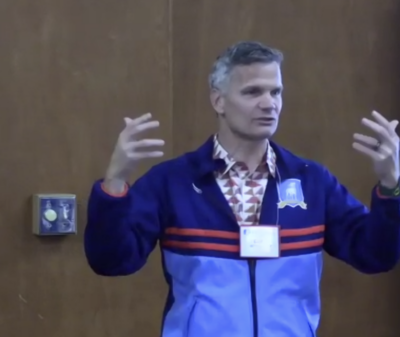
He led the board on a walking tour of Stony Point’s grounds — where, before the pandemic, the Presbyterian Mission Agency Board had considered beginning a $4 million, multi-year fundraising campaign to support a plan to more than $10 million in capital improvements at the center over the next decade. The pandemic put an end to that momentum as travel came to a halt and groups stopped making reservations to meet at the center. In the summer of 2020, Stony Point laid off most of its staff.
Now, Frick said, things are beginning to shift again, and “there is a lot of great Matthew 25 missional alignment going on” with groups meeting again at the Stony Point space.
Don’t accept a narrative of scarcity, Schlosser-Hall urged Presbyterians. “We say ‘yes’” when others might say “no,” or “that might be too hard.”