It’s 2018, and it’s my 36th birthday. My sister and I are biking in a nicely paved nature area. On a whim, she offers to let me try her mountain bike (instead of my road-style bike) to go on a little dirt trail just visible through the woods. I think, “it’s my birthday, why not be daring?!”
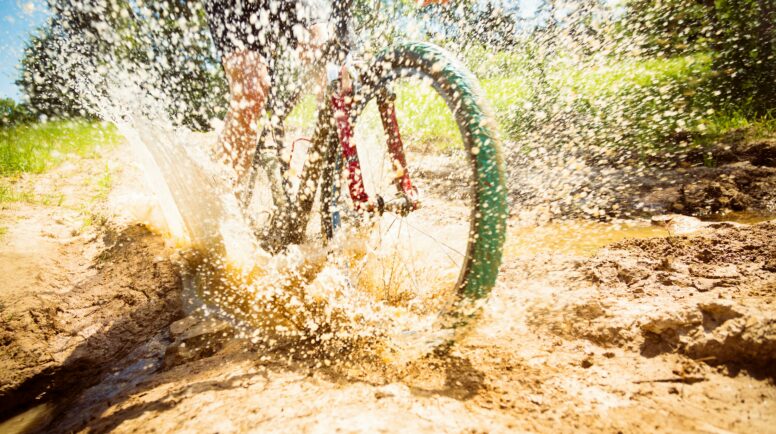
As I wind around trees, my confidence and enjoyment grow. And then I encounter a truly giant puddle full of mud and tire tracks. I didn’t yet know the inadvisability of riding a washed-out trail, so I boldly “go for it.”
… right into the mud, flat on my face.
There’s mud in my eyelashes. In my hair. All over one side of my body.
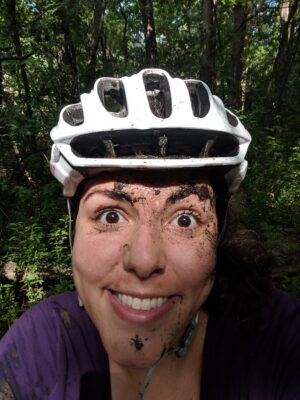
Luckily, I decide this is hilarious, and so does my sister, even the part where I have to walk the muddy bike back through the suburbs to where we had parked the car.
Now, I’m not actually someone who enjoys being covered in mud or totally wiping out (on a bike or in real life), so I could’ve seen this as a sign that I’d met my limit and should stick to the pavement.
But where’s the fun in that?
Let failure be your invitation
I could have let the bruises teach me that I couldn’t mountain bike. I could have believed storylines from my childhood gym classes that tell me I am uncoordinated and should avoid sports. I could have let this be the end of my mountain biking adventure. But I didn’t, and it wasn’t.
Here’s the thing: for almost the first decade of my ministry career, I worked as a chaplain for mental health and chemical dependency at the University of Minnesota hospital, and one thing I learned from the people I sat with is the power of embracing opportunity in the moment — even if, in my case, it comes with a mouthful of mud.
So instead of giving up, I bought a mountain bike of my own and taught myself the skills to ride the trails properly. I let that initial “failure” – a word steeped in judgment and either/or thinking – be my invitation to go deeper.
The thrill of the wind in your hair
What can I say? Riding a flowy trail or nailing a tricky section that I’m only 65% sure I can tackle is … friggin’ fantastic.
As an adult, I mostly move my body to be pragmatic (driving, walking/moving) or functional (exercise), with the occasional impromptu dance party in the mix. When I mountain bike, though, I get to play. I experience the zest of being alive.
It’s so infrequent as adults that we get to lean into full-bodied play. We talk about the value of playing. We play with kids or try to invite a sense of whimsy into our lives. But children play in a deeply immediate, extended, improvisational, un-self-aware way that’s very hard to recreate and stay present with as adults. We mostly lose our capacity to turn off our minds and be fully in the moment for that long — even in our most intimate relationships.
Yet the simplest mountain biking (MTB) trails can guide me back to a version of myself I thought I left back in childhood — a person full of immediacy, imagination and play.
Pick your line
I’ve learned that there are two ways to mountain bike: get a super expensive over-built bike (the Escalade of bikes) and trust it to cover over all your mistakes, or get a simpler bike and learn the skills right from the start. Both can be fun, but I will say that I’ve learned a lot more about myself, my bike, and the trail from the second method.
One skill I love is picking my “line” — the route I want to take through a tricky feature like a rock roll, a series of roots sticking up from the ground, or snaking switchbacks on a trail. If I pick a strategic line, I can sail through with my skills, but if I pick poorly or don’t anticipate the challenges, I might go home with bruises or worse.
This is where I know biking isn’t just a metaphor for spirituality, it’s an expression of my spirituality.
On the bike, I have to trust myself and know when to keep going and when to stop. I have to let go of what anyone else might think of me or my skills and be there only and fully for myself. I have to choose whether I’ll see the natural world around me as an obstacle or as a being with which I’m in a dynamic, humble, and joyful dance. I need to decide how I’ll respect the trail and the others riding around me. I have to pick my line through all of these choices … or chose to stay off the bike when I’m lacking the energy or focus to be safe.
Infinite ways
There are infinite ways toward practicing our spirituality, and MTB has taught me that my own practices and spiritual path will often surprise me. The PE-hating, poetry-loving 8th-grade version of me would certainly never have pictured me now.
Here’s the other truth: MTB is a notoriously expensive, White and male sport. (This article explains it well.) Even though I’m not into the competitive aspects at all, it’s often synonymous with try-hard “bro” culture. And biking, as with other physical activities, can have very ableist dynamics.
As a Latine woman in a bigger body and with a modest income, I’m very aware of the narratives I’ve chosen to resist by choosing this activity: inner stories about “Latinos don’t do nature” or “we don’t spend on frivolities,” and awareness that my body would be judged — all of these thanks to White supremacy culture, including patriarchy, fatphobia, class culture and more.
My awareness of the barriers I experienced (and the ones I didn’t) increases my commitment to widening the circle for all of us to have access to practicing our spirituality in many forms. I use my joy on the trails to energize me for the ways I’m helping build a world where we all can find ways to feel a connection to our bodies, to each other, and to our place within the web of God’s creation.