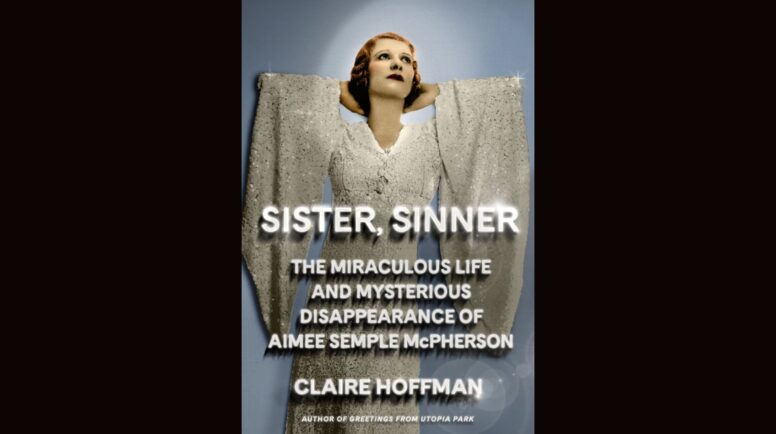
By Claire Hoffman
Farrar, Straus & Giroux,
384 pages
Published April 22, 2025
McPherson was a remarkable female American religious leader when that description fit few others, making her story relevant to Christians today.
Aimee Semple McPherson (1890-1944) was like today’s Joel Osteen, T. D. Jakes, Rick Warren and Joyce Meyer piled into one human frame and jetted with steroids.
And Sister, Sinner captures not just her unmatched Pentecostal fame but also her self-destructive tendencies. That’s a good reason for Presbyterians and other non-Pentecostal Christians to know her story and learn of her adamant devotion to Jesus and what can happen to religious leaders whose moral compass occasionally drifts from true north.
Breathless stories about McPherson filled the front pages of America’s newspapers in the 1920s and 30s, describing her ability to attract huge crowds, build a megachurch in Los Angeles and set the foundation for today’s Foursquare Church — which, as author Claire Hoffman writes, now “counts 67,500 churches with more than eight million members in 150 countries.”
Near the peak of her fame, McPherson disappeared for a month and was presumed dead. In a simplistic version of McPherson’s biography, Foursquare’s website says, “As Aimee’s reputation grew so did the threats. In 1926, she was kidnapped and held for ransom. After she escaped from the tiny shack in Mexico where she was being held captive, the media cast it as a ploy to cover up an affair.”
The story of what happened is inordinately more complicated and contested. Hoffman tells the story fairly, even as she raises difficult questions about McPherson’s veracity. As for the affair, the shack, the captivity and the rest, plenty of evidence allows the reader to either accept or reject it all with almost equal certainty.
McPherson was a remarkable female American religious leader when that description fit few others, making her story relevant to Christians today. From her early childhood on a Canadian farm, she was confident in her relationship with God and in her belief that God wanted her to share the Gospel. Her national and international travel was breathtaking in its scope and frequency, and she somehow managed to spearhead the construction of a booming religious building, Angelus Temple, still active today.
However, the financial and spiritual oversight of her highly theatrical ministry and radio broadcasts was slight, although her mother, with whom she had a push-pull relationship, did her best to keep things solvent and legal. The whole story should remind ministries of any size, shape and foundation of the crucial need for financial transparency.
Hoffman includes a good history of a significant religious movement. Although the 1906 Azusa Street Revival is often associated with the start of the Pentecostal movement, Hoffman digs deeper, connecting readers to its earlier roots in Topeka, Kansas, and to Charles Fox Parham, whom she calls “a mustachioed Iowan with a taste for the mystical.”
These details and the rest of Sister, Sinner amount to worthwhile history that can guide us today — not only so we can avoid the errors of judgment and behavior that marked McPherson’s ministry, but also so we can recommit to sharing the good news of Jesus Christ with a world hungry for generative spiritual direction.
Presbyterian Outlook supports local bookstores. Join us! Click on the link below to purchase Sister, Sinner: The Miraculous life and Mysterious Disappearance of Aimee Semple McPherson from BookShop, an online bookstore with a mission to financially support local, independent bookstores. As an affiliate, Outlook will also earn a commission from your purchase.
Sign up for Page Turners, our monthly email newsletter, to receive book-related content in your inbox once a month.