The news hit us like a gut punch. Just a day after we visited the Silwan district of East Jerusalem, government tractors rolled in at 4:30 a.m., and three more Palestinian homes now lay in ruins. Our group of 15 seminary professors from five countries had observed the persistent, creative resistance of the Palestinian community in the face of the methodical encroachment of the City of David Foundation. This Israeli settler organization has raised hundreds of millions of dollars to remove Palestinian families from the district. Our debriefing time after the visit was full of our observations of Silwan. Only now did we begin to realize how much we hadn’t seen.
Only now did we begin to realize how much we hadn’t seen.
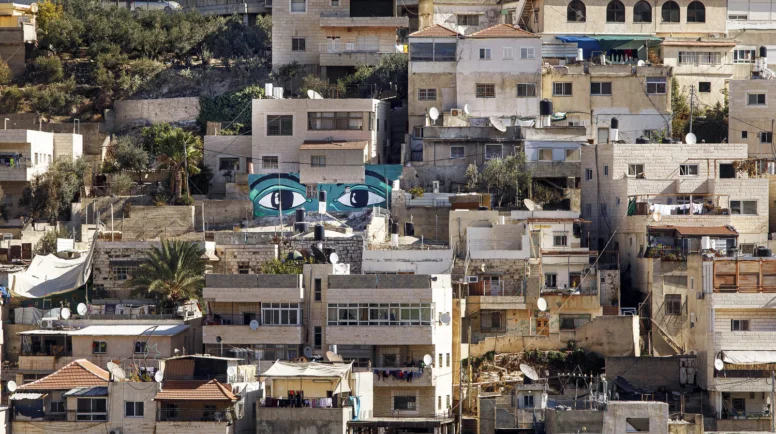
Silwan has been an Arabic-speaking Palestinian community for centuries, situated around the Pool of Siloam, the site where the Gospel of John records the controversial healing of the man born blind. Over time, metropolitan Jerusalem grew to encompass Silwan, transforming it from a sleepy farming village to a thriving district of East Jerusalem. In 1967, Israel took control of the area after the Six-Day War, and by 2010, the City of David Foundation succeeded in gaining control of hundreds of Palestinian properties and renting them to several thousand Israeli settlers. But it has also gained notoriety for the forced removal of Palestinians and the tactics it employs.
The municipal government rarely grants Palestinians a building permit, thus even a family with longstanding property rights to their plot quickly finds itself forced into illegality: the mere act of adding a room for a growing family puts the home in danger of demolition. Eighty percent of the houses in Silwan have received eviction notices.
Even so, the valley is dotted with large murals representing pairs of human eyes silently watching over this invisible violence. The “I Witness Silwan” project has painted more than a dozen pairs of eyes of local and global writers, justice-seekers and martyrs such as Black Lives Matter icon George Floyd, a Palestinian farmer and an Indigenous leader from the Philippines. These visible signs of resistance subtly bring into focus the transnational linkages between the Palestinian struggle and liberation struggles around the world.
On the same day we walked through Silwan, we met Buddour Hassan, an Amnesty International researcher. Hassan is the co-author of the December 2024 Amnesty International report that first declared Israel’s actions to be genocide. She is legally blind. Her painstaking research has helped many to see more clearly what has been before their eyes for too long.
“How is it that a blind woman could see more clearly than most Americans that there is a genocide going on in Gaza?”
“How is it that a blind woman could see more clearly than most Americans that there is a genocide going on in Gaza?” asked Rodney Sadler, associate professor of Bible at Union Presbyterian Seminary.
Our seminary professors’ group thought the unending attacks on Gaza were the hidden story, only visible to those willing to see the genocide unfolding daily on social media. But the trip, organized by Sabeel, a respected Palestinian Christian organization, opened our eyes to the rapid escalation of Israeli land theft and settler violence against Palestinians in the West Bank under the cover of the bombing of Gaza – and now, the attacks on Iran – as something larger and more frightening.
In an email, trip participant Mark Lewis Taylor of Princeton Theological Seminary noted:
“Since I was last there in 2007, when the siege of Gaza was just beginning … Israel’s genocide in Gaza, backed by the U.S., is recognized by the International Court of Justice, Amnesty International, Human Rights Now, two reports of the U.N. Special Rapporteur for the Palestinian occupied territories and many other reputable analysts. So, now, in the West Bank, this only confirms the long-running sense of ‘slow genocide’ that is at work there also. This was sobering … because Israel’s launching of war on Iran was accompanied by putting the West Bank on ‘lockdown,’ closing off almost all of its communities. Closing off for what purpose? Alas, we know.”
In John 9, we find the evocative story of the man born blind who the Pharisees pressure to disavow his own healing and renounce the man who healed him:
“Then [the Pharisees] reviled him, saying, ‘You are his disciple, but we are disciples of Moses. We know that God has spoken to Moses, but as for this man, we do not know where he comes from.’ The man answered, ‘Here is an astonishing thing! You do not know where he comes from, yet he opened my eyes’ … They answered him, ‘You were born entirely in sins, and are you trying to teach us?’ And they drove him out” (John 9:28-34).
The Pharisees’ social status and privilege blinded them to what a man born without eyesight perceived instantly.
Perceiving my own blindness
I read Palestinian Lutheran theologian Mitri Raheb’s powerful new book, Decolonizing Palestine, overnight on the plane as I made my way to Palestine. His analysis shook me to the core: the very countries – Britain, France and the United States – that strong-armed the United Nations in 1948 into supporting the wholesale migration of tens of thousands of European Jews from post-war Europe onto Palestinian lands are the same countries whose experience of colonialism prevents them from seeing the Palestinians. There are frightening parallels between the experience of Native Americans and Palestinians when we look at how they have been portrayed by their colonizers (“primitive,” “uncivilized,” “violent,” etc.). If I, as a citizen of the United States, could actually see Palestinian families in their full humanity, my American worldview, which is steeped in Manifest Destiny and its “civilizing” mission, would necessarily begin to unravel. I would be forced to reflect on and respond to the genocide committed against Native Americans — a painful heritage of massive land theft that, together with the stolen labor of millions of enslaved Africans, bequeathed to our country the building blocks that would become the wealthiest nation in the history of the world.
Our American colonial legacy creates a blind spot that has prevented us from seeing the horrendous injustices committed against Palestinians as surely as American history books have inoculated us against seeing the suffering of … Native American nations.
Raheb’s searing work helped me perceive my own blindness: our American colonial legacy creates a blind spot that has prevented us from seeing Palestinian pain and the horrendous injustices committed against them daily as surely as American history books have inoculated us against seeing the suffering of the Aniyvwiya – the Cherokee – and Nde, also known as the Apache, and other Native American nations.
The man born blind dared to believe Jesus’ words: he went and washed his eyes in the Pool of Siloam, and his eyes were opened to see things as they truly were.
Ways to learn more
- Reach out to the PC(USA)’s Palestine Justice Network ([email protected]) for resources and strategies;
- Send a representative on a Sabeel delegation;
- Gather weekly to share news and pray for Palestine;
- Begin a book study. Any of these actions could be the first step in illuminating our darkened sanctuaries.