I am a young pastor in a declining denomination.
I love the Presbyterian Church (U.S.A.). But since my ordination, I’ve heard the laments when annual statistics reveal another staggering drop in membership. I’ve heard other pastors express fear about the number of churches closing in their presbyteries.
Does it have to be this way? Or is new life possible?
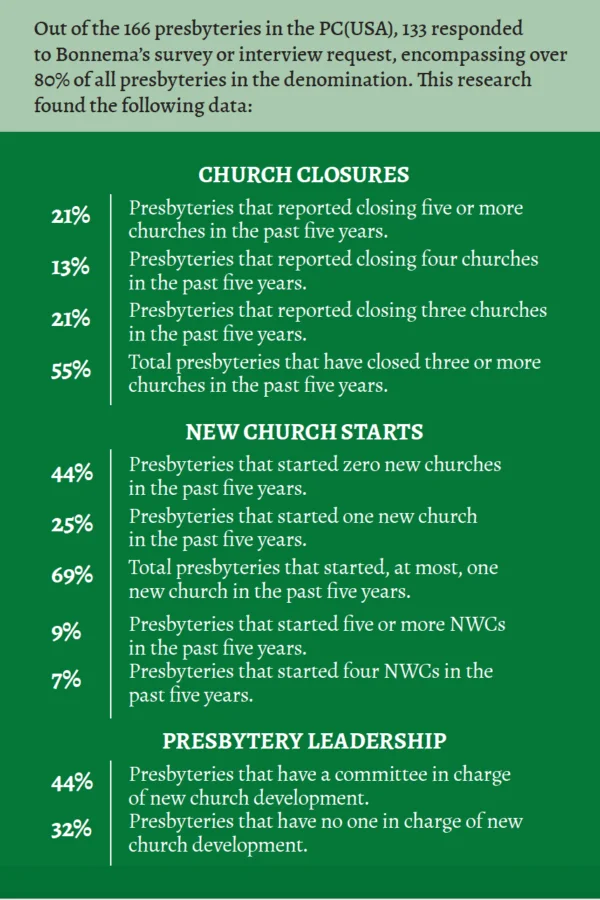
In 2024, I spent the year interviewing general presbyters from across the country to learn how their presbyteries supported the creation of New Worshiping Communities (NWC). Of the 166 presbyteries in the PC(USA), 133 (80%) responded to the survey.
The results paint a complex picture of new church development within the PC(USA). Among the 133 that responded, many of the presbyteries report a struggle to focus on anything except the rapid decline of churches. One general presbyter said, “We are in a season of hospice and death, not the new life of planting new churches.”
Other presbyteries, however, have created models that continually invest in innovative ministry.
Here is the state of NWCs within the PC(USA), according to my research.
A handful of innovators
A handful of presbyteries are rapidly starting and supporting NWCs. One out of 10 presbyteries started five or more churches or NWCs in the past five years. What can we learn from these presbyteries? Three themes emerged.
1. Think outside the box.
Presbyteries that successfully planted NWCs have embraced the freedom to look and function completely differently from traditional churches. Some NWCs meet in coffee shops, and others meet in trailer parks. One congregation meets exclusively on TikTok. NWCs do not have to fit the mold of how Presbyterian churches have looked for the past 50 years.
Consider House of Mercy, the Presbytery of Western North Carolina’s newest NWC. Located in Asheville, House of Mercy meets in a brewery and consists of people reentering society after incarceration, people who did not or still don’t identify as Christian and Christians who left evangelicalism. It was founded as a mission church in the Evangelical Presbyterian Church (EPC) in 2021, but by 2025, the community no longer fit within the EPC. Theologically, it aligned more closely with the PC(USA). Because House of Mercy was not a chartered congregation in the EPC, the presbytery decided it would fit best into the PC(USA) as a New Worshiping Community.
Presbyteries that successfully planted NWCs have embraced the freedom to look and function completely differently from traditional churches.
We joyfully welcomed House of Mercy during our April presbytery meeting in Montreat. The Presbytery of Western North Carolina now has two New Worshiping Communities within its bounds. Artisan Church in Lincolnton is located in a more rural area, and House of Mercy is in an urban space. Neither meets in a traditional church building. Both are incredibly different from one another and from traditional Presbyterian churches, but both have grown a community centered on following Jesus.
NWC leaders don’t focus on building a community that resembles a typical Presbyterian church from five decades ago. Instead, NWCs are about building up the kingdom of God, wherever God takes them. Practically, this work means engaging in the broader community rather than inviting people to a particular place of worship. It means intentionally seeking out those whose voices have historically been underrepresented. For many NWCs, this outreach means renting space or not having a building at all.
NWC leaders don’t focus on building a community that resembles a typical Presbyterian church from five decades ago.
Successful presbyteries choose to think outside the box.
2. Choose a specific funding model.
According to my research, more than half of presbyteries have closed three or more churches in the past five years. When churches close, those buildings are often sold. But what if all presbyteries used the proceeds from selling closed churches to invest in creating new ones?
One presbytery leader said, “The sale of property is one of the best ways to fund NWCs. We are in this moment where there is going to be so much property sold.”
“The sale of property is one of the best ways to fund NWCs. We are in this moment where there is going to be so much property sold.”
Unfortunately, 52% of presbyteries that responded to the survey do not use the sale of church property to create new worshiping communities.
However, funding new church development at a high level is one of the best practices of presbyteries that are consistently starting NWCs. The funds are available, and presbyteries across the PC(USA) are currently deciding how to allocate them. One presbytery that has successfully started numerous NWCs attributes its success to “creating a structure where 70% of the sale of property goes to new church development.”
Faithful stewardship of these funds presents an incredible opportunity for the development of new churches.
The same leader continued, “Look at your assets — your resources and your human assets. Who are the innovators in your community? Who are the entrepreneurs that are members of your congregations? What sort of financial resources do you have and what churches are willing to partner?”
Other successful funding methods emerged from the research:
- Apply for PC(USA) grants and supplement them with consistent funding from the presbytery.
- Set aside a percentage each year from an investment account.
- Conduct a capital campaign for new church development.
- Add NWCs to the annual operating budget of the presbytery.
- Ask churches to take up a special offering for new church development.
Regardless of the method chosen, a consistent funding model that the NWC and presbytery can rely upon each year is essential. Most NWCs are planned several years in advance, and teams must know that the funds can be counted on.
3. Have the courage to start … and fail.
In the past 10 years, almost every presbytery in the denomination attempted to start an NWC, according to Nikki Collins from 1001 New Worshiping Communities. The past five years, however, tell a different story: today, less than half of our presbyteries are engaged in this work. Why aren’t more presbyteries trying to start NWCs? Why did they stop?
Why aren’t more presbyteries trying to start NWCs? Why did they stop?
One general presbyter offered an answer: “Not enough energy, intelligence or imagination. Most of these resources are spent walking with churches as they conclude their ministries.” Another remarked, “Not enough interest. We are a small presbytery, and the focus is on keeping current churches going and pulpits filled.”
My research indicates that a third of our presbyteries have no one in charge of new church development. These presbyteries do not have a team, committee or even one staff member dedicated to creating a vision for new church development.
Does this describe your presbytery?
If so, it is time to ignite the imagination of your presbytery. It is time to create space to dream. Presbyteries of every size can engage in this work.
Some presbyteries that started an NWC, only to see it close later, have chosen not to try again. Not every presbytery has the risk capacity to try new things, knowing that some will fail.
One presbytery that has started many NWCs views this process as “research and development.” It understands that some NWCs thrive and others close. Instead of viewing the closures as a failure, the team seeks to harvest the lessons learned from each closing community. A closed NWC may be just as valuable as a thriving one, as it provides insight into the church’s direction. Every failure is an opportunity to learn, not an excuse to stop investing.
“I can’t imagine the last time this presbytery planted a church … decades,” said one general presbyter from a rural presbytery. That presbytery has focused on helping existing churches to survive or, when that’s not possible, to close gracefully. The ability to look to the future and create a vision for NWCs felt like a luxury the presbytery didn’t have time for.
“The biggest challenge,” said a different general presbyter, “has been the focus on propping up declining ministries as opposed to starting new ones. So few of our congregations are healthy that we don’t have a mindset of abundance.”
Can presbyteries without a growing population center still start an NWC? Yes! Doing so requires shifting the conversation within the presbytery. If your presbytery has focused exclusively on maintaining existing churches, then set aside time at an upcoming meeting to dream about future ministry opportunities. Presbyteries of every size can create space to dream and imagine what is possible in their context.
Presbyteries of every size can create space to dream and imagine what is possible in their context.
One presbytery leader from a self-described “shrinking presbytery” shared how it used church closures as a catalyst to start something new. Seeing churches close made the need for new churches glaringly obvious.
Speaking about the PC(USA)’s 1001 New Worshiping Communities initiative, that presbytery leader also said, “Some presbyteries have been completely transformed by this movement, and others have been completely left out” because they chose not to engage. This leader’s presbytery chose transformation. It partnered with the 1001 New Worshiping Communities movement, and to date, this tiny presbytery has created five NWCs.
Presbyteries can change the narrative from hospice to new life. Recapturing a theology of Christian hope is the necessary first step.
Recapturing a theology of Christian hope is the necessary first step.
The stories we weave
A lack of any hopeful vision plagues presbyteries across the PC(USA). Instead, one finds much resignation about the slow dying of the denomination. Rather than resigning to what is, Christian hope requires us to ask: What may be?
A thriving Presbyterian church is possible. Yet denominational leaders and pastors must create a hopeful vision accompanied by concrete steps to make it a reality.
A thriving Presbyterian church is possible.
Everyone lives inside a story. This story shapes our thinking, beliefs and attitudes and can become the guiding metaphor of our lives. For Christians, our story is inextricably linked to our theology. What we believe about God inevitably shapes how we understand our lives.
I believe in a God of hope.
In his letter to the Romans, the Apostle Paul highlights hope as an essential element of God’s character: “May the God of hope fill you with all joy and peace in believing, so that you overflow with hope by the power of the Holy Spirit” (15:13).
God’s character is rooted in hope. As God’s children, we are to be people of hope.
As God’s children, we are to be people of hope.
What is hope?
 Aristotle referred to hope as a “waking dream.”
John Calvin said hope was the difference between the pain of the present and God’s future promises.
Søren Kierkegaard understood hope as “a passion for what is possible.”
Or in the words of Emily Dickinson: “Hope is the thing with feathers/ That perches in the soul,/ And sings the tune without the words/ And never stops at all.”
Are Presbyterians filled with hope at what God may do through our denomination?
Are Presbyterians filled with hope at what God may do through our denomination? Based on my research, resignation currently appears much more common than hope.
In his book The Theology of Hope, theologian Jürgen Moltmann calls this thinking “the sin of despair”: “If faith thus depends on hope for its life, then the sin of unbelief is manifestly grounded in hopelessness. To be sure, it is usually said that sin in its original form is man’s wanting to be as God. But that is only the one side of sin. The other side of such pride is hopelessness, resignation, inertia and melancholy.”
Despair and resignation are akin to hopelessness. Neither has a place in the Christian faith.
Has the PC(USA) fallen into the trap of despair?
This question can only be answered by asking, What sort of story are we telling ourselves?
What sort of story are we telling ourselves?
Currently, as I mentioned, the dominant narrative I hear is one of resignation. But what if we told ourselves a story of hope? Hope for the denomination and hope for the church’s future? Not a naive hope. Not a resigned hope. A Christian hope.
God will use the church to transform and heal the world. God promises to build up Christ’s body because God wants the church to thrive. We can place our hope in these promises.
The story of our denomination must shift from one of resignation to one of expectant hope.
Each presbytery has an opportunity to ask itself:
- How do we ignite the imagination of our presbytery?
- How do we move from resignation to hope?
- How do we create space to dream?