Fifteen years ago, I wrote an editorial for the final print edition of the United Church News newspaper of the United Church of Christ in which I concluded, “The future of the church is small, focused on local mission, and less connected to or reliant upon a national denomination.” This summary was based on the work of scholars who contributed to the issue and rooted in trends and studies of the time.
Fast forward to 2025, look at any recent statistics about mainline Christianity, and you’ll continue to see a common theme – decline. A reduced and aging membership, fewer churches, less resources, higher costs of operation and maintenance, and a drop in baptisms.
PC(USA) statistics reveal membership losses, aging trends and rising generosity
PC(USA) membership decline shows 30 years of losses
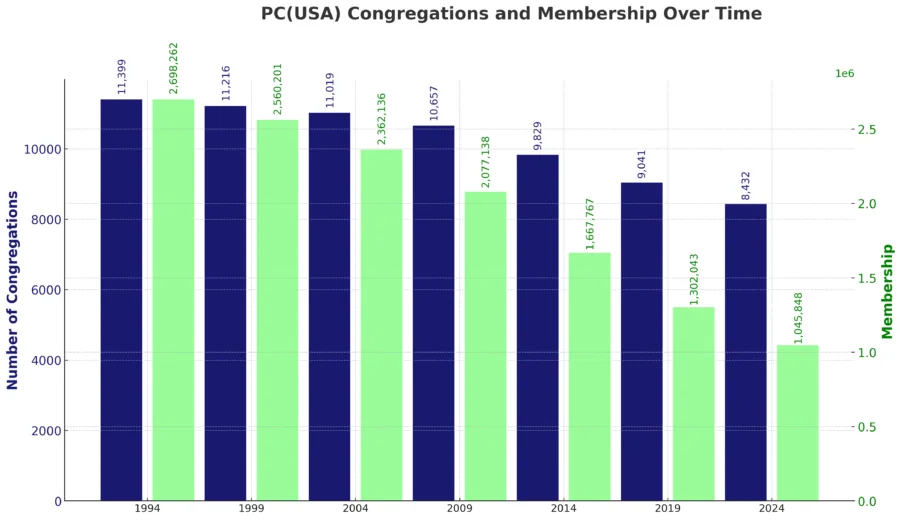
There’s really no sugarcoating the numerically bad news. A 30-year overview of key markers from data provided and verified by the Presbyterian Church (U.S.A.)’s research services tells a grim numerical story.
Each year since 1994, the denomination has lost nearly 1% of its churches, almost 99 numerically, for a total of 2,967.
Based on a 30-year longitudinal collection of data organized in 5-year increments, we see that each year since 1994, the denomination has lost nearly 1% of its churches, almost 99 numerically, for a total of 2,967. In that same period, membership declined by a total of 1.7 million people for an average of a loss of 55,080 members each year. There are 2,882 fewer ministers of Word and Sacrament than there were in 1994, with an average loss of .5% per year. In 1994, each ordained minister served an average of 131 members. By 2024, that number had dropped to 59 members served per ordained minister.
Aging congregations reshape PC(USA) demographics
Recent trends also show that the membership of the PC(USA) is aging. Since the membership age range collection has been conducted, there has been an increase in the percentage of members over the age of 55, from 56.3% in 2019 to 59.2% in 2024.
Other factors remain relatively unchanged. The percentage of women and men members in PC(USA) churches has held steady at roughly 59% and 41% respectively, over the period 1994-2024. While prior surveys only included female/male statistics, the denomination’s research services group began collecting data on non-binary and queer members in 2024, showing 0.2% of members identifying as such in its most recent report.
Racial and ethnic diversity slowly increases in PC(USA)
The denomination’s racial and ethnic composition has shown minor shifts in the past 20 years during which this data has been collected. While White membership decreased 4.5% in this period, from 92.1% to 87.6%, other racial ethnic groups have shown slight increases in total membership. Black and African members have increased by 1.5% to 4.6%; Asian and Pacific Islander membership is up 1% to 3.9%. Hispanic membership has increased by 0.5% to 1.8%. Native American membership is unchanged over the reporting period, holding steady at 0.3%. The relatively recent tracking of Middle Eastern and North African members has increased to 0.4% since it began being reported. Those identifying as multi-racial or “other” make up 1.5% of the PC(USA)’s membership, an increase of 1.2% since 2004.
According to a recent report by the Pew Research Center that notes the decline of Christianity may have slowed in the U.S., the share of the U.S. population identifying as Mainline Protestants has declined from 18% to 11% since 2007. Applying PC(USA)’s average rate of annual decline, the denomination has lost 14.8% of its members in that same 17-year period, in contrast to the national average of 9%. The data does not show why PC(USA) members are outpacing national mainline losses by 5.8%. Perhaps these people have joined the “nones” who claim no religious affiliation. They may have also migrated into other groups that have seen slower rates of decline, including evangelical Protestants at 3%, Catholics at 5%, and historically Black Protestants at 2%.
Giving trends: Why Presbyterians are donating more even as membership shrinks
When you look at the big picture in this longitudinal data, a surprising information outlier contrasts with these depressed numbers – average member giving. Giving isn’t the only, nor is it the best, indicator of member involvement, but it does reflect a willingness to support the mission of the church at greater levels over time.
The average PC(USA) member giving in 1994 was $553, or an inflation-adjusted $1,163. In 2024, PC(USA) members contributed an average of $2,161 – a 47% increase in giving per member.
In 2024, PC(USA) members contributed an average of $2,161 – a 47% increase in giving per member.
Eileen Lindner, a retired PC(USA) pastor and a sociologist of religion who formerly served on the Way Forward Commission, believes older members, who are now nearly 60% of the denomination, are responsible for this influx of giving.
“What you’re talking about is a group of people who have now aged to the point that their money [and] investments have now matured,” she said. “Their kids are grown, their kids are fine and making a living for themselves. And the church has been an institution in their lives, and now they are contributing to it in greater proportion.”
Generational shifts raise questions for the future of Presbyterian membership
The question remains: what happens when this older generation is no longer around? Will their membership, attendance, and giving be replaced by younger worshipers?
Ryan Burge, a sociologist who publishes the popular “Graphs About Religion” Substack, posits that there are “10,000 coming into adulthood, 25,000 dying in the PC(USA) in an average year. Of course, there are other ways to join or leave a denomination, but these two figures are pointing toward a future where the denomination has to ‘find’ an additional 15,000 members a year just to offset the losses from death.”
In another post, Burge examined statistics surrounding young mainline members, showing their shrinking numbers and a trend toward political conservatism.
These findings were brought to light in a New York Times article last fall, highlighting research from the conservative-leaning American Enterprise Institute and conclusions based on the Barna Group “State of the Church 2025” study, which cites a 12% increase, from 54 to 66 %, in Americans saying they’ve made a personal commitment to follow Jesus since 2021.
But what if the PC(USA) doesn’t find these new members or see growth in a similar way? Lindner believes there is a bottom threshold to the overall membership in which a “core faithful remnant” will remain, allowing the church to still function. She likens this decline to a melting snowman.
“A snowman doesn’t start to melt and look like a lump, like a basketball, immediately,” she said. “It looks like a smaller and smaller snowman unless something exceptional happens, like it’s built under an eave of a roof that’s dripping on it. That’s what happened when we dismissed congregations to other denominations (over issues of LGBTQ equality, marriage and ordination) – the form changed rapidly.”
Potential signs of hope for the declining Presbyterian Church (U.S.A.)
Gen Z and young adults: Signs of Presbyterian renewal?
In a recent article, I interviewed several Gen Z young adults who are involved in and committed to their local congregations. Some were returning lifelong PC(USA) members, and some were new to the denomination. While fellowship and belonging to a group with like-minded people were part of the reason for each person returning to church, the strongest response they gave was a little more existential: church allowed them to be part of a group that was focused on something bigger than themselves.
In part, some of the factors that brought these young people into PC(USA) congregations were:
- An invitation from a clergy member or friend.
- A social network of care that shows connection and compassion, faith in action.
- A mix of learning, spiritual activities and recreation.
- Service work as a component, not the entire focus.
- The ability for other group members to relate to and relay the mission of the ministry.
New worshiping communities bring fresh energy and new members
Another hopeful sign is in the growth of new worshiping communities (NWC). From the first report of 94 NWCs in 2015, that number has grown to 327 fellowships registered as new worshiping communities in presbyteries in 2024.
Nikki Collins, national coordinator for 1001 New Worshiping Communities at the PC(USA), says the actual number of new worship communities is more than 800. The discrepancy is likely due to reporting variances by presbytery, the fact that 100 NWCs have chartered as congregations, and other variations in classifications, such as how to classify the 50 campus ministries that are receiving NWC funds.
“New worshiping communities are the place where new disciples are coming into the church — and they are coming.” — Nikki Collins
The program has invested over $15 million since its inception and provides leadership training, mentoring, funding and other resources for new worshiping communities. Collins estimates 35% to 55% of the people who are participating in NWCs were either previously unchurched, de-churched or not a Christian at all.
“New worshiping communities are the place where new disciples are coming into the church — and they are coming,” she said.
Immigrant congregations strengthen Presbyterian vitality
Her office has been closely tracking demographics in NWCs as well. Over 70% of communities supported by the 1001 New Worshiping Communities throughout the life of the program are still active. Among immigrant and refugee NWC communities, that number is closer to 80%.
Nearly 50% of NWCs have been started among immigrant populations.
Nearly 50% of NWCs have been started among immigrant populations. These groups, Collins said, are more connected to the PC(USA) as a denomination than their Anglo counterparts because they came from places that were affected by PC(USA) and its world mission. It is, she said, the fulfillment of a phrase used by the PC(USA)’s former Stated Clerk, J. Herbert Nelson, II, “the mission field come home.”
“[Immigrant NWCs] just don’t quit when the grant runs out,” she said. “Among our immigrant new worshiping communities and those that are primarily people of color, there are 14 different languages spoken. I think those are beautiful signs of hope and call for us to think about how we really welcome people who have chosen to make the USA their home and the PC(USA) their spiritual home, because there’s a lot of vibrancy there.”
New worshiping communities thrive on Presbyterian hospitality
Another factor in the growth of new worshiping communities, and an explanation for the high rate of those joining the PC(USA) and/or being baptized in these fellowships, is the broad range of acceptance offered by the denomination that is lived out by those forming NWCs.
The growth of new worshiping communities and other expressions of church continue to provide hope — even if the church is smaller, more focused on local mission, and not as connected to the national denomination.
“Many of our new worship communities are focusing on and led by people who have left denominations where they were not accepted or welcomed, and they have come to the PC(USA) because we are,” said Collins.
“While they might not really want to talk about themselves as Presbyterian, there’s also at the same time a lot of gratitude for what it means to be PC(USA), and they really recognize and appreciate the difference in who we are and from where they have come and were raised and had to leave.”
Local PC(USA) ministries offer hope amid membership decline
While reversing numeric declines in membership, number of churches, active clergy and baptisms in the PC(USA) may not be realistic options in the near future, there are signs of new life and vitality in some corners of the church. The growth of new worshiping communities and other expressions of church continue to provide hope — even if the church is smaller, more focused on local mission, and not as connected to the national denomination.
There are thousands of congregations in the PC(USA) doing significant and faithful work.
It’s also important to note that there are thousands of congregations in the PC(USA) doing significant and faithful work. Many of these congregations are growing, have robust discipleship programs, and are sprouting new ministries to serve the needs of their members and the surrounding community. The long-term numerical decline across the whole of the denomination does not diminish the importance of these vital ministries.
Is right-sizing the future of the Presbyterian Church (U.S.A.)?
For her part, Lindner thinks a sort of right-sizing “could be good news” for the denomination.
“If the issue is fidelity, and meaningful presence in people’s lives, we’re not measuring any of that with these numbers we’re talking about,” she said of the statistical reporting provided by the denomination.
I just can’t conclude that we have good news or bad news on the basis of the data. — Eileen Lindner
“And I happen to think that’s where the pay dirt is. So I just can’t conclude that we have good news or bad news on the basis of the data. We would need to look back, and maybe plan on looking forward, to ask more meta questions to see what difference participation in the PC(USA) made in your life or in society.”
Thanks to Sean Payne of PC(USA) Research Services for his assistance in providing additional details for and validating the data in the linked spreadsheet.